Echoes of 1873: Why History Warns Us That Today’s Greatest Economic Threat Isn’t the Bubble—It’s the Policy Mistake
September 20, 2026
By Ben Carlson (Adapted and Expanded for Financial Journal)
Main Facts: The Parallels Between the 19th Century and Modern Markets
Financial history rarely repeats itself in exact terms, but it frequently rhymes with an eerie, poetic precision. When examining modern economic data, it is easy to become desensitized to today’s cycles of inflation, technological disruption, and monetary interventions. However, stepping back to look at the broader sweep of financial history reveals staggering anomalies.
In modern economic times, sustained inflation feels like a permanent fixture of daily life. Yet, for a vast stretch of the 19th and early 20th centuries, this was not the case. Between 1800 and 1940, the average inflation rate sat at a meager 0.2% per year. The cost of living in 1940 was a mere 28% higher than it was at the dawn of the 19th century. During this era, deflation—periods where prices fell—was a regular occurrence, happening across nearly 70 separate stretches.
The most catastrophic of these deflationary periods followed the Panic of 1873, triggering what economists historically dubbed the Long Depression. Over the course of more than two decades, prices plummeted by roughly 40%.
Drawing on research from financial historian Liaquat Ahamed’s acclaimed book 1873, modern analysts are beginning to see striking parallels between the Gilded Age and the present day. Today, we witness a familiar cocktail of ingredients: a massive technological innovation boom, a real estate bubble, aggressive bond market speculation, lax credit standards, and an abundance of speculative capital chasing the next big thing.
Yet, the primary takeaway from the crisis of the 19th century—and a sobering warning for modern central bankers and policymakers—is that the initial crash is rarely what destroys an economy. Instead, it is the catastrophic policy blunders that happen after the bubble bursts.
Chronology: From the Gilded Age Panic to Modern Over-Intervention
The 1870s: The Infrastructure Mania and the Panic
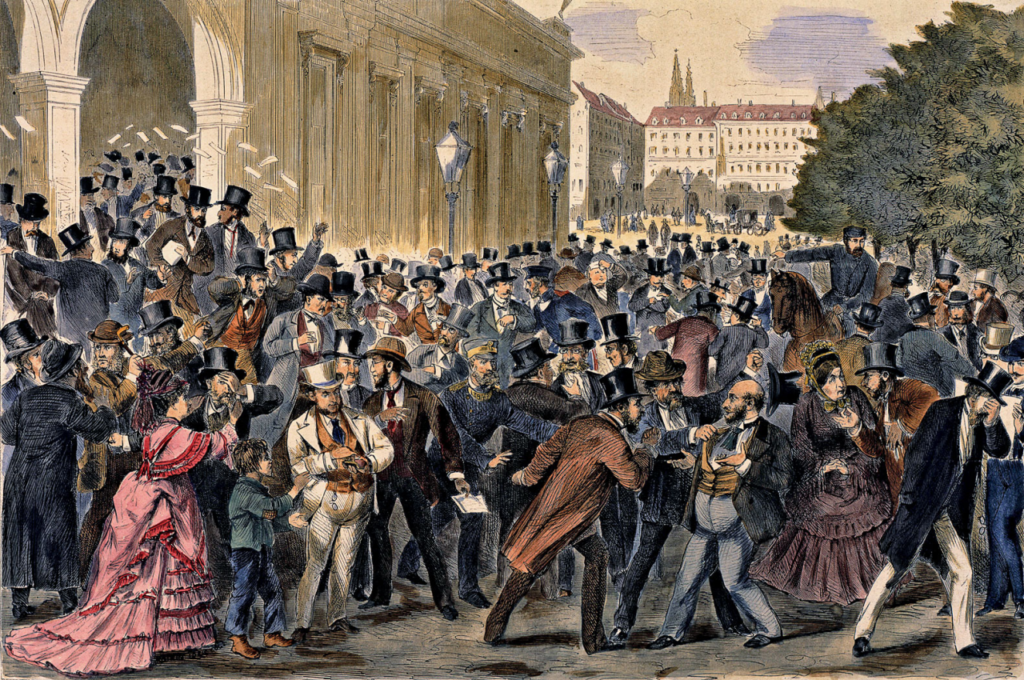
The roots of the Crisis of 1873 lay in an unprecedented era of global progress. Driven by the rapid expansion of railroads, telegraph lines, and heavy industry, economies across the West experienced a massive speculative boom. Investors poured capital into railway bonds with little regard for underlying fundamentals, relying on loose credit and the assumption that growth would continue indefinitely.
When the bubble inevitably burst in September 1873, triggered by the collapse of the prominent banking firm Jay Cooke & Company, it sparked a liquidity freeze and a stock market panic. However, its initial economic impact was surprisingly modest. Outside of the United States—which suffered a peak-to-trough decline of barely 6% in industrial production—major global powers like Britain, France, and Germany experienced little more than standard economic stagnation. By all accounts, 1873 had the makings of a run-of-the-mill cyclical correction.
The Self-Inflicted Wound of Global Policy
What transformed a manageable downturn into a multi-decade economic scar was not market forces, but human error. Simultaneously, major economic powers blundered into a radical and unnecessary restructuring of the global currency system.
By shifting monetary baselines and constricting the volume of global liquidity, governments engineered a massive, self-inflicted deflationary squeeze. Over the next six years, global prices dropped by 20% to 25%. In the United States, wholesale goods plummeted by 35%. This downward spiral resumed in the 1880s and persisted until the mid-1890s, culminating in the longest recorded bear market in financial history.
The Modern Echo: From Dot-Com to the Great Financial Crisis
Fast-forwarding to the 21st century, the pattern of over-intervention repeats itself. When the dot-com bubble burst in 2000, the resulting recession was remarkably mild. GDP fell by less than 1%, and the downturn lasted a mere eight months. It was a textbook unwinding of excessive late-1990s speculation.
However, panicked by the speed of the contraction, the Federal Reserve slashed interest rates to historic lows and kept monetary policy loose for too long. Combined with relaxed lending standards, this policy response birthed one of the largest housing bubbles in modern history—setting the absolute stage for the catastrophic Great Financial Crisis of 2007–2008. The cure proved far more dangerous than the disease.
Supporting Data: The Anatomy of Deflation and Speculation
To understand the mechanics of these historical events, one must examine the divergent impacts of economic regimes on different segments of society.
- The 1873–1896 Deflationary Spiral: Over this multi-decade period, overall price levels fell by one-third, while wholesale prices were cut in half.
- Creditors vs. Debtors: Deflation is historically celebrated by creditors and lenders, as the money they are paid back has higher purchasing power. Conversely, it is lethal to debtors. In the late 19th century, this meant devastating hardship for farmers and small business owners who had locked in high-interest debt during the boom years, only to watch crop prices and business revenues collapse.
- The Modern AI vs. Railway Analogy: Financial historians frequently draw a direct line between the 19th-century railway boom and today’s artificial intelligence (AI) infrastructure buildout. Both eras feature massive capital expenditures on foundational technologies, hyper-optimistic corporate forecasts, and a rush of retail and institutional capital.
- The 2001 Contrast: During the dot-com fallout, unemployment rose modestly from roughly 4% to 6%, proving that technology-driven equity busts do not inherently require aggressive, systemic monetary bailouts to survive.
Official Responses: The Danger of Central Bank Overreach
As financial markets become increasingly intertwined with government policy, the stakes of regulatory intervention have never been higher. Historically, official responses to market corrections follow a predictable trajectory of panic, intervention, and unintended consequence.
During the late 19th century, political leaders failed to recognize that tampering with global currency standards during a credit contraction would choke off the lifeblood of commerce. They prioritized structural monetary rigidity over human economic stability, driving millions of workers and farmers into destitution.
In the modern era, central banks and fiscal authorities face a different temptation: the constant urge to rescue markets from every minor hiccup. Every time equities correct or a sector experiences a cyclical slowdown, the political and monetary pressure to intervene—through rate cuts, liquidity injections, or federal backstops—grows stronger.
As experts discuss in financial commentary and market retrospectives, the greatest risk facing the global economy today is not necessarily the popping of an AI-driven equity bubble or a standard economic slowdown. The true danger lies in a modern policy error. Whether that error manifests in monetary tightening, fiscal overspending, poorly conceived AI regulation, or abrupt trade policy shifts, the capacity for governments to turn a minor economic adjustment into a systemic crisis remains alarmingly high.
Implications: What Lies Ahead for Investors
As we navigate an era defined by speculative tech booms, expansive fiscal policies, and shifting global trade dynamics, the lessons of 1873 and the post-dot-com era offer vital takeaways for investors and policymakers alike.
- Expect Cycles, But Fear the Remedy: Market corrections, bubbles, and recessions are natural parts of a dynamic capitalist economy. Trying to engineer a completely risk-free financial system frequently lays the groundwork for larger, more violent shocks down the line.
- The Threat of Policy Blind Spots: Investors must monitor not just corporate earnings and technological adoption rates, but the legislative and monetary environment. When governments overreact to normal market volatility, the resulting liquidity shocks or regulatory shifts can upend even the most fundamentally sound portfolios.
- The Longevity of Bear Markets: As the 1880–1896 period proved, structural deflation and prolonged stagnation can grind investor sentiment down far longer than a sharp, sudden crash. Preserving capital requires an awareness that economic recoveries can be suffocated by rigid administrative blunders.
Ultimately, history teaches us that markets can weather bad loans, speculative manias, and technological overbuilding. What they struggle to survive is the well-intentioned but catastrophic intervention of policymakers trying to prevent the unpreventable.