The 2026 Economic Paradox: Surging Inflation, Spiking Yields, and a Defiant Stock Market
September 15, 2026
By Financial Markets Desk
Main Facts
Financial markets and macroeconomic indicators are currently presenting a deeply counterintuitive puzzle. By all traditional economic metrics, the macroeconomic landscape of 2026 should be signaling distress.
Consider the stark movement of foundational economic pillars over the course of the year:
- Mortgage Rates: Surged from 6% to 7%, squeezing prospective homebuyers and freezing significant segments of the real estate market.
- Treasury Yields: The benchmark 10-year Treasury yield climbed from 4% to 5%, raising the cost of capital across the board.
- Inflation: After cooling to 2.4% earlier in the year, the inflation rate has rebounded to 3.4%, reigniting concerns over price stability.
- Energy Markets: Crude oil prices have nearly doubled, shooting up from less than $60 a barrel in January to more than $100 a barrel.
- Consumer Impact: At the pump, average nationwide gasoline prices have escalated in tandem, rising sharply from $2.90 to well over $4.00 per gallon.
Examined in a vacuum, these numbers would traditionally form the basis of a textbook economic downturn. Higher borrowing costs, persistent inflation, and expensive energy usually spell trouble for both corporate bottom lines and consumer discretionary spending.
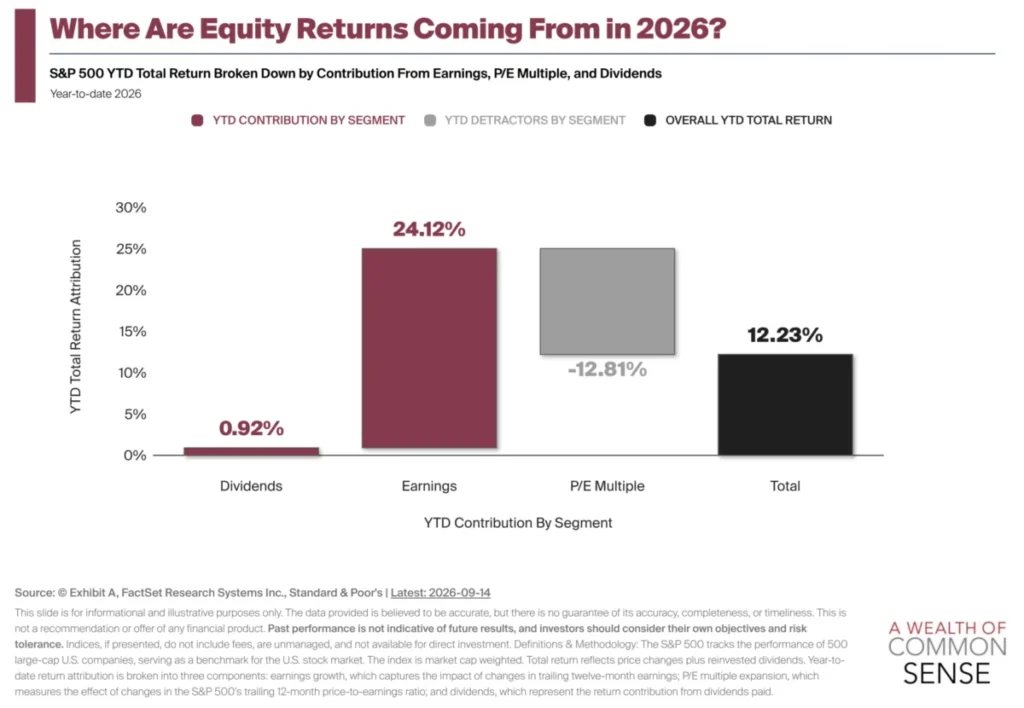
Yet, the broader economic reality refuses to cooperate with conventional theory. The wider U.S. economy continues to chug along at a resilient pace, while the stock market has delivered double-digit gains yet again this year. Even more striking is the engine driving these equity returns: corporate earnings are expanding at a clip even faster than stock prices, causing market valuations to actually compress rather than inflate.
Chronology of the 2026 Macro Shift
To understand how the financial markets reached this paradoxical juncture, it is necessary to retrace the timeline of economic developments that have shaped 2026 thus far.
Q1 2026: The Baseline and Early Optimism
As the year opened in January, the macroeconomic outlook was viewed with cautious optimism. Crude oil prices languished comfortably below $60 per barrel, keeping transportation and production costs restrained. Inflation prints hovered near 2.4%—strikingly close to the Federal Reserve’s coveted 2% target. Mortgage rates sat at 6%, and the 10-year Treasury yield rested at 4%. Equity markets entered the year riding the momentum of late 2025, with artificial intelligence-related infrastructure spending serving as a primary catalyst for corporate capital expenditures.
Q2 2026: The Accretion of Pressures
By the midpoint of the second quarter, cracks began to form in the disinflationary narrative. Supply chain adjustments, resilient global demand, and geopolitical friction combined to push crude oil past the $80 mark, quickly dragging national average gas prices north of $3.50 a gallon. Concurrently, sticky labor markets and robust consumer spending forced inflation metrics upward, ticking past 3%. Bond vigilantes reacted swiftly, driving the 10-year Treasury yield toward 4.5% as fixed-income investors demanded higher risk premiums. Despite these headwinds, mega-cap technology firms reported blowout earnings seasons, driven almost entirely by enterprise adoption of AI infrastructure.
Q3 2026: The Full-Blown Divergence
Entering the late summer and early fall, the divergence between macroeconomic headwinds and market performance widened into a chasm. Oil breached $100 a barrel, pushing retail gasoline averages well above $4.00. Mortgage rates touched 7%, and the 10-year Treasury yield officially consolidated at 5%. Yet, rather than pulling back, the S&P 500 pushed further into double-digit year-to-date gains. Earnings reports revealed that corporate profitability was not just surviving the higher-rate environment—it was thriving, fueled by unmatched productivity gains and massive hyperscaler investments in digital infrastructure.
Supporting Data and Market Attribution
The most fascinating attribute of the 2026 bull market is its foundation. Unlike speculative bubbles driven purely by multiple expansion (where investors pay increasingly higher prices for the same dollar of earnings), this year’s rally is fundamentally driven by actual profit growth.
Market attribution data for the S&P 500 reveals that corporate earnings are expanding at a rate that outpaces stock price appreciation. When earnings grow faster than share prices, the price-to-earnings (P/E) multiple actually contracts. This indicates that equities are arguably more grounded today than they were during periods of lower interest rates where valuations stretched to historical extremes.
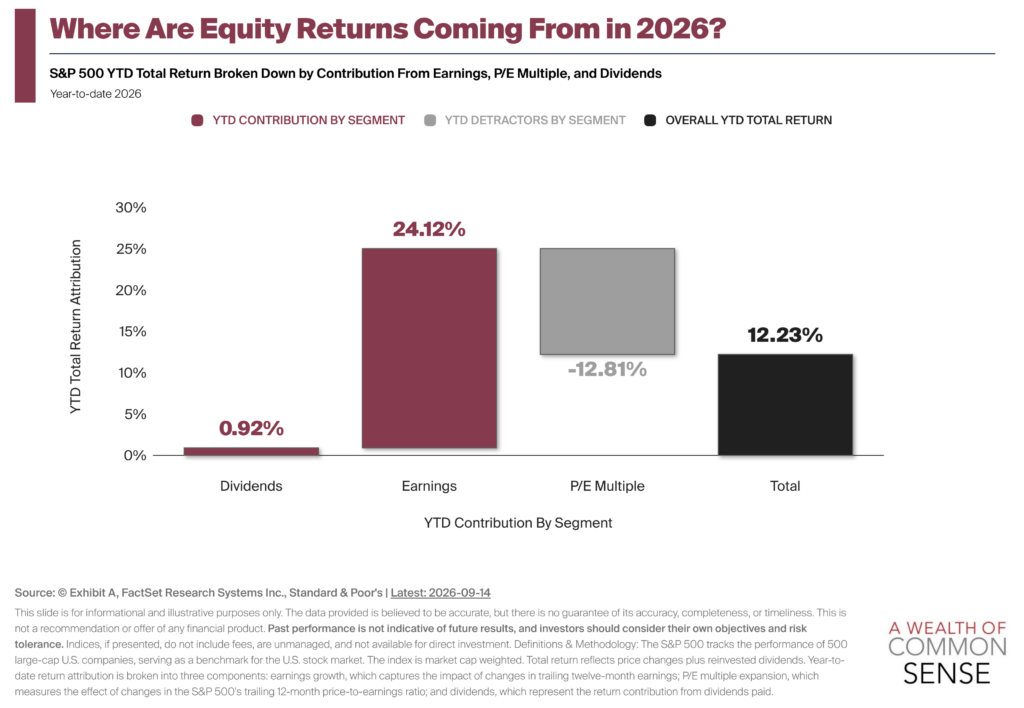
However, this data exists in stark contrast to the bond market and consumer price indices:
- The Cost of Debt: A 7% mortgage rate has locked many homeowners into existing properties, subduing housing turnover.
- Corporate Borrowing: A 5% 10-year Treasury yield sets a high hurdle rate for corporate debt issuance and refinancing.
- Energy Drag: Surging fuel costs act as a regressive tax on everyday consumers, siphoning capital away from discretionary retail sectors.
Despite these heavy anchors, the market’s leadership—heavily concentrated in technology, semiconductors, and cloud infrastructure—has absorbed these costs and maintained operating margins that defy historical norms.
Official Responses and Perspectives
Market analysts, economists, and portfolio managers are grappling with how to interpret this disconnect. Financial commentators, such as market strategist Ben Carlson, have highlighted the central questions dominating Wall Street boardrooms:
- The Sustainability of AI Spending: Do investors view this year’s extraordinary earnings growth as a transient phenomenon? Much of the current profitability is being driven by heavy capital expenditures from "hyperscalers"—massive cloud computing and tech conglomerates building out the physical infrastructure for artificial intelligence. Skeptics question whether end-users will generate sufficient return on investment to justify these multi-billion-dollar outlays over the long term.
- The Inflation Threat: Are equity investors underestimating the danger of a re-accelerating inflation rate (now at 3.4%)? Persistent inflation typically forces central banks to keep monetary policy restrictive, which eventually filters down to corporate balance sheets.
- The Yield Compression Effect: Is the reluctance of stock prices to explode upward entirely a byproduct of soaring bond yields? With risk-free Treasuries paying 5%, investors can capture attractive yields without stepping out on the risk curve, naturally keeping a lid on equity valuation multiples.
Most institutional consensus points to a combination of all three factors. The market is pricing in a complex tug-of-war between stellar fundamental earnings growth on one side, and restrictive monetary policy, high energy costs, and valuation competition from bonds on the other.
Macroeconomic Implications
The ongoing divergence between the real economy and the financial markets carries profound implications for investors, policymakers, and everyday citizens.
For the Consumer
While Wall Street celebrates double-digit portfolio gains, Main Street is feeling the pinch. The combination of 7% mortgages, 5% yields, $4-plus gas, and 3.4% inflation creates a palpable squeeze for households not directly exposed to equity markets or the tech sector. This K-shaped dynamic means that asset owners are thriving while wage-earning consumers face escalating living costs.
For Corporate Strategy
Businesses are being forced to adapt to a "higher-for-longer" interest rate paradigm. Companies lacking the pricing power or structural efficiencies of the mega-cap tech cohort are finding debt refinancing painfully expensive. This environment favors cash-rich giants capable of funding their own research and development without tapping traditional credit markets.
For the Broader Financial System
For the time being, artificial intelligence acts as the ultimate market insulator. It is the gravitational center around which equity returns revolve. As long as AI-driven productivity and capital expenditures continue to fuel earnings growth, the stock market appears willing to look past 5% yields and $100 oil.
Yet, market dynamics dictate that this regime will persist only until it doesn’t. When the AI-driven earnings wave eventually moderates—whether through market saturation, regulatory intervention, or shifting enterprise priorities—the broader macroeconomic reality of high interest rates and elevated energy costs will reassert its influence.
Until that inflection point arrives, 2026 remains a testament to the supremacy of corporate earnings over macro headwinds—a high-stakes balancing act where technology rules the day, and traditional economic rules are rewritten in real-time.