The Invisible Gym: Why Physical Activity Belongs in Your Retirement Plan
When Diane retired at 65 after a 32-year career as a hospital administrator, she felt ready for her next chapter. She was in good health, high spirits, and possessed a secure nest egg. For over three decades, Diane had walked miles of corridors every day, climbed endless flights of stairs between hospital wings, and navigated a sprawling, fast-paced campus that never truly slowed down.
Yet, she had never belonged to a gym. She never followed a structured fitness regimen, and she certainly never considered herself an athlete or someone who "worked out." Her movement was simply a byproduct of making a living.
Within 18 months of stepping away from her career, however, the picture changed drastically. Diane had gained weight, felt consistently fatigued, and noticed a subtle, frustrating slip in the sharp mental acuity she had always taken for granted. Baffled by these sudden physical and cognitive shifts, she sat across from her primary care physician and declared, "I don’t understand. I’ve always been active."
Her doctor paused and asked a deceptively simple question: What do you mean by "active?"
For the first time in her life, Diane had no ready answer. The realization hit her hard: The workplace had served as her de facto gym, but because she hadn’t built that environment intentionally, its disappearance left a massive void. Once the structural architecture of her job was removed, her default lifestyle became entirely sedentary.
Diane’s story is far from unique. It highlights a critical blind spot in modern retirement planning: We meticulously calculate our financial assets while completely ignoring our physical architecture.
Main Facts: The Hidden Architecture of Workplace Movement
The core issue illuminated by Diane’s experience is known in behavioral research as an environmental design problem. Too often, people attribute their daily activity levels to personal discipline and character when, in reality, movement is almost always a function of environment.
Consider the lifestyle of the average office or healthcare worker. Without ever setting foot in a fitness center, an employee easily logs two to four miles of walking every day. Add the morning and evening commute, walking to conference rooms across different floors, stepping out for lunch, and navigating the physical demands of a bustling workplace, and the structure of employment quietly delivers a massive share of the daily movement the human body requires.
When retirement arrives, that structural scaffolding vanishes overnight. Without deliberate architectural redesign, the natural human inclination—and the modern suburban environment—defaults to a sedentary routine.
This decline is rarely driven by laziness. Rather, it is the predictable outcome of overhauling a life’s structure while completely overlooking its physical dimensions. Diane was not inactive during her working career; she was merely passive about her activity. In retirement, failing to be intentional about movement carries heavy consequences.
Chronology: The 18-Month Post-Retirement Decline
To understand how rapidly physical and cognitive regression can set in without a deliberate activity plan, health researchers often look at the trajectory of newly retired professionals:
- Months 0 to 3 (The Honeymoon Phase): The retiree enjoys newfound freedom, traveling, catching up on reading, and relaxing. Daily step counts drop drastically from corporate averages (often plummeting from 7,000–10,000 steps to under 2,500), but the immediate drop is masked by psychological relief and excitement.
- Months 3 to 6 (The Metabolic Shift): Basal metabolic rates adjust downward to match the sudden decrease in daily energy expenditure. Without workplace pacing, minor joint stiffness begins to manifest, and sleep quality often deteriorates due to a lack of physical fatigue.
- Months 6 to 12 (The Cognitive Creep): Subtle changes in memory, focus, and processing speed appear. Retirees often mistake this for normal aging, failing to connect it to the reduction in cerebral blood flow and neurotrophic factors that come with a sedentary lifestyle.
- Months 12 to 18 (The Visible Toll): Weight gain crystallizes, fatigue becomes a chronic background hum, and the loss of baseline muscular strength makes everyday tasks (like carrying groceries or gardening) noticeably more difficult. This is the exact window when Diane confronted her doctor, realizing her "active" past had dissolved.
Supporting Data: Exercise as an Essential Retirement Asset Class
Most financial planners and retirement workshops treat exercise as a minor lifestyle preference or, at best, a way to lower future healthcare premiums. Public health and longevity research, however, reframes physical fitness as an actual asset class with measurable financial and biological returns.
The Neurological Dividends
A landmark 2020 Lancet Commission report identified 12 modifiable risk factors that account for roughly 40% of all dementia cases worldwide. Remarkably, physical exercise directly targets six of those factors: physical inactivity, hypertension, diabetes, obesity, depression, and social isolation. Few, if any, pharmaceutical interventions available to older adults can match that breadth of impact.
Furthermore, a comprehensive 2025 meta-analysis confirmed that regular aerobic exercise significantly reduces the risk of depression and cognitive decline in adults over 65, boasting an effect size comparable to pharmacological interventions for mild-to-moderate cases.
The underlying biology is direct and powerful: movement increases Brain-Derived Neurotrophic Factor (BDNF), a crucial protein that supports the growth, survival, and plasticity of neurons. Simply put, a body that moves continuously builds a brain that continues to adapt.
The Financial Calculation of Long-Term Care
To truly understand the value of exercise in retirement, one must look at the balance sheet of aging. According to data from Morningstar, the average cost of long-term care in the United States reached $242,373, with approximately 70% of adults turning 65 requiring some form of extended care in their lifetimes.
Physical fitness is the single most effective intervention identified by medical research capable of deferring, reducing, or entirely eliminating the conditions that drive individuals into long-term care facilities:
- Catastrophic falls resulting from muscle atrophy and poor balance.
- Cardiovascular events.
- Metabolic syndromes like Type 2 diabetes.
- Cognitive impairment and dementia.
An investment in physical fitness that successfully defers the need for long-term care by even two years yields a financial return that traditional portfolio rebalancing strategies struggle to match. Yet, this vital metric appears on no conventional financial statement. Financial advisors routinely calculate the rates of return for equities, bonds, and real estate, but exercise remains one of the highest-yield assets available to a retiree—paying out in a currency that money can never buy back once it is lost: independent mobility.
Official Responses and Expert Perspectives
Gerontologists, behavioral economists, and financial planners are increasingly calling for an integration of health and wealth strategies.
"We have spent decades treating retirement planning as purely an exercise in asset accumulation," notes Dr. Elena Vance, a specialist in the psychology of aging. "We run Monte Carlo simulations for market downturns, but we run zero simulations for physical decline. If your body fails you at age 70, a well-funded portfolio loses its utility. You cannot outsource the physical experience of living."
Financial institutions are also beginning to shift their advisory frameworks. Forward-thinking wealth managers now emphasize that comprehensive retirement readiness requires evaluating three distinct forms of capital:
- Financial Capital: The money required to sustain your lifestyle.
- Social Capital: The network of relationships that provides emotional and mental resilience.
- Physical Capital: The functional health and bodily capacity required to enjoy the other two.
Advisors stress that these three forms of capital do not operate in silos; they compound one another. When physical health collapses, social isolation often follows, which in turn accelerates cognitive decline and poor financial decision-making.
Implications: Designing Your Post-Career Ecosystem
Recognizing exercise as an essential asset class changes how retirees must approach their daily lives. The research points toward three core design principles for maintaining physical vitality without relying on sheer willpower:
1. Environmental Design
Make the correct choice the effortless choice. Just as automating your 401(k) contributions removes the friction of saving, designing your physical environment removes the friction of moving. Keep walking shoes visible by the bed rather than hidden in a closet. Choose a home or neighborhood that encourages walking to local amenities.
2. The Social Multiplier
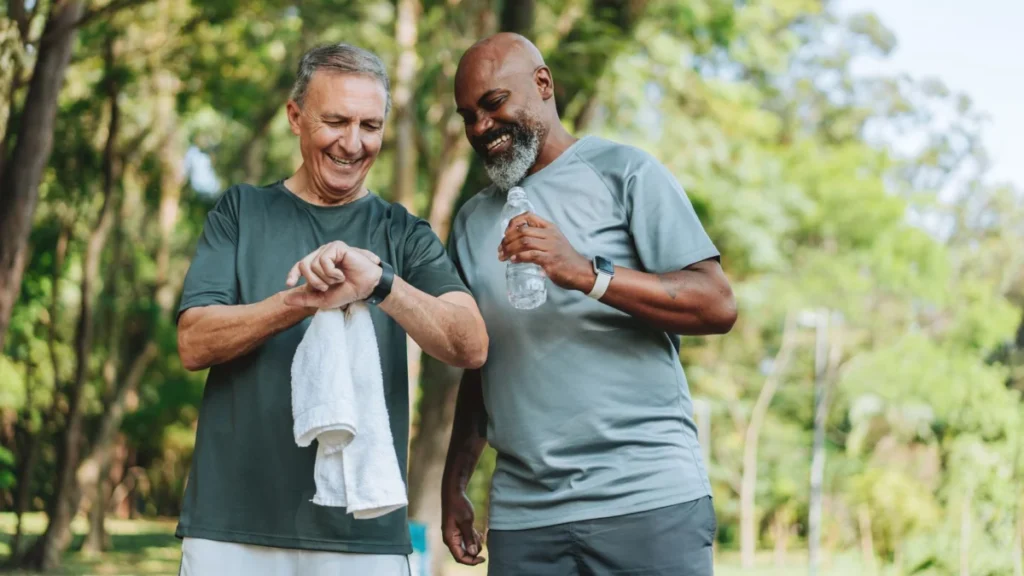
Solitary exercise is certainly better than no exercise at all, but social exercise acts as a powerful return multiplier. Activities such as group fitness classes, walking clubs, or recreational sports simultaneously address physical fitness, emotional well-being, and cognitive engagement. Research consistently shows that social engagement is one of the most powerful protective factors against cognitive decline in later life, often outperforming cognitive training games and nutritional supplements.
A standing date to walk with a friend three mornings a week is not merely a social outing; it is an integrated retirement health strategy.
3. Incremental Progression
Avoid the trap of aggressive, all-or-nothing fitness transformations that often lead to burnout or injury within weeks. Sustainable behavior change in older adults relies on gradual accumulation. Adding just 10 minutes to a weekly walking routine may yield imperceptible results in week two, but by month six, the compounding biological benefits become profound.
Re-evaluating Diane’s Routine
Today, Diane’s life looks entirely different than it did during her rocky first 18 months of retirement. She walks every morning with two neighborhood friends, plays nine holes of golf twice a week, and has successfully maintained a healthy, stable weight for over two years.
When asked about her routine, she no longer views it as a burdensome chore or an obligatory "workout." Instead, she treats it as the most important appointment marked on her calendar.
Diane’s transformation proves a vital truth for anyone approaching retirement: You cannot leave your physical well-being to chance. Your financial plan calculates precisely how long your money will last, but your physical fitness determines whether you will be present, capable, and lucid enough to enjoy it. Both questions deserve concrete, intentional answers long before you hand in your resignation letter.