The Bardella Paradox: Antisemitism Scandals, the 2027 French Presidency, and the National Rally’s High-Stakes Gamble
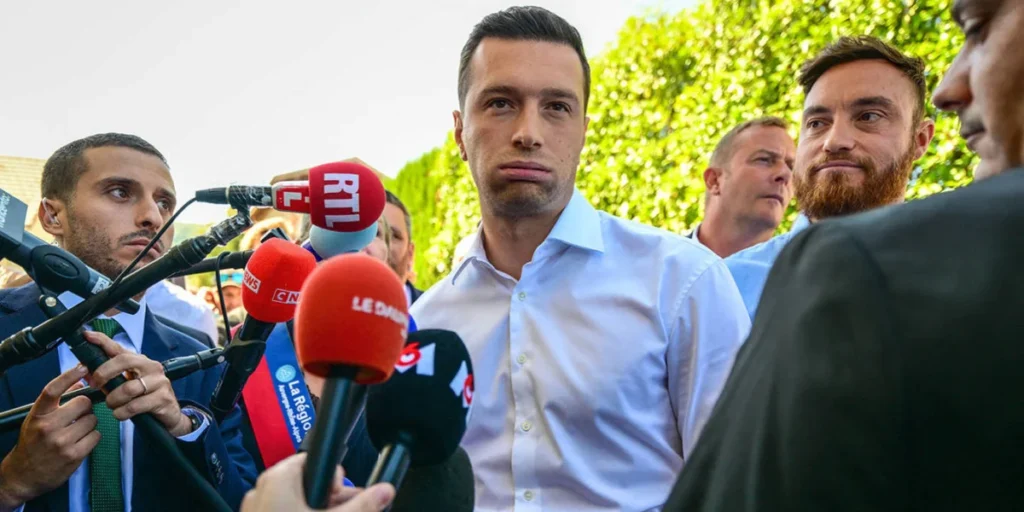
PARIS — For years, the French far-right has engaged in a calculated, systematic process of political sanitization. Under the leadership of Marine Le Pen, the Rassemblement National (National Rally, or RN) has aggressively sought to shed the explicit antisemitism, xenophobia, and neo-fascist associations of its predecessor, the Front National, founded by her father, Jean-Marie Le Pen. This long-term strategy of dédiabolisation (detoxification) has yielded staggering electoral dividends, pushing the party to the precipice of national power.
Yet, this meticulously constructed facade is currently facing its most severe stress test to date. A burgeoning political and moral scandal surrounding recent antisemitic comments linked to Jordan Bardella—the charismatic, 31-year-old president of the RN and Le Pen’s designated choice for prime minister—threatens to derail a trajectory that many analysts once viewed as unstoppable.
While the immediate political fallout could conceivably blow over, allowing Le Pen to proceed with her blueprint for the 2027 French presidential election, political scientists and insiders warn that the controversy has exposed deep, unresolved ideological currents within the party. As France looks toward a high-stakes electoral cycle, the Bardella affair has introduced profound uncertainty into the nation’s political landscape, forcing observers to weigh whether the far-right’s modernizing makeover is merely skin-deep.
Main Facts
The core of the crisis centers on explosive allegations and revelations regarding antisemitic discourse within the wider ecosystem of the National Rally, with direct and indirect implications for Jordan Bardella.
- The Designated Successor: Jordan Bardella remains central to Marine Le Pen’s 2027 strategy. Le Pen has repeatedly and publicly committed to naming Bardella as her prime minister should she secure the Élysée Palace, cementing a powerful political tandem designed to appeal to both older, grievance-driven working-class voters and younger, digitally native demographics.
- The Antisemitism Controversy: The scandal erupted following a series of investigative reports and public disclosures highlighting antisemitic remarks, online behavior, and historical associations among figures close to the party, as well as scrutiny over Bardella’s own historical reticence to firmly repudiate certain figures from the far-right’s dark past.
- The Electoral Stakes: Despite the growing tempest, recent polling—such as data from the IFOP group—indicates that Le Pen maintains a formidable position heading into the 2027 presidential race. However, the durability of this lead is now intrinsically tied to how the RN manages the fallout from the scandal.
- The Strategic Dilemma: The controversy has presented Le Pen with a stark strategic choice: stick by her protégé and weather the moral and political storm, or sacrifice her designated prime minister to protect the broader project of mainstreaming the party.
Chronology of Events
To understand how the current crisis reached a boiling point, it is necessary to examine the timeline of events that brought Jordan Bardella to the center of French politics and subsequently plunged him into controversy.
- September 2021: Jordan Bardella takes over the leadership of Génération Nation (the RN’s youth wing) and is subsequently chosen by Marine Le Pen to serve as the interim president of the National Rally while she focuses on her 2022 presidential campaign. This move signals his elevation to the inner sanctum of the party’s leadership.
- November 2022: At the RN party congress in ಪಕ್ಷ (Party Congress) in Marseille, Bardella is officially elected as the permanent president of the National Rally, defeating rival Louis Aliot. He becomes the first leader of the party who does not share the Le Pen family name, marking a symbolic generational shift.
- June 2024: Bardella leads the RN list to a historic landslide victory in the European Parliament elections, securing over 31% of the French vote. This triumph prompts President Emmanuel Macron to dissolve the National Assembly and call a snap legislative election, catapulting Bardella into the national spotlight as a credible candidate for the office of prime minister.
- July 2024: Following a coordinated “republican front” blockade by left-wing and centrist parties in the second round of the legislative snap elections, the RN finishes third in seat share, denying Bardella the Matignon premiership. Despite this setback, the party’s overall vote share hits historic highs, cementing its status as a permanent fixture of French governance.
- Late 2025 – Early 2026: Investigative journalism uncovers a series of past social media posts, internal communications, and associations involving fringe elements of the RN and figures within Bardella’s professional and political orbit. The disclosures highlight persistent antisemitic tropes and historical revisionism.
- October 2026: The scandal broadens, drawing sharp rebukes from civil rights organizations, international monitors, and political opponents. Analysts begin openly debating whether the controversy will permanently damage Bardella’s viability as a future prime minister.
Supporting Data & Polling Analysis
The political calculus surrounding the Bardella scandal cannot be understood without examining the empirical data driving French electoral dynamics. Despite successive moral panics and historical baggage, the National Rally has steadily expanded its electoral ceiling.
+--------------------------------------------------------------------+
|            IFOP Presidential Voting Intentions (2026 Trend)        |
+--------------------------------------------------------------------+
| Marine Le Pen (RN)        ██████████████████████████ 34% - 36%     |
| Center-Macronist Bloc     ██████████████████ 22% - 24%             |
| Left-Wing Coalition       █████████████████ 21% - 23%              |
| Others / Undecided        ████████████ 15% - 17%                   |
+--------------------------------------------------------------------+
According to recent metrics from the IFOP group and other leading French polling institutions, Marine Le Pen consistently polls ahead in hypothetical first-round matchups for the 2027 presidential election, often hovering between 34% and 36% of the vote.
Furthermore, data regarding Jordan Bardella’s personal popularity reveals a unique phenomenon:
- Youth Appeal: Bardella boasts the highest approval ratings among voters aged 18 to 35 within the nationalist-populist demographic, largely cultivated through a slick, highly polished presence on TikTok and Instagram.
- The Moderation Gap: While core RN supporters dismiss the antisemitism scandal as a media-driven smear campaign intended to sabotage the party, moderate conservative voters—whose support Le Pen will need to win a presidential runoff—exhibit heightened sensitivity to issues of antisemitism and historical revisionism. Polling indicates that up to 18% of potential center-right runoff voters would reconsider their ballot if the party fails to adequately distance itself from extremist elements.
Official Responses
The unfolding crisis has drawn fierce reactions from across the political spectrum, highlighting the deep polarization defining contemporary French democracy.
The National Rally Defense
Official spokespersons for the RN have aggressively pushed back against the accusations, characterizing the scandal as a desperate attempt by a collapsing political establishment to halt the party’s democratic momentum.
- Jordan Bardella has issued categorical denials regarding any personal animus or ideological alignment with antisemitism, framing himself as a modern political leader committed to the protection of all French citizens.
- Marine Le Pen has rallied behind her protégé, arguing that the attacks prove the establishment is terrified of their impending victory in 2027. Insiders within the party suggest that Le Pen views abandoning Bardella as a sign of weakness that would demoralize the RN base.
Condemnation from Opponents and Civil Society
The response from political opponents and civil rights groups has been swift and unforgiving.
- The Left (Nouveau Front Populaire): Leaders from France Insoumise and the Socialist Party have seized upon the controversy to argue that the National Rally’s dédiabolisation campaign is a fraud. They contend that beneath the tailored suits and sanitized rhetoric, the party remains fundamentally anchored in the xenophobic and antisemitic traditions of the twentieth century.
- The Center and Government: Representatives of the Macronist Ensemble bloc have accused Bardella of failing the fundamental test of republican values. Government officials have argued that a figure tainted by associations with antisemitism is fundamentally unfit to exercise executive power in the French Republic.
- The Representative Council of French Jewish Institutions (CRIF): Civil society organizations have expressed profound alarm over the findings, reiterating that historical vigilance against antisemitism remains a vital cornerstone of French democracy and demanding complete transparency and accountability from political leaders.
Implications: Three Scenarios for 2027
As political analysts parse the fallout, consensus is emerging around three distinct trajectories for Jordan Bardella and Marine Le Pen’s presidential campaign.
Scenario 1: The Quick Fade (The Base Holds)
In the first and most probable scenario, the scandal follows a familiar modern political rhythm: intense media scrutiny followed by rapid fatigue among the general electorate.
- The Dynamics: Core RN voters, already deeply distrustful of mainstream media outlets, dismiss the accusations as politically motivated mudslinging. The news cycle moves on to economic anxieties, inflation, and immigration—topics that favor the far-right.
- The Outcome: The scandal dies down quickly, enabling Marine Le Pen to stick steadfastly to her current plan: win the 2027 presidential election and name Jordan Bardella as her prime minister.
Scenario 2: The Managed Demotion (The Pragmatic Pivot)
If the pressure from moderate conservative allies and the business community becomes politically unsustainable, Le Pen may calculate that Bardella has become an electoral liability.
- The Dynamics: To secure the vital votes of center-right electors in a presidential runoff, Le Pen chooses optics over personal loyalty. While keeping Bardella within the party apparatus, she quietly sidelines him as her designated prime minister, opting instead for a more moderate, technocratic figure to reassure the financial markets and traditional conservatives.
- The Outcome: Bardella is sidelined, suffering a severe blow to his political ambitions, while Le Pen preserves her path to the presidency by demonstrating a willingness to discipline her own ranks.
Scenario 3: The Fatal Fracture (Electoral Collapse)
In the worst-case scenario for the far-right, the scandal triggers a cascading crisis of confidence that shatters the electoral coalition Le Pen has spent a decade building.
- The Dynamics: New, damaging revelations emerge that make it impossible for even the most loyal supporters to wave away the concerns. Internal rivalries within the RN—suppressed during years of electoral success—boil over as ambitious figures vie to position themselves in the wake of Bardella’s decline.
- The Outcome: The party fractures internally, alienating the moderate right and handing a strategic lifeline to the center and left blocs. Neither Le Pen nor Bardella recovers, plunging the nationalist movement into an existential crisis.
Conclusion
The controversy surrounding Jordan Bardella is far more than a localized political spat; it is a referendum on the credibility of the French far-right’s transformation. For decades, Marine Le Pen’s primary objective has been to render her party electable by purging its historical ghosts. The emergence of antisemitism scandals at the very pinnacle of the party’s leadership demonstrates just how fragile that transformation truly is.
As France barrels toward the 2027 presidential election, the nation stands at a historic crossroads. Whether the Bardella paradox resolves into a minor bump on the road to the Élysée or serves as the catalyst that halts the far-right’s ascent will depend entirely on a fickle electorate and the ruthless calculus of political survival. What remains certain is that the stakes could not be higher for the future of French democracy.