The Great Wealth Expansion: Exploring Modern Prosperity, Inflation’s Toll, and the Resiliency of the American Dream
By Ben Carlson
Published: September 11, 2026
Main Facts: The New Landscape of American Prosperity
The financial landscape of the United States has undergone a dramatic transformation over the past decade. Driven by robust equity markets, compounding retirement accounts, and entrepreneurial resilience, American household net worth has surged to unprecedented heights.
Data compiled from major financial institutions highlights this paradigm shift. Fidelity Investments reports that nearly 800,000 of its customers now hold balances of $1 million or more in their 401(k) plans, alongside another 684,000 clients who have crossed the seven-figure threshold in their Individual Retirement Accounts (IRAs). Furthermore, according to data from The Wall Street Journal, the number of taxpayers holding IRA balances of $10 million or more skyrocketed to nearly 12,000 in 2024, a massive leap from just 3,625 in 2019.
On a macro level, UBS global wealth data indicates that the United States is now home to well over 23 million millionaires, with roughly half a million new members entering the "two-comma club" in 2025 alone. Globally, an estimated one million individuals joined the millionaire ranks last year.
Yet, these eye-popping figures coexist with a persistent paradox: while wealth is accumulating across multiple demographics, the definition of what it means to be "rich" has fundamentally changed. Inflation and shifting economic expectations mean that a million dollars simply does not carry the purchasing power it once did, forcing economists and everyday savers alike to recalibrate their financial milestones.
Chronology: From Pandemic Lows to the $174 Trillion Milestone
To understand how rapidly the American balance sheet has expanded, it is helpful to look back at the trajectory of household net worth over the last several years:
- Late 2019 – Early 2020: On the precipise of the global pandemic, total American household net worth stood at just shy of $109 trillion. Economic uncertainty loomed large, and traditional savings models faced unprecedented stress tests.
- 2021 – 2023: Massive fiscal stimulus, aggressive monetary policy, and a surging post-pandemic stock market supercharged household balance sheets. Asset prices—particularly residential real estate and equities—appreciated rapidly, lifting net worth figures globally.
- 2024: Wealth concentration reached new milestones, highlighted by the Internal Revenue Service and financial reporting showing nearly 12,000 taxpayers managing IRA portfolios exceeding $10 million.
- 2025: UBS reports that approximately 500,000 new millionaires were minted in the United States over the course of the year, pushing the domestic total past the 23 million mark.
- Late 2026: Total American household net worth officially surpasses $174 trillion and continues to climb, sparking intense debates regarding wealth distribution, inflation, and the viability of upward mobility.
Supporting Data: Examining Wealth Concentration and the Inflation Squeeze
Despite the impressive growth seen across various household demographics, wealth remains unevenly distributed. According to recent Federal Reserve and market distribution data, the top 1% of American households control roughly one-third of the nation’s total wealth, while the top 10% commands a staggering 68% share.

[ Wealth Distribution Overview ]
---------------------------------------------------------
 Top 1% of Americans    -> Controls ~33% of Total Wealth
 Top 10% of Americans   -> Controls ~68% of Total Wealth
 Millionaire Class      -> Makes up ~1.5% of Global Population
---------------------------------------------------------
While these concentration metrics frequently fuel narratives of systemic inequality, the sheer velocity of wealth creation has permeated lower rungs as well, even if inflation continually moves the financial goalposts.
As explored in the book Risk & Reward, inflation exacts a heavy toll on nominal wealth over time:
- The 1993 Benchmark: One million dollars in 1993 possessed the purchasing power equivalent to just $475,000 by the end of 2024.
- The Equivalence Threshold: To match the exact spending power that $1,000,000 commanded in 1993, an investor needed more than $2,000,000 by 2024.
- The Mathematics of Decay: A consistent 3% inflation rate cuts the real value of a cash dollar in half over 23 years. At a 4% inflation rate, that timeline accelerates, halving your purchasing power in just 17 years.
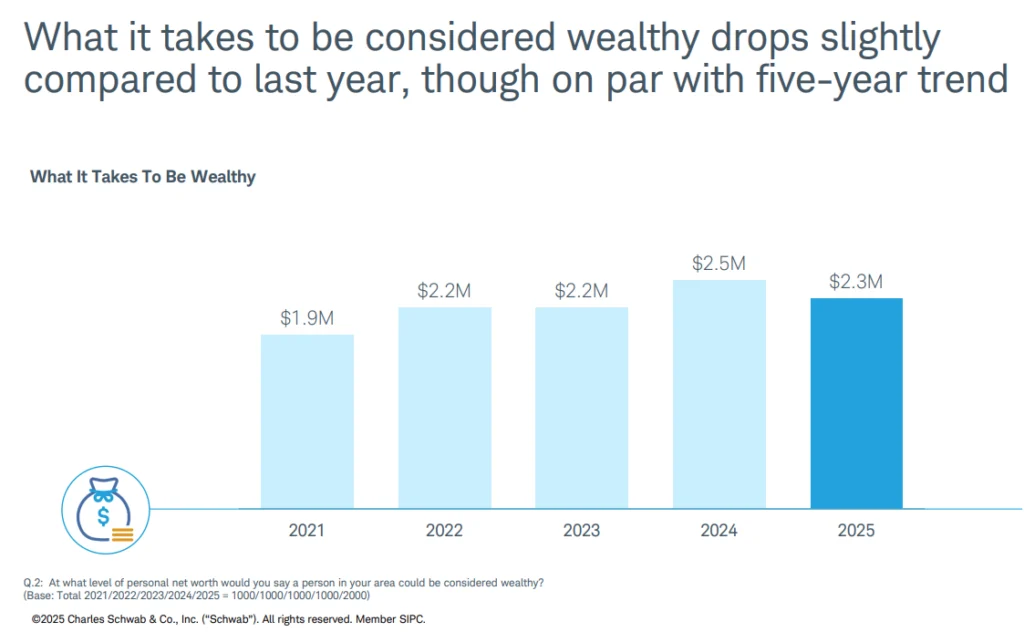
This erosion of value helps explain why affluent individuals often argue that "a million dollars doesn’t make you rich anymore." According to the Schwab Modern Wealth Survey, the average American believes an individual needs roughly $830,000 simply to feel "financially comfortable." However, when asked what threshold qualifies someone as genuinely wealthy, that figure more than doubles to $2.3 million. The "millionaire next door" has effectively been replaced by the "$2.3 millionaire next door."
Official Responses and Societal Perceptions: Is the American Dream Dead?
In an era defined by high asset valuations and visible wealth gaps, public sentiment often leans toward disillusionment. Many citizens feel that economic mobility has stalled and that the modern financial system is engineered to favor entrenched fortunes.
However, cultural and economic researchers push back against the absolute narrative that upward mobility is a relic of the past. Recent excerpts published by The Wall Street Journal from the book The Everywhere Millionaire shed light on a hidden class of wealth creators—individuals who built substantial fortunes entirely outside of traditional financial powerhouses like Wall Street or Silicon Valley.
A prime example of this grassroots entrepreneurial spirit is Dick Portillo. Opening a modest hot-dog stand in 1963 with zero prior culinary experience and a capital investment of just $1,100, Portillo built his enterprise over half a century into the Midwest’s largest privately owned restaurant company. Operating without outside investors or franchises, individual Portillo’s locations generated up to $9 million annually—roughly triple the revenue of a typical McDonald’s franchise. When he ultimately sold the company for $1 billion, it funded a lifestyle featuring a Chicago-area mansion, a private jet, and a sprawling waterfront estate in Naples, Florida.
Portillo’s trajectory challenges fatalistic assumptions about class mobility. Born in Chicago to working-class immigrants from Mexico and Greece and raised partly in notorious public housing projects, Portillo reflected in his memoir:

"I came from a poor family and at one time thought I didn’t have anything to offer the world."
Statistical analyses further support the resilience of economic mobility. Data highlights that the typical "star founder" or high-net-worth business owner is rarely born into extreme privilege. Because the bottom 99% outnumbers the top 1% by a factor of 99-to-1, successful founders originating from modest or poor backgrounds outnumber those from the top 1% by a factor of 2.5. Furthermore, only about 25% of business owners worth $5 million or more inherited their enterprises.
Generational wealth also faces natural friction: studies indicate that approximately 40% of children born into the top 1% eventually fall out of the top fifth of income distribution entirely over the course of their lives.
Implications: Balancing Inequality with Accessible Wealth-Building
The juxtaposition of a $174 trillion household net worth economy against persistent wealth inequality presents complex implications for society, policymakers, and individual investors.
- The Dual Reality of Modern Finance: Two opposing truths can—and do—coexist simultaneously. On one hand, wealth inequality is a tangible and growing structural issue, driven largely by the fact that affluent households own the vast majority of appreciating financial assets like equities and real estate. On the other hand, ordinary Americans are building long-term wealth at historic rates through disciplined saving, utilization of tax-deferred retirement accounts (such as 401ks and IRAs), and active participation in the stock market.
- Redefining Financial Security: As inflation steadily chips away at purchasing power, financial planning parameters must adapt. Milestones that once guaranteed lifelong security—such as accumulating a single million dollars—must now be viewed as stepping stones rather than ultimate destinations, pushing the target for true financial independence closer to the $2 million to $2.3 million range.
- The Enduring Power of Enterprise and Discipline: While inherited wealth provides undeniable structural advantages, the continued emergence of self-made entrepreneurs and everyday retirement savers proves that the mechanisms for wealth accumulation remain accessible to those who combine patience, smart investing, and business acumen.
Ultimately, while being wealthy is a matter of immense statistical fortune—with the global millionaire class making up a mere 1.5% of the world’s population—the path to financial resilience is wider and more active than ever before for those willing to navigate the complexities of the modern economic landscape.