The Great Fixed-Income Rebound: Why a 5% Bond Yield Changes Everything for Investors
September 18, 2026
By Financial Market Analysis Desk
For more than a decade, fixed-income investors lived through an era of financial repression. Following the global financial crisis and the unprecedented economic interventions of the COVID-19 pandemic, the bond market offered little more than scraps. Yields on core bond indexes lingered below 3% for years, eventually plunging under 2% in the early 2020s. For retirees, conservative savers, and institutional asset allocators alike, safe yield was effectively dead.
Today, the landscape looks radically different. Following the most aggressive monetary tightening cycle in decades, high-quality fixed-income assets are offering yields not seen in a generation. The average yield to maturity on the iShares Core U.S. Aggregate Bond ETF (AGG)—widely known as "the Agg"—has climbed to approximately 5.3%.
This dramatic shift has prompted a fundamental question among everyday savers and professional investors alike: Is the yield on the Agg the equivalent of a near-guaranteed 5.2% annual return?
While the answer is nuanced, the resurgence of 5% yields marks a historic turning point for the asset class, offering a silver lining after the worst bond bear market in modern financial history.
Main Facts: Understanding the Current Bond Landscape
To decode what a 5% yield means for a portfolio, investors must look under the hood of broad bond market indexes. The Agg, which serves as the benchmark for the U.S. investment-grade bond market, includes a mix of U.S. Treasuries, government-related agencies, and corporate bonds.
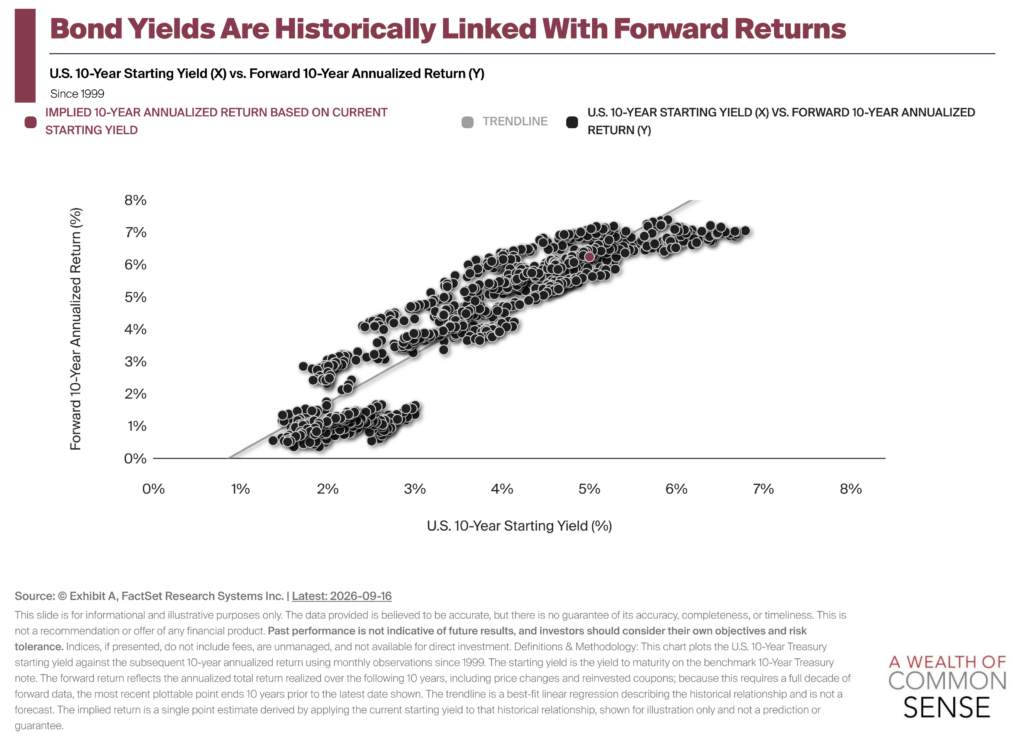
- The Yield: The average yield to maturity for the Agg currently hovers around 5.3%. Meanwhile, the 10-year U.S. Treasury note is yielding roughly 5%, a striking recovery from the sub-0.5% yields recorded earlier this decade.
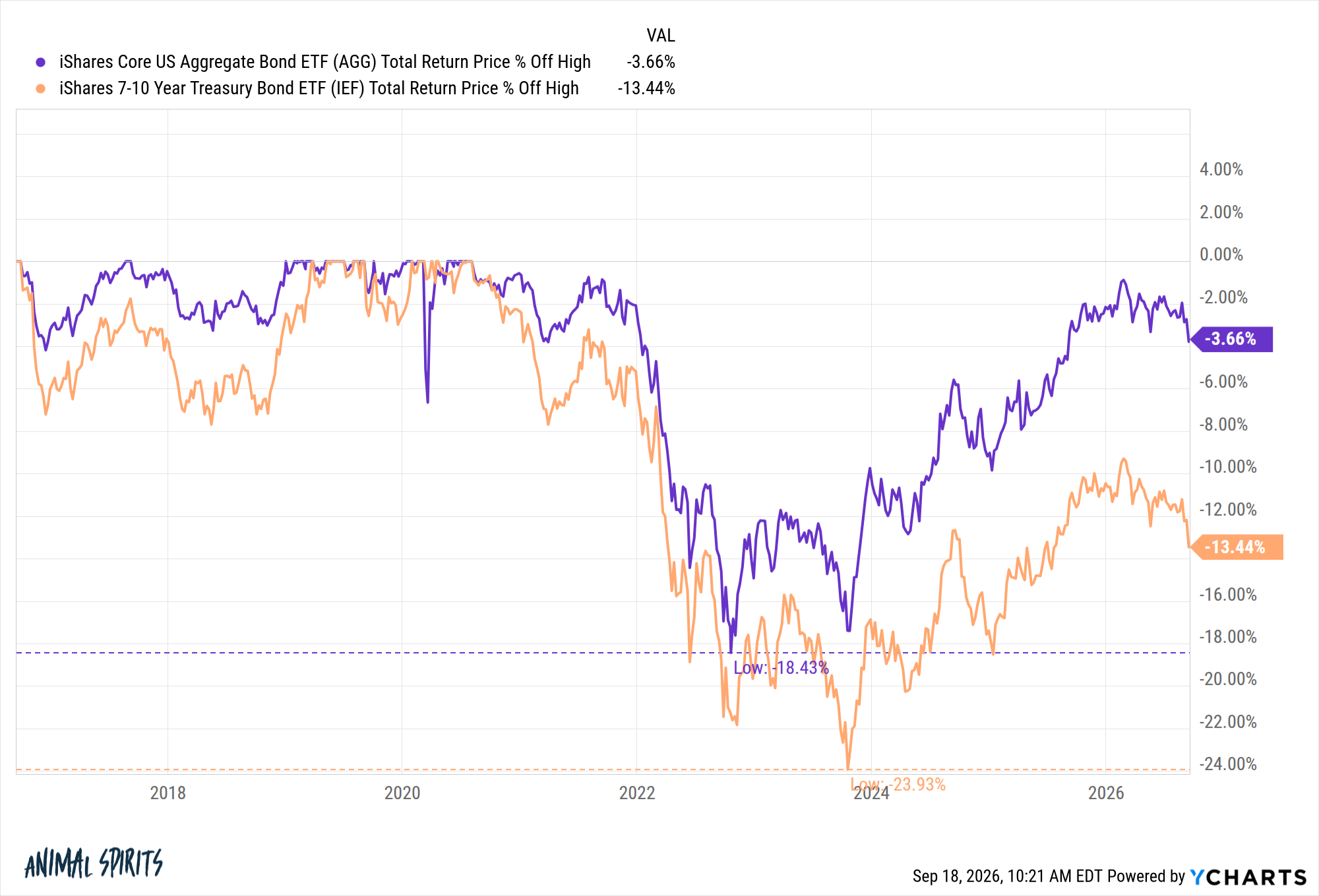
- The Historical Context: During the 2010s, earning a 3% return on a high-quality bond fund felt acceptable only because inflation was exceptionally low. When inflation surged in the post-pandemic era, it triggered the worst bond bear market in history. As interest rates skyrocketed, bond prices plummeted, causing the Agg and 10-year Treasuries to suffer drawdowns approaching 20% (with long-term Treasuries facing even steeper drops of up to 40%).
- The Math of Future Returns: Unlike the stock market—where forward returns are heavily dictated by fickle investor emotions, valuations, and sentiment—bond returns are driven primarily by math. While not a rigid, one-to-one guarantee over short horizons, a bond’s starting yield has historically served as a remarkably reliable predictor of its annualized returns over its intermediate-to-long-term duration.
Chronology: From Ultra-Low Rates to Historic Pain and Recovery
The journey from the era of zero-interest-rate policy (ZIRP) to today’s 5% yield environment has been a turbulent ride for fixed-income investors.
2010–2019: The Era of Financial Repression
Following the 2008 financial crisis, global central banks slashed interest rates to stimulate economic growth. For nearly a decade, the yield on the U.S. Aggregate Bond index struggled to break out of the sub-3% range. Savers seeking safety were essentially forced to accept negligible returns or push further out on the risk spectrum into equities and alternative assets.
2020–2021: The Pandemic Plunge
When the COVID-19 pandemic struck, central banks doubled down, pushing benchmark rates back to historic lows. Interest rates on the Agg dipped below 2% for a sustained period in the early 2020s, creating an environment where nominal bond yields failed to keep pace with rising consumer prices.
2022–2024: The Worst Bond Bear Market in History
To combat runaway inflation, the Federal Reserve embarked on one of the fastest monetary tightening campaigns in history. As interest rates spiked from near-zero to over 5%, existing bond prices cratered. Because bond prices and interest rates move inversely, investors holding fixed-rate bonds watched the capital value of their portfolios drop by nearly 20%. Long-term government bonds, such as the iShares 20+ Year Treasury Bond ETF (TLT), suffered structural drawdowns exceeding 40%.
2025–2026: Stabilization and the New Normal
As the interest rate hiking cycle matured and plateaued, the fixed-income market found its footing. With starting yields now stabilizing above 5%, the asset class has transitioned from a source of capital pain to a formidable anchor of portfolio income.
Supporting Data: Why Starting Yield Matters
In equity markets, forecasting forward returns is notoriously difficult because stock prices are dictated by both fundamental performance (earnings and dividends) and emotional sentiment (price-to-earnings multiples).
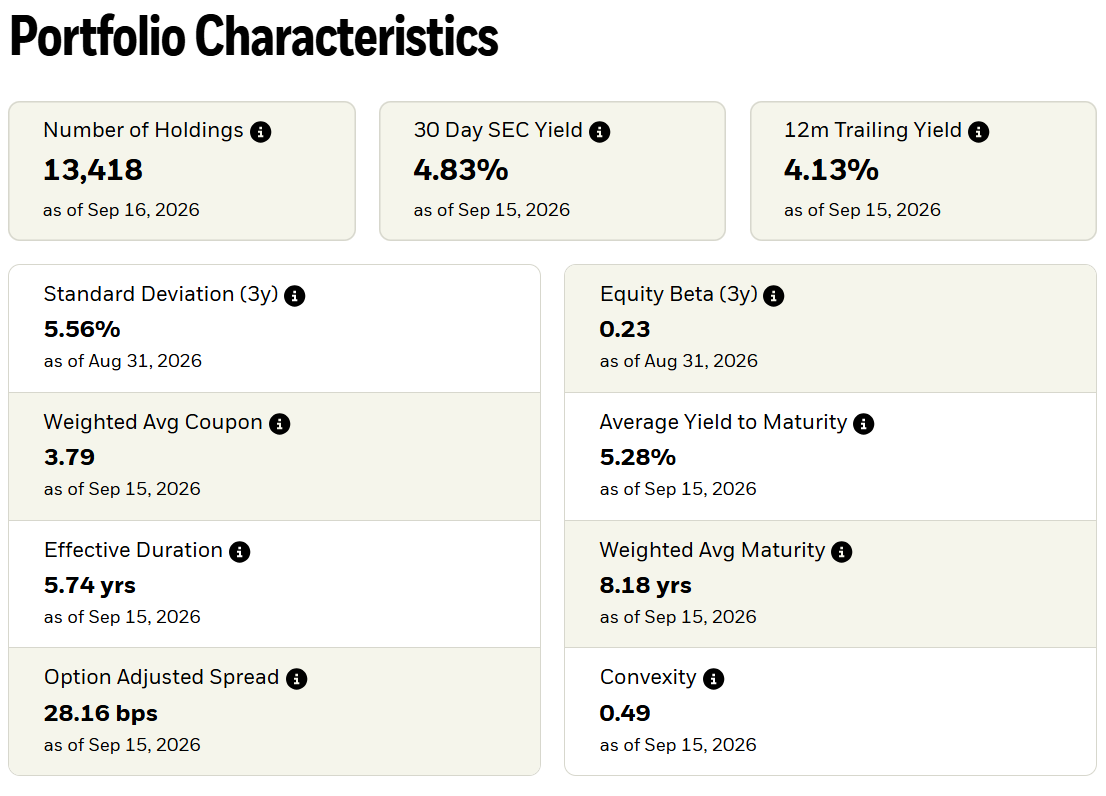
In fixed income, however, the relationship between the starting yield and subsequent returns is grounded in mathematical reality. Historical data compiled by advisory platforms such as Exhibit A illustrates a powerful correlation between the 10-year Treasury’s starting yield and its annualized forward returns over ensuing 10-year periods.
| Metric | Historical Range (2010s) | Current Environment (2026) |
|---|---|---|
| Agg Yield to Maturity | 1.5% – 3.0% | ~5.3% |
| 10-Year Treasury Yield | 0.5% – 2.5% | ~5.0% |
| Maximum Bear Market Drawdown | Minimal (Low Rates) | ~20% (Historical Worst) |
| Expected 5-7 Year Return Profile | Low Single-Digits | ~5.0% Annualized |
While short-term deviations do occur—primarily driven by unexpected shifts in monetary policy or inflation shocks that temporarily depress bond prices—the underlying yield eventually exerts its gravity.
For example, when the 10-year Treasury yield climbed from roughly 4.2% earlier in the year to 5%, it represented a 20% jump in yields. Yet, a 10-year U.S. government bond portfolio only experienced a modest 3% price decline on the year. Why? Because the steady accumulation of regular interest income significantly cushioned the blow of falling bond prices.
Official Perspectives and Market Expert Insights
Market commentators and financial experts have increasingly focused on the rehabilitation of fixed income as a viable asset class.
Appearing on a recent segment of The Compound, Alex Morris of F/m Investments joined hosts Ben Carlson and Barry Ritholtz to dissect the changing role of bonds in modern asset allocation. The discussion—recorded live from the Future Proof wealth management festival—emphasized that investors who abandoned bonds during the painful 2022–2024 drawdown risk fighting the last war.
Industry leaders have pointed out that while cash equivalents like money market funds and high-yield savings accounts provided an attractive refuge during the peak of the Fed’s hiking cycle, those short-term yields are inherently fleeting. As central banks inevitably adjust rates over economic cycles, cash yields will drop. High-quality intermediate bond funds, by contrast, "lock in" these higher yields for years to come, protecting investors against future reinvestment risk.
Implications for Investors: Is a 5.2% Return Guaranteed?
To return to the reader’s original question: Is the yield on the Agg the equivalent of a near-guaranteed 5.2% annual return?
The short answer is no, but it is a powerful baseline.
- Short-Term Price Volatility: If inflation expectations flare up or the Federal Reserve surprises markets by raising rates further, bond prices could face short-term downward pressure. Total returns (which include price changes plus reinvested income) can and will fluctuate year-to-year.
- The Long-Run Math: Over a 5-to-7-year horizon—roughly matching the average duration of the Agg—a starting yield of 5.3% strongly implies that an investor’s annualized return will cluster close to that figure.
- The End of the TINA Era: For over a decade, investors operated under the banner of TINA ("There Is No Alternative") to stocks, forcing conservative portfolios into risky equities to chase yield. Today, savers have a genuine, high-quality alternative.
Strategic Takeaways
For asset allocators, the return of a 5% bond yield restores the traditional 60/40 portfolio (or customized variations) to its historical function. Bonds are once again capable of generating meaningful income, damping portfolio volatility, and providing genuine diversification against potential equity market shocks.
While the historic bond bear market left emotional scars on many investors, today’s elevated yields offer a compelling invitation to re-engage with fixed income on favorable terms.