Wall Street’s Witty Mirror: A Decades-Old Comic Collection Offers Timeless Market Insights
Posted: June 16, 2026
By: Ben Carlson (via awealthofcommonsense.com)
MAIN FACTS
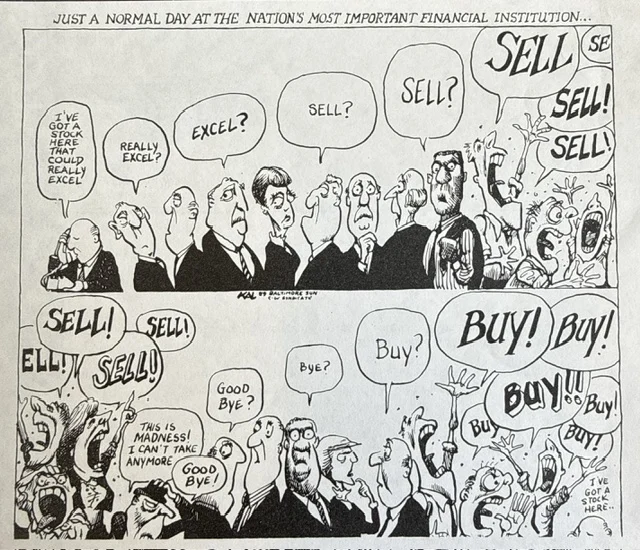
A unique collection of Wall Street comics, meticulously clipped from newspapers and financial publications over several decades, has surfaced, offering a humorous yet profoundly insightful commentary on financial history. Shared by a long-time reader with financial writer Ben Carlson, this trove of satirical artwork spans key market eras, particularly focusing on the frenetic 1990s dot-com bubble and the pervasive influence of then-Federal Reserve Chairman Alan Greenspan. Beyond historical snapshots, the comics reveal enduring truths about investor psychology, media bias, and the inherent unpredictability of financial markets, providing a powerful lens through which to understand past upheavals and potentially navigate future ones.
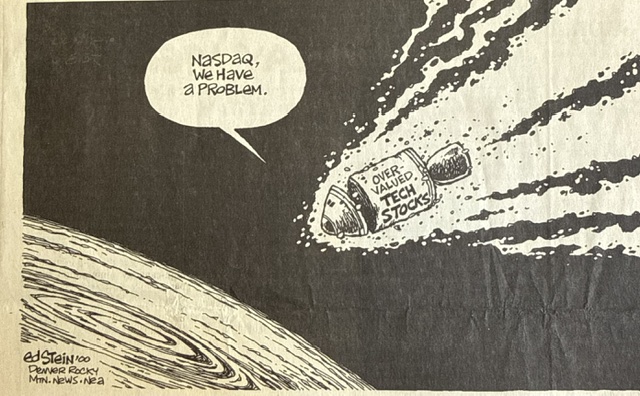
The collection serves as a vibrant, often cutting, retrospective, chronicling the euphoria of speculative booms, the pain of subsequent busts, and the often-absurd dynamics that shape market sentiment. Its re-examination comes at a pertinent time, with contemporary discussions frequently drawing parallels between past speculative excesses, like the dot-com era, and emerging trends, such as the rapid ascent of Artificial Intelligence (AI) technologies.
CHRONOLOGY: A Journey Through Market Eras via Satire
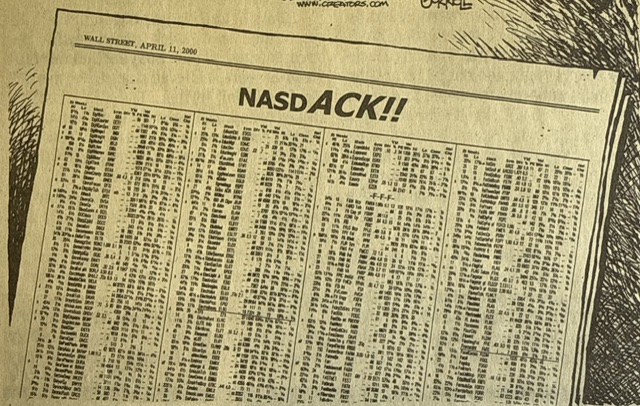
The genesis of this fascinating retrospective lies in the dedicated hobby of a reader who, over decades, compiled a comprehensive archive of financial cartoons. This extraordinary contribution underscores the vibrant community aspect of financial commentary, where shared insights and historical artifacts enrich the collective understanding of market phenomena. Ben Carlson, known for his ability to distil complex financial concepts, found himself sifting through a "pile" of these hand-clipped gems, recognizing their intrinsic value as both historical documents and timeless reflections on human behavior in finance.
The Roaring Nineties and the Dot-Com Frenzy (1990s)
The bulk of the collection from the 1990s zeroes in on two dominant forces: the burgeoning tech stock phenomenon and the towering figure of Alan Greenspan. This era, often recalled for its unprecedented economic expansion and technological optimism, laid the groundwork for one of the most significant market bubbles in modern history.
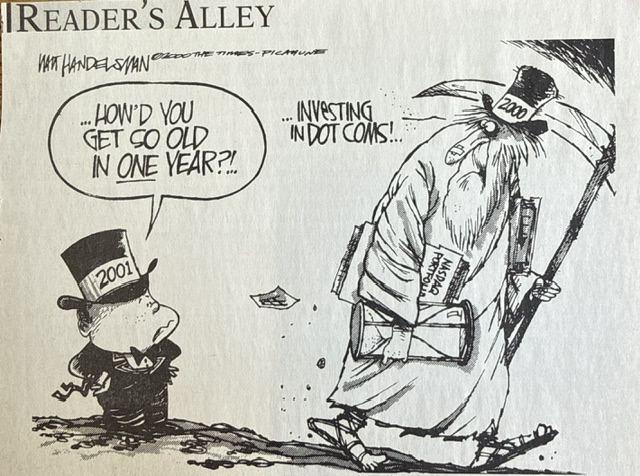
The 1990s witnessed the internet’s meteoric rise, transforming from a niche academic tool into a commercial and public phenomenon. This technological revolution fueled an intense speculative fervor, particularly in the nascent "dot-com" companies. Investors, captivated by the promise of new paradigms and exponential growth, poured capital into often unprofitable ventures, driving stock valuations to dizzying heights. The financial media, in turn, amplified this excitement, creating an environment where traditional valuation metrics seemed obsolete. Comics from this period vividly capture the irrational optimism, depicting investors blindly chasing tech stocks, often with little understanding of underlying fundamentals, a scenario eerily reminiscent of various speculative manias throughout history. The sheer scale of the dot-com frenzy, as depicted in the comics, makes even contemporary AI comparisons feel somewhat muted, hinting at a "different stratosphere" of speculation.
The Unraveling: Dot-Com Bust (2000-2002)
The exuberance, however, was unsustainable. The turn of the millennium brought a stark reversal, as the dot-com bubble burst with brutal force. The aftermath was characterized by widespread panic, bankruptcies, and significant wealth destruction, particularly in the technology sector.
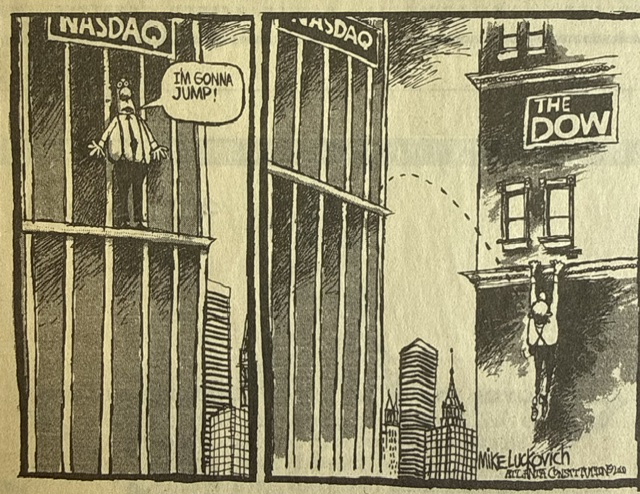
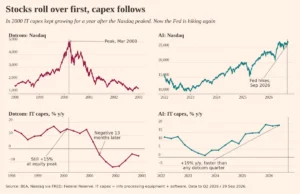
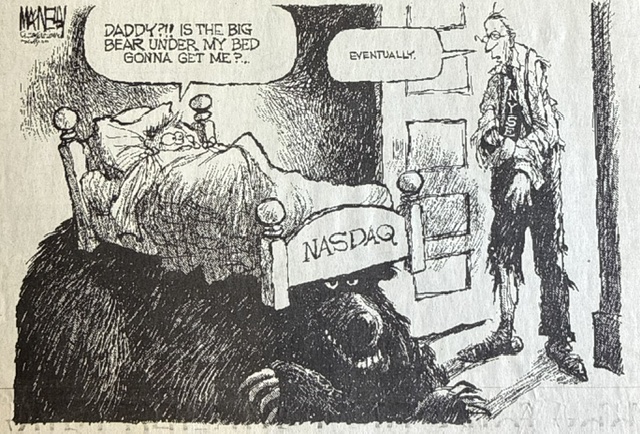
The Nasdaq Composite, a bellwether for technology stocks, endured a catastrophic decline, plummeting nearly 80% from its peak. The more concentrated Nasdaq 100 fared even worse, crashing over 82%. This level of decimation in a major market index rivaled the magnitude of declines seen during the Great Depression for specific sectors, highlighting the profound pain inflicted upon tech investors. Comics from this period poignantly illustrate the despair and disbelief that gripped the market, depicting shattered dreams and the stark reality of speculative losses. One comic, in particular, captures the raw emotional toll, portraying investors grappling with the rapid evaporation of their perceived wealth.
Crucially, this period also underscored the importance of diversification. While the tech-heavy Nasdaq was in freefall, other segments of the market offered a relative safe haven. The Dow Jones Industrial Average, comprising more established, dividend-paying blue-chip companies, experienced comparatively modest declines. In 2000, when the Nasdaq dropped almost 40%, the Dow fell only 6%. The following year, the Nasdaq shed another 20%, while the Dow decreased by 7%. This divergence provided investors with a "place to hide out" in more stable, value-oriented assets, a lesson frequently emphasized by financial advisors in times of market volatility.
Greenspan’s Shadow: The Federal Reserve’s Guiding Hand
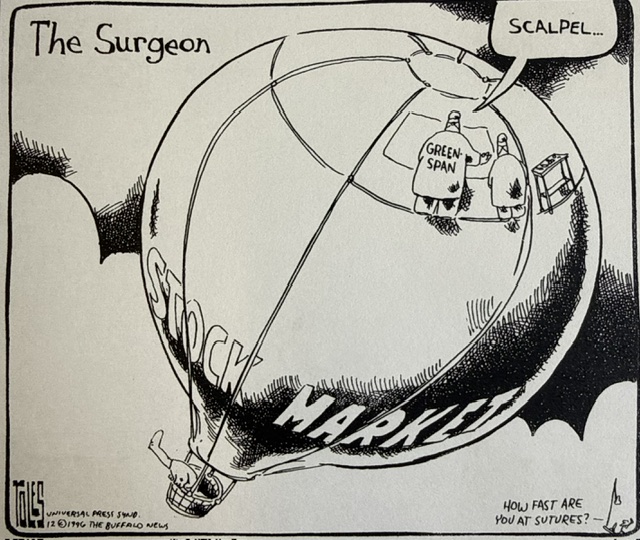
Intertwined with the narrative of tech speculation was the omnipresent figure of Alan Greenspan, then Chairman of the Federal Reserve. Greenspan’s influence on the markets during the 1990s was immense, making him a central character in many of the era’s financial cartoons.
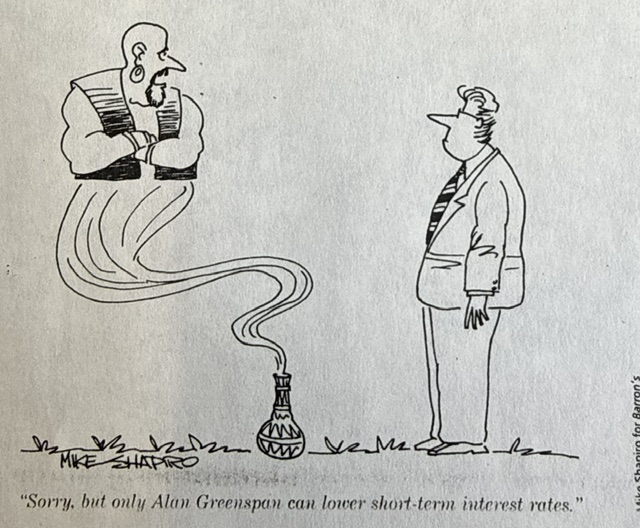
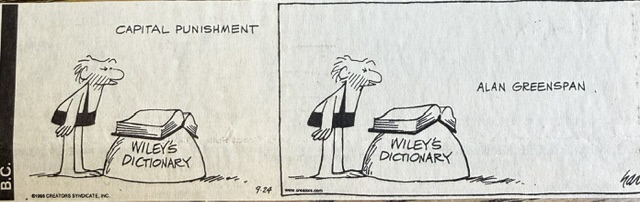
His now-famous "irrational exuberance" speech in December 1996, delivered at the height of market optimism, served as a cautious warning against speculative excesses. However, rather than deflating the bubble, the market continued its ascent for several more years, illustrating the difficulty of taming rampant speculation, even with pronouncements from the world’s most powerful central banker. Greenspan became a "larger-than-life figure," with investors and analysts hanging on his every word, scrutinizing his speeches for clues about future monetary policy and market direction. Comics humorously depict this almost cult-like reverence, showing investors deciphering his cryptic remarks or attributing market movements directly to his influence. Even popular comic strips, like B.C., featured Greenspan, underscoring his widespread public recognition and significance beyond specialist financial circles. His celebrity status reflected a period where the Fed’s role in guiding the economy and markets became increasingly prominent, shaping not just policy but also public perception and investor behavior.

SUPPORTING DATA: The Enduring Wisdom of Satire
The collection of comics transcends mere historical documentation, offering a rich tapestry of "supporting data" that illuminates timeless financial principles and human biases.
Market Bubbles: From Dot-Com to AI
The comics graphically depict the intoxicating allure and devastating aftermath of the dot-com bubble. One illustration, for instance, might show a soaring rocket labeled "Tech Stocks" with investors clinging on precariously, oblivious to the impending descent. This visual narrative serves as a stark reminder that while the specific technologies change (from internet startups to AI), the underlying human tendency towards speculative frenzy and herd mentality remains constant. The initial comparison in the article between the 1990s bubble and current AI trends highlights this cyclical nature. While AI’s fundamental potential is undeniable, the comics implicitly caution against allowing enthusiasm to outpace fundamentals, echoing Greenspan’s "irrational exuberance" warning. The brutal 80%+ crash of the Nasdaq Composite and Nasdaq 100 illustrates that even groundbreaking technological shifts can be accompanied by severe market corrections if valuations become detached from reality.
The Oracle Effect: Greenspan’s Pervasive Influence
The numerous cartoons featuring Alan Greenspan underscore the profound impact of central bank leadership on market sentiment. One comic might portray Greenspan as a puppeteer, manipulating market strings, or as a sage whose pronouncements are interpreted with fervent intensity by eager investors. This "oracle effect" highlights how, in times of uncertainty, market participants often look to authoritative figures for guidance, sometimes attributing almost magical powers to their words. Greenspan’s celebrity status was not merely a quirk of the era; it reflected a genuine belief among many that the Fed could, and would, steer the economy away from peril, fostering a sense of a "Greenspan put" – the implicit belief that the Fed would intervene to prevent severe market downturns. The humor in these comics often derives from the contrast between the complexity of monetary policy and the simplistic, often panicked, reactions of market participants.
The Negativity Bias in Financial Media
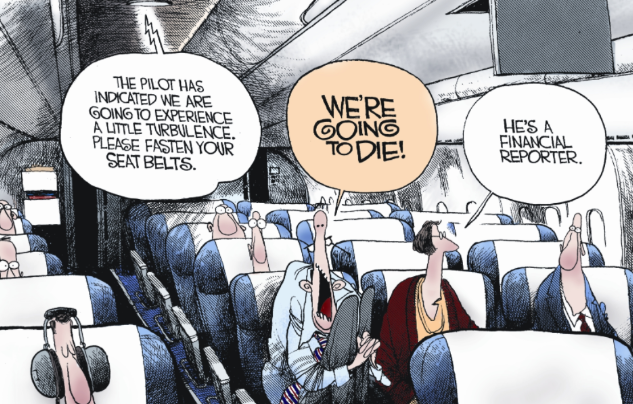
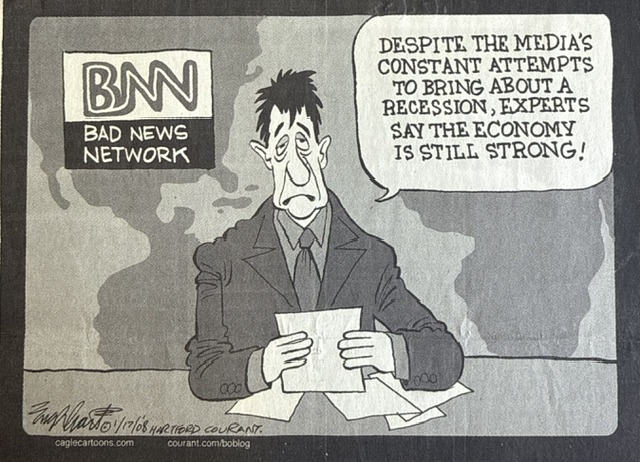
A striking observation from the collection is the disproportionate number of "bear market comics" compared to "bull market cartoons." This phenomenon speaks to a deep-seated "negativity bias" prevalent in financial media and human psychology. Bad news, particularly market downturns, tends to be more sensational, captivating, and memorable than periods of steady growth. One comic from the collection, dated 2008 but still relevant today, humorously depicts a financial news anchor exclaiming "The sky is falling!" while a tiny, healthy bull market trots by unnoticed. Another similar comic reinforces this, suggesting that positive market news often struggles to gain traction compared to dire predictions. This bias is rooted in evolutionary psychology: humans are wired to pay more attention to threats. For financial media, this translates into a tendency to highlight risks, crashes, and crises, as these narratives often generate more engagement. The comics satirize this dynamic, reminding us that while caution is prudent, an incessant focus on gloom can distort perceptions of long-term market trends.
The Futility of Market Prediction
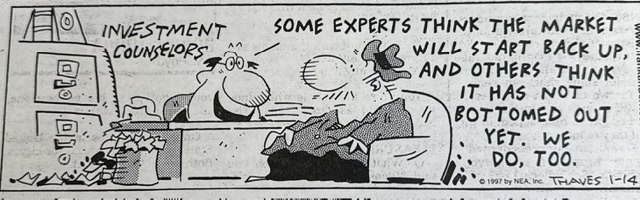
Several comics directly address the perennial challenge of predicting market movements. One, perhaps from Barron’s, might show a befuddled analyst staring at conflicting charts, or a crystal ball revealing only question marks. Another comic, succinct and impactful, suggests that trying to forecast the market is akin to navigating a maze blindfolded. These humorous takes serve as a powerful reminder of the inherent unpredictability of complex adaptive systems like financial markets. Despite sophisticated models and expert analyses, myriad factors—geopolitical events, technological breakthroughs, shifts in consumer behavior, and collective investor psychology—make precise predictions exceedingly difficult. The comics implicitly endorse a more humble approach to investing, one that acknowledges uncertainty and prioritizes long-term strategies over short-term forecasts.
Humor as a Critical Lens
Ultimately, the collection demonstrates the profound power of humor and satire as a critical lens through which to examine financial realities. The "greatest Wall Street comic of all-time," as described by Carlson – depicting a simple, undeniable truth about market dynamics – exemplifies how a well-crafted cartoon can convey more insight than pages of analytical prose. Humor simplifies complexity, highlights absurdity, and often delivers uncomfortable truths in an accessible, memorable way. It allows for a collective catharsis during market downturns and provides a shared understanding of common investor pitfalls.
OFFICIAL RESPONSES: Historical Context and Expert Reflection
While the comics themselves are not "official responses," they are cultural artifacts that reflect public sentiment and expert critiques of their time. Historically, the period of the dot-com bubble and its subsequent bust spurred various "official responses" and reflections from financial institutions, regulators, and economists.
The Federal Reserve, under Alan Greenspan, faced immense pressure to manage the economic boom without either stifling innovation or fueling a dangerous asset bubble. Greenspan’s "irrational exuberance" speech was, in essence, an official warning, albeit one that markets largely shrugged off initially. Post-bust, there were numerous official inquiries and academic studies into the causes and consequences of the bubble. Regulators intensified scrutiny on accounting practices, particularly for internet companies, and investment bank research, which was often accused of hyping stocks to win lucrative IPO business. The Sarbanes-Oxley Act of 2002, though primarily a response to Enron and WorldCom, reflected a broader regulatory push for greater corporate accountability and transparency following a period of market excesses.
Economists and market strategists, both during and after the bubble, offered diverse official responses. Some, like Robert Shiller, famously warned of a bubble based on historical valuation metrics. Others argued that "this time was different" due to the transformative power of the internet. The comics, in their satirical portrayals of both the optimists and the Greenspan-obsessed investors, implicitly comment on the varied and often conflicting "official" and expert narratives that existed concurrently.
IMPLICATIONS: Lessons for Contemporary Investors
The Wall Street comic collection, despite its vintage, offers profound implications for today’s financial landscape.
Vigilance Against Hype Cycles
The most salient lesson is the enduring nature of market hype cycles. Whether it’s dot-coms, housing, or the latest technological marvel like AI, markets are prone to periods where enthusiasm can overshadow fundamental value. The comics serve as a visual vaccine against the intoxicating siren song of "this time is different." Investors must remain vigilant, questioning high valuations, understanding underlying business models, and resisting the urge to chase every trending asset. The severe pain inflicted on Nasdaq investors in the early 2000s is a stark reminder of the consequences of unchecked speculation.
The Timelessness of Market Psychology
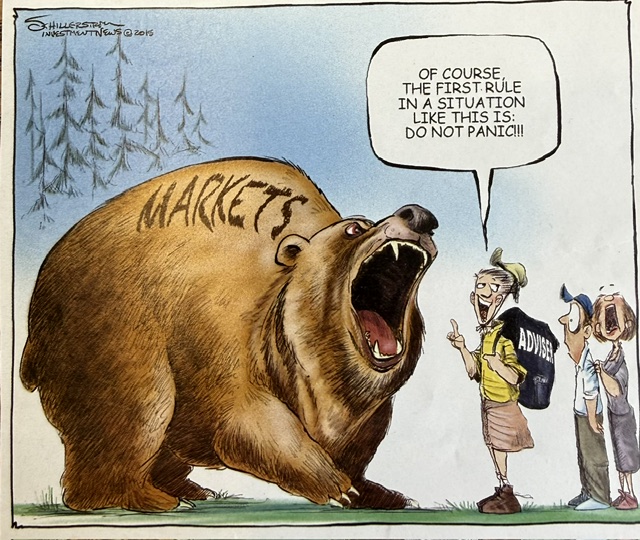
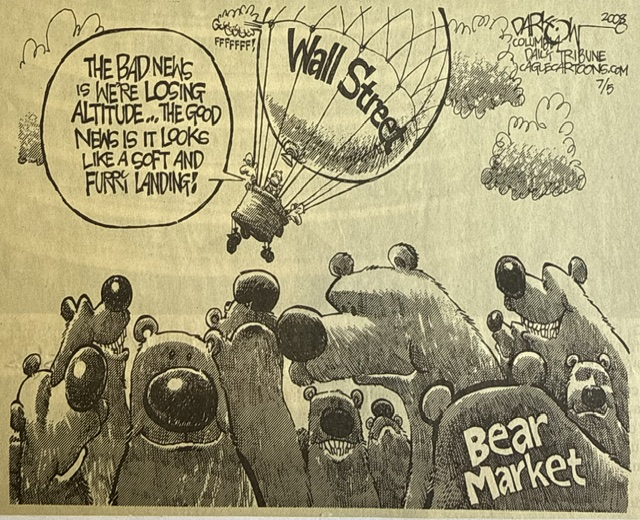
These decades-old cartoons underscore that human emotions – greed, fear, hope, and despair – remain the primary drivers of short-term market fluctuations. The negativity bias in media, the herd mentality in booms, and the panic in busts are not new phenomena; they are deeply ingrained aspects of collective investor psychology. Recognizing these biases in ourselves and in the broader market environment is crucial for making rational investment decisions, especially when market narratives become highly emotional.
The Importance of Diversification and Long-Term Perspective
The divergence between the Nasdaq’s brutal decline and the Dow’s relative resilience during the dot-com bust highlights the critical importance of diversification. Hiding out in "boring dividend-paying blue chips" was a sensible strategy then, and it remains a core tenet of prudent portfolio management today. Furthermore, the very existence of these comics, reflecting past market gyrations, reinforces the need for a long-term investment horizon. Market corrections are inevitable, but history consistently shows that well-diversified portfolios tend to recover and grow over extended periods.
The Role of Central Banks and Media
The comics featuring Alan Greenspan remind us of the immense influence central bank communications can have on market sentiment. While today’s Fed chairs may not command the same "celebrity" status, their words and actions continue to be meticulously dissected by market participants. Similarly, the media’s negativity bias continues to shape perceptions. Savvy investors learn to filter out the noise, focusing on factual reporting and long-term trends rather than sensational headlines that often exploit fear.
The Value of Historical Perspective and Community
Finally, this entire collection serves as a testament to the invaluable role of historical perspective and community engagement in finance. By looking back at how past market cycles were perceived and satirized, we gain a deeper appreciation for the cyclical nature of markets and the enduring patterns of human behavior. The reader’s dedication to collecting these pieces, and Ben Carlson’s willingness to share them, exemplifies how collective knowledge and historical artifacts can enrich financial education, making complex lessons accessible and memorable. The timeless humor embedded in these comics ensures that the lessons of the past resonate powerfully, offering guidance and a chuckle to generations of investors navigating the unpredictable currents of Wall Street.