The Trillion-Dollar Dilemma: Is the Artificial Intelligence Boom a Historic Bubble or the Ultimate Paradigm Shift?
Main Facts: The Great AI Overhang
In the intricate, high-stakes theater of modern global finance, the primary rule of thumb has long been that systemic market shocks rarely originate from where the crowd is staring. Financial history is littered with catastrophic disruptions that caught investors flat-footed precisely because the danger was obscured in plain sight. Yet, the current macroeconomic landscape defies this tradition. Today, the most glaring, universally acknowledged threat to market stability is no longer hidden in the shadows; it is blazing like a supernova at the very center of the financial universe: Artificial Intelligence (AI).
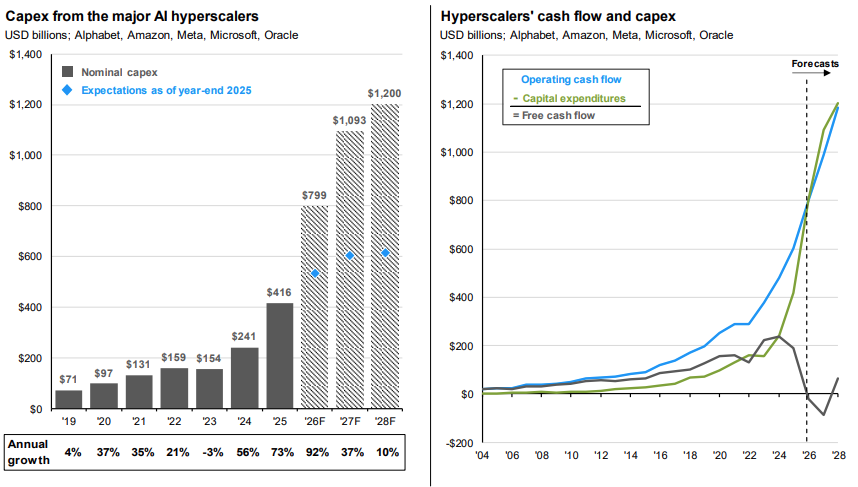
The modern AI buildout checks every historical box of a classic capital expenditure (capex) super-cycle destined to end in a sobering bust. A spiderweb of deeply interconnected hyperscalers—massive technology conglomerates bankrolling the infrastructure of the digital future—are pouring unprecedented sums of capital into chips, data centers, and power grids. Back-of-the-envelope calculations place the collective market capitalization of these primary players somewhere between $22 trillion and $25 trillion.
These firms are bound together by a complex lattice of cross-investments, supplier agreements, and strategic partnerships. In the vivid phrasing of industry observers, they have all jumped out of the aircraft holding hands, completely unburdened by parachutes. Driven by executives who openly declare that underinvesting poses an existential threat far greater than overspending, the tech elite are "all in."
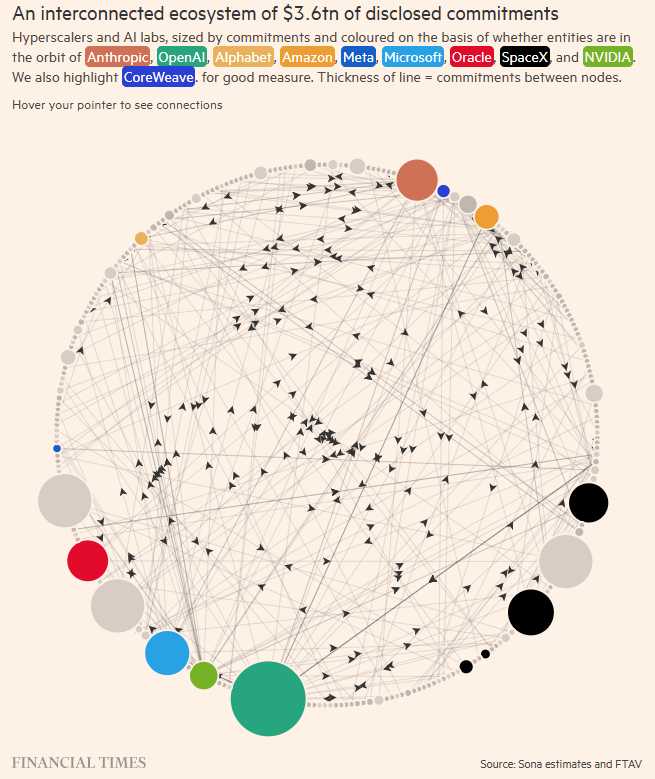
However, beneath the euphoria lies a mounting structural tension. What began as a capital expenditure binge funded entirely out of the massive, organic free cash flows of tech titans has evolved into something far more leveraged. As the sheer scale of the required investments outstrips even their staggering cash reserves, these hyperscalers have begun tapping the corporate bond market in earnest, introducing a new layer of systemic vulnerability.
Chronology: Tracing the Capex Cycle from Dot-Com to Deep Learning
To understand where the current AI trajectory may lead, financial historians and market strategists frequently look backward to find familiar structural blueprints.
The Historical Precedent of Capex Booms
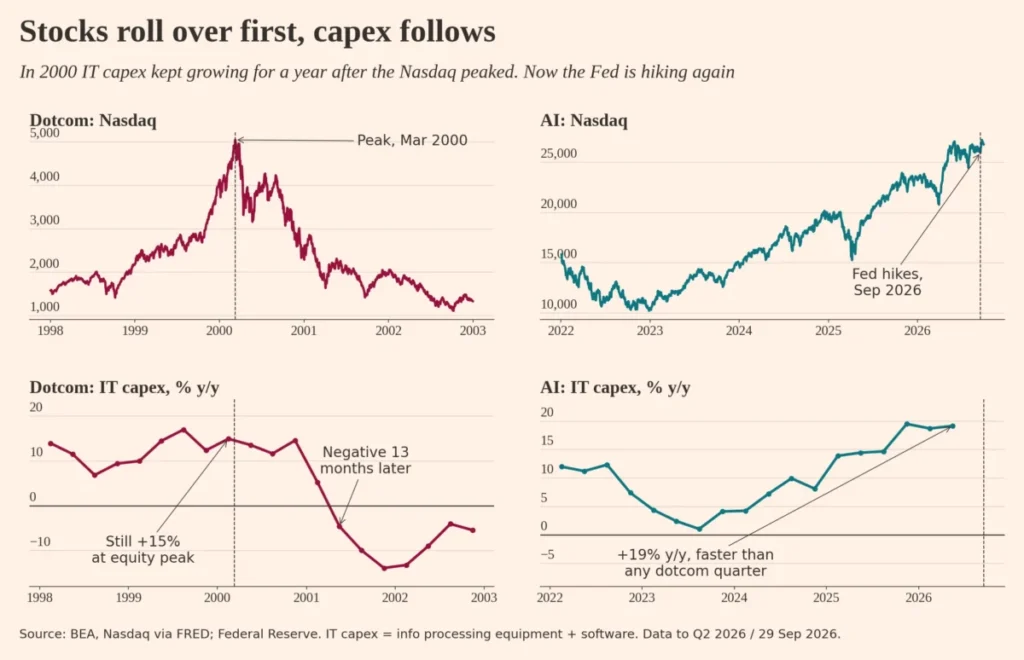
Historically, major technological revolutions follow a predictable psychological and financial arc. Whether examining the 19th-century railway mania or the late-1990s dot-com explosion, capital expenditure typically follows a lagging relationship with equity valuations. Data compiled by financial institutions illustrates a consistent chronological pattern: the broader stock market reliably peaks and begins its downward correction well before the underlying capex spending by corporations finally decelerates.
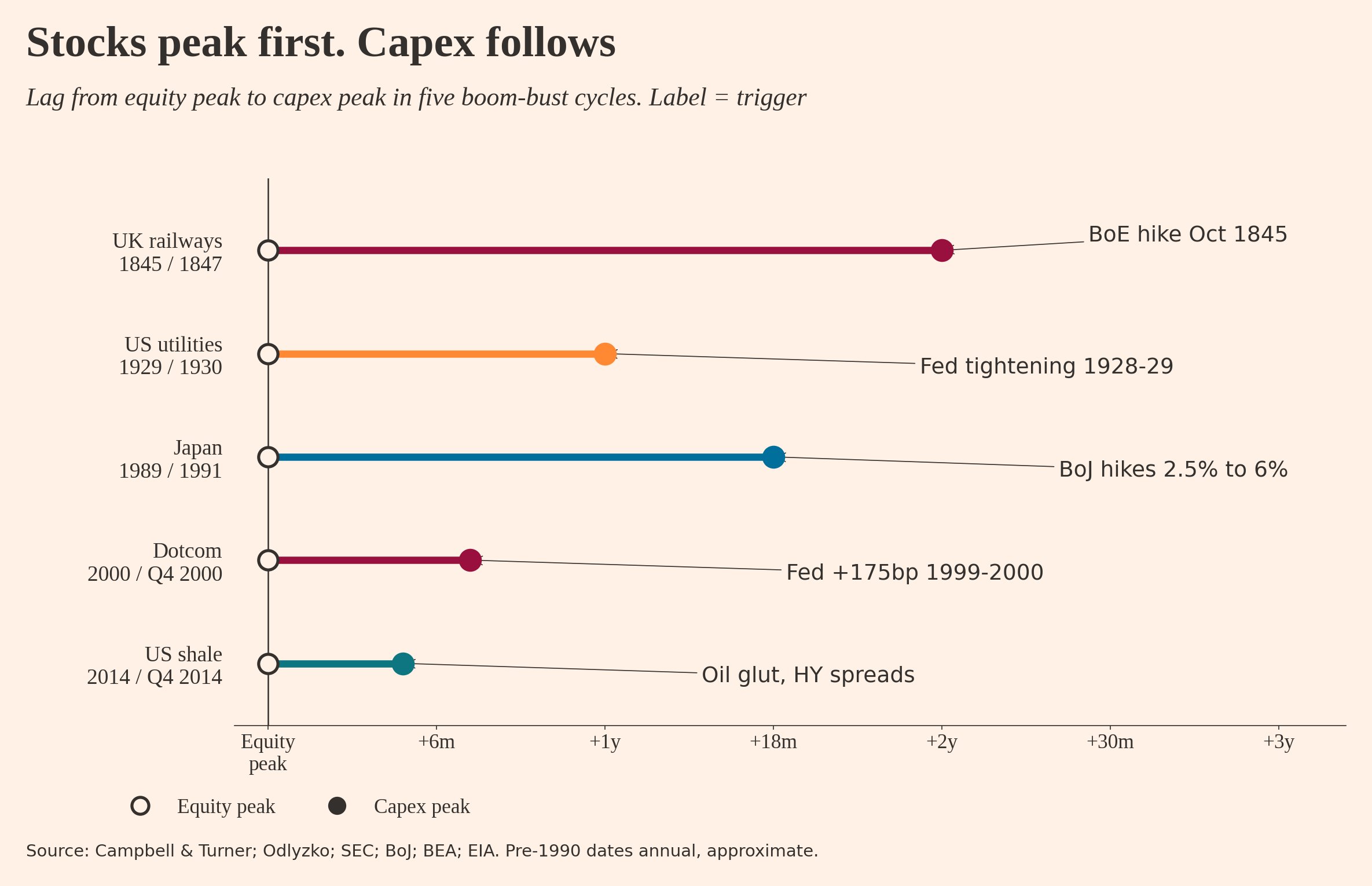
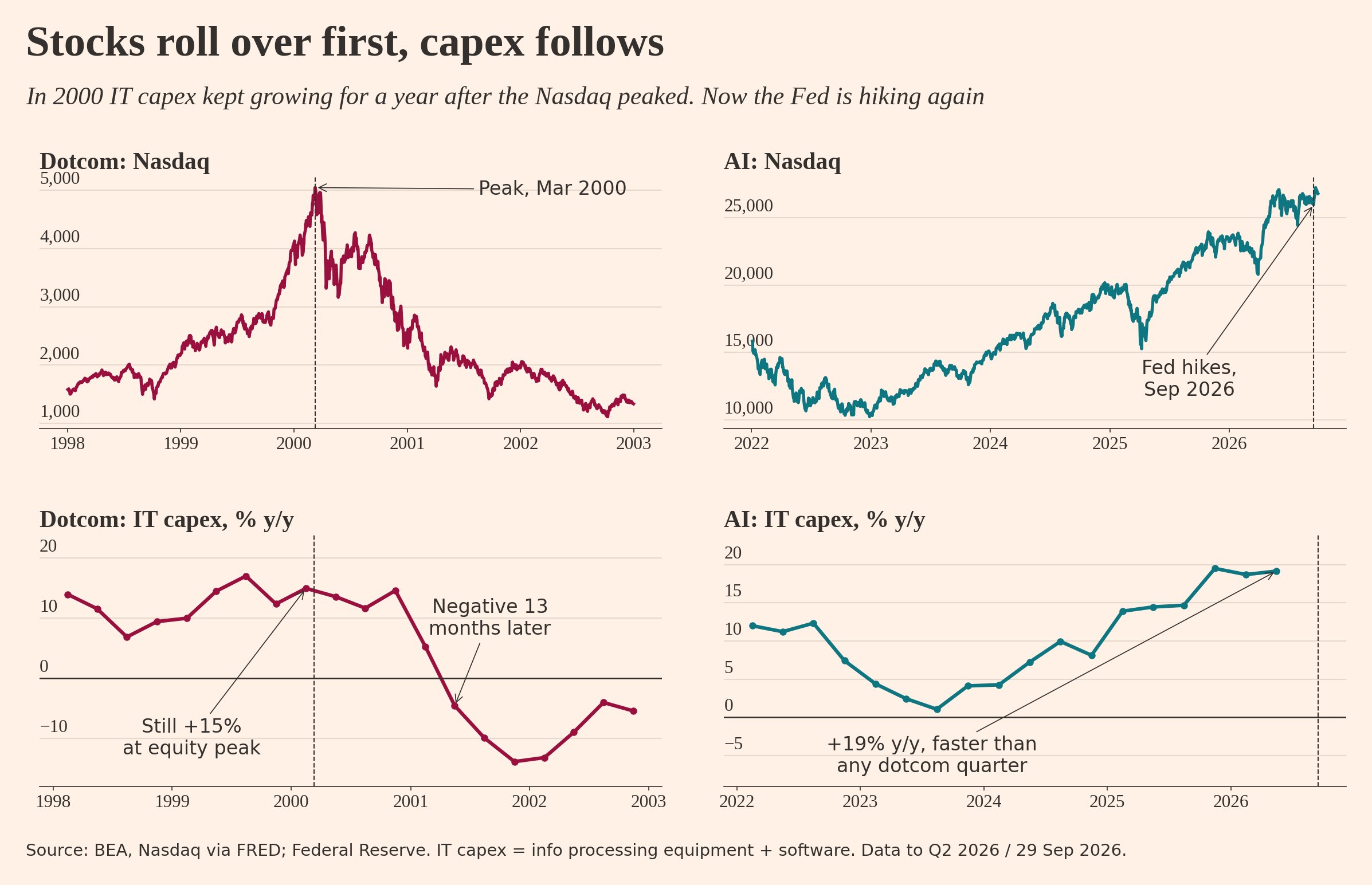
During the dot-com boom of the late 1990s, telecommunications and internet infrastructure spending surged dramatically, creating an optics of infinite growth. Even as equity markets began to buckle under the weight of stretched valuations and unrealized monetization, capital expenditure momentum continued chugging forward for months, creating a painful disconnect between corporate investments and market reality.
The Modern Parallels
Mapping the dot-com infrastructure buildout directly against today’s AI hardware acquisition cycle reveals an unsettling symmetry. The velocity at which data centers are being commissioned mirrors the laying of fiber-optic cables twenty-five years ago. Analysts note that while the technology and the addressable markets are profoundly different, human psychology remains remarkably constant. The market, acting as a forward-looking discounting mechanism rather than an omniscient oracle, may well peak long before the current AI spending frenzy reaches its natural exhaustion point.
Supporting Data: Concentration, Capital, and Credit
Data compiled by institutional giants such as JPMorgan Chase, Vanguard, and specialized equity research firms paints a stark picture of modern market concentration and debt accumulation.
Unprecedented Market Concentration
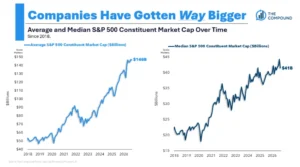
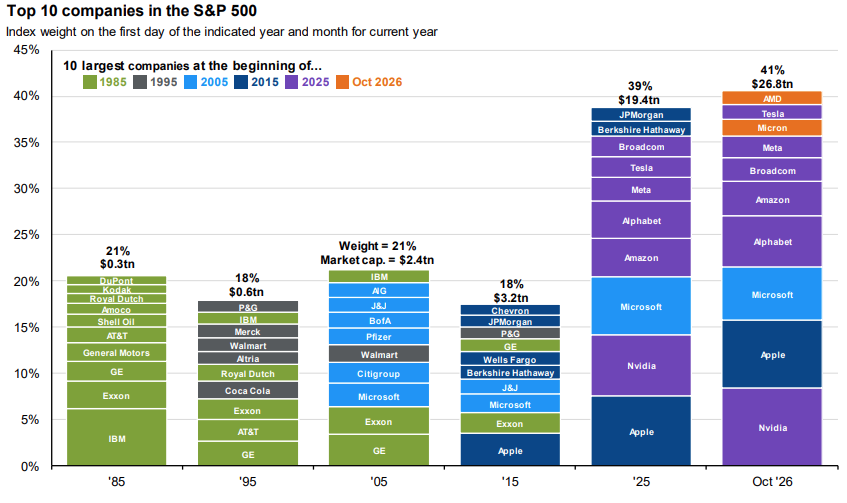
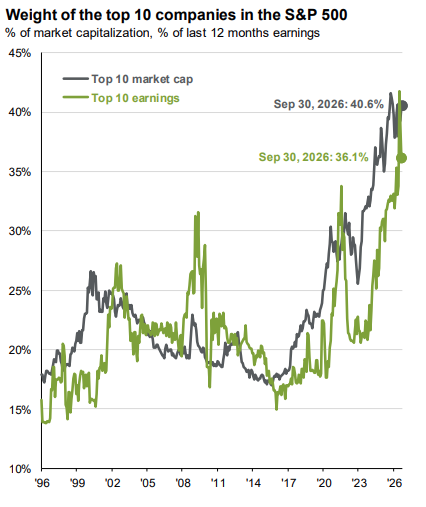
According to JPMorgan’s long-term market insights, the largest corporations in the S&P 500 currently command a share of total market capitalization that far exceeds anything seen over the past four decades. Furthermore, this concentration is not merely a phenomenon of valuation multiples; it is backed by earnings. The top ten companies in the S&P 500 account for an outsized majority of the index’s aggregate corporate profits.
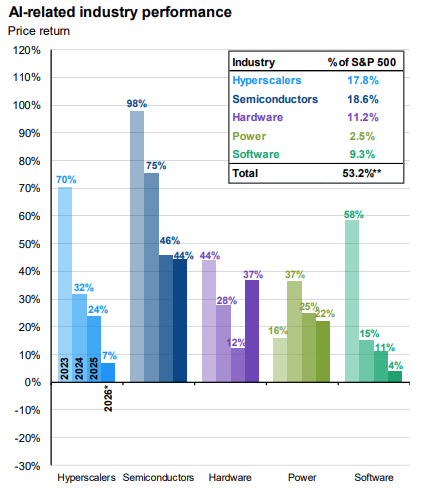
When categorized by exposure, AI-related stocks now form the dominant majority across multiple sectors of the S&P 500. This represents one of the most highly concentrated capital allocation bets in the history of global capitalism. Trillions of dollars are being deployed at a velocity that defies traditional corporate budgeting norms, making it exceptionally difficult for institutional investors to accurately model long-term return on invested capital (ROIC).
The Bond Market Influx
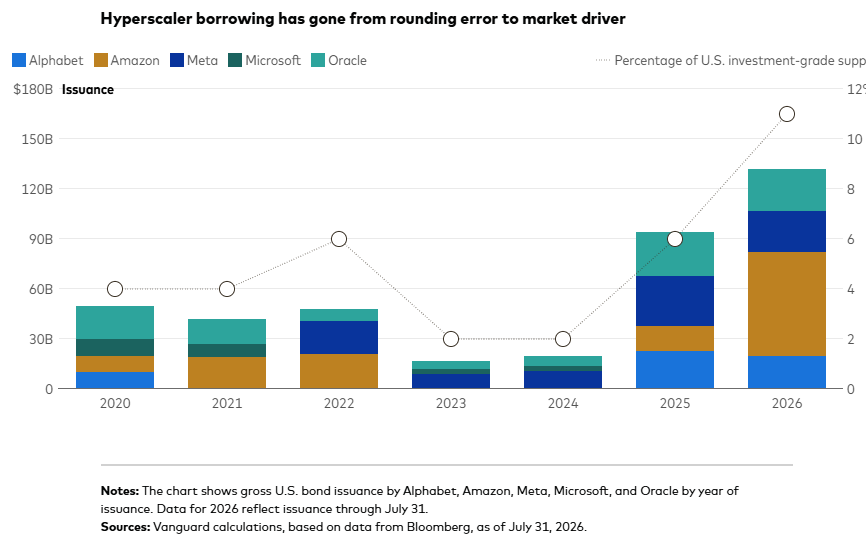
The funding mechanism behind this technological revolution is shifting. Vanguard’s fixed-income analysis reveals a noticeable uptick in corporate debt issuance by technology hyperscalers. As capital expenditure projections stretch into the hundreds of billions of dollars annually, these firms are increasingly turning to the debt markets.
The volume of tech-sector bond issuances is climbing rapidly as a percentage of overall corporate debt issuance. While these companies still maintain relatively pristine balance sheets compared to historical industrial borrowers, the sheer scale of the anticipated debt load introduces a new risk vector. If the anticipated productivity gains or revenue streams from enterprise AI fail to materialize at the scale promised by tech executives, servicing this newly minted debt could transform a tech-sector correction into a broader credit-market event.
Official Responses and Industry Perspectives: The Nvidia Paradox
Amidst the chorus of warnings from seasoned economists and risk managers, the response from within the technology sector—and select pockets of equity research—offers a fascinating counter-narrative.
The Nvidia Phenomenon
At the epicenter of the AI hardware ecosystem sits Nvidia, a company whose market capitalization has swelled to eclipse the entire national stock market valuations of numerous developed economies. By all conventional metrics of corporate history, a single hardware provider commanding such immense financial gravity should ring every alarm bell associated with speculative mania.
Yet, a closer examination of valuation metrics reveals a bizarre paradox. According to analysis from firms like Exhibit A, Nvidia’s forward Price-to-Earnings (P/E) ratio has actually compressed over recent quarters, sinking to some of the lowest levels seen this decade. Rather than out-of-control multiple expansion driven purely by speculative fervor, Nvidia’s blistering profit growth has consistently outstripped its soaring share price appreciation.
For market bulls, this fundamental reality is cited as definitive proof that the AI trade is fundamentally different from the dot-com bubble. In 1999, companies with zero revenues traded at astronomical multiples based on empty promises; today, the market leader is generating tens of billions of dollars in tangible, cash-backed net income.
The Divergence of Expert Opinion
Industry leaders maintain that underestimating the transformational potential of artificial intelligence is a far graver error than overpaying for compute power. Proponents argue that AI is a foundational general-purpose technology—comparable to the steam engine, electrification, or the internet—that will permanently elevate global productivity across healthcare, logistics, software development, and scientific research.
Conversely, risk-conscious market historians counter that even the most revolutionary technologies frequently suffer devastating financial crashes during their early adoption phases. The underlying utility of a technology does not insulate its early investors from the destructive consequences of overbuilding, overleveraging, and overpaying.
Implications: Navigating the Unknown
As investors, portfolio managers, and corporate strategists attempt to handicap the remainder of the decade, the implications of this trillion-dollar gamble are far-reaching.
Macroeconomic Vulnerability
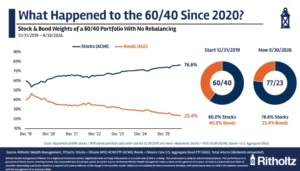
Because modern passive investing vehicles (such as cap-weighted index funds) are heavily front-loaded with these mega-cap AI beneficiaries, the average retail investor’s retirement portfolio is implicitly tied to the success or failure of the AI infrastructure buildout. A sharp repricing of these assets would trigger widespread wealth effects, impacting consumer confidence, corporate IT spending, and broader economic growth.
The Psychological Trap of History
In finance, relying too heavily on historical templates can be a dangerous trap. As legendary investor Warren Buffett famously observed, "If past history was all that is needed to play the game of money, the richest people would be librarians." Market cycles rhyme, but they rarely repeat verbatim. Technology is accelerating the velocity of financial innovation and market cycles faster than at any point in human history, suggesting that the resolution to the AI boom may play out in ways entirely unprecedented.
Furthermore, market psychology since the Great Financial Crisis of 2008 has been conditioned by trauma. Investors have spent nearly two decades obsessively asking, "What can go wrong next?" rarely pausing to seriously contemplate what might go right if technological productivity gains exceed even the most optimistic projections.
Conclusion: Embracing Intellectual Humility
Ultimately, the current market environment leaves macro analysts, value investors, and growth enthusiasts alike caught in a state of deep ambivalence. Standing on the podium to boldly declare that the AI bubble is moments away from catastrophic implosion feels just as reckless as pounding the table to claim this is a risk-free industrial revolution.
History suggests that when risks become this visible, the ultimate catalyst for change will likely emerge from an entirely unexpected quarter. For anyone attempting to navigate the complex crosscurrents of today’s equity markets, the most profound, intellectually honest, and necessary three words an investor can utter remain simple:
I don’t know.