The Illusion of Easy Wealth: Why "Buy-and-Hold" Stock Picking is Failing Modern Investors
September 25, 2026
By Ben Carlson (Adapted for Financial Journal)
Main Facts
The traditional financial adage claims that even a dart-throwing monkey could match or beat the success of a professional investor in the stock market. However, a deeper look at modern market mechanics reveals this to be a persistent myth.
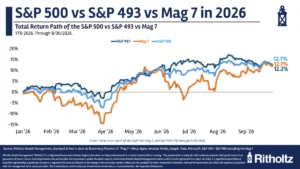
As the S&P 500 pushes forward with a solid year-to-date gain of over 13%, the underlying reality of individual equities tells a starkly contrasting story. The modern stock market is heavily bifurcated: it features a high slugging percentage driven by massive, outlier home-run stocks, balanced against a remarkably low batting average where the vast majority of individual companies lag far behind the broader index.
Recent data underscores this dramatic divergence. Only 35% of all S&P 500 stocks are currently outperforming the index in 2026. Four out of ten individual equities are negative for the year, and an alarming 25% of all S&P 500 corporations have suffered double-digit losses of 10% or worse.
Household-name brands have not been immune to this downward pressure. Major corporations have seen steep valuations cuts:
- Lululemon: -51%
- Nike: -42%
- Domino’s: -28%
- FedEx: -26%
- Netflix: -24%
Conversely, a select few high-flying mega-caps and tech giants have surged dramatically. Nineteen stocks within the index have doubled or more, led by eye-popping rallies in SanDisk (+665%), Dell (+341%), Intel (+232%), and CrowdStrike (+124%).
This extreme polarization has led financial analysts to question long-held conventions, raising a provocative question for retail and institutional investors alike: Is the foundational strategy of "buy-and-hold" stock picking fundamentally broken?
Chronology and Evolution of the Market Cycle
To understand how the market reached this point of extreme concentration, it is helpful to examine how win rates for individual stocks have shifted over the decades.
The Post-Dot-Com Era (Early 2000s)
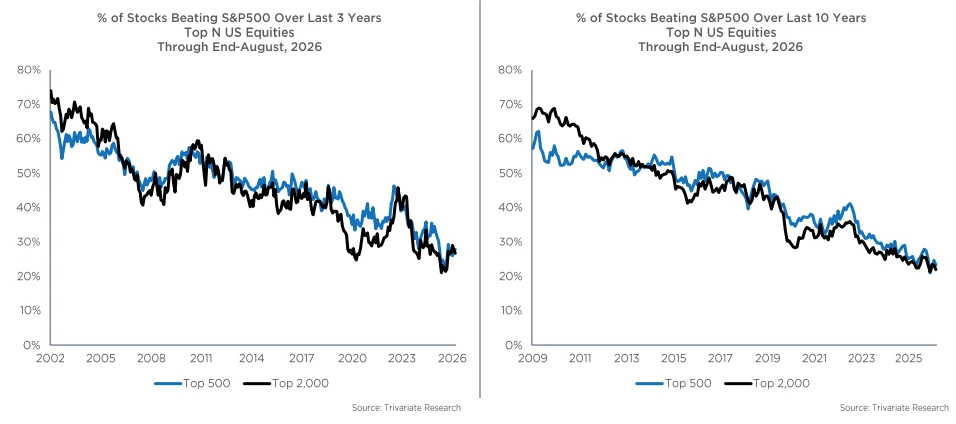
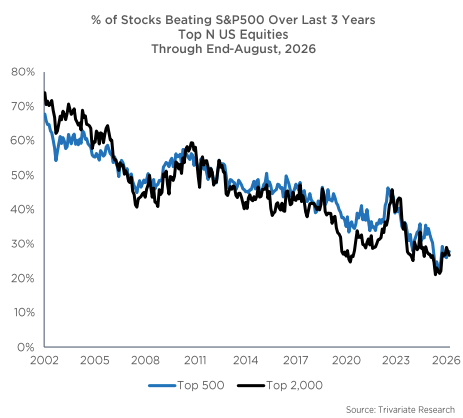
Following the collapse of the dot-com bubble in the early 2000s, the stock market operated under vastly different internal dynamics. During that cycle, individual stock win rates—the percentage of companies beating the broader index—hovered between 60% and 70%. Broad diversification and individual stock selection offered a reasonable probability of matching or exceeding benchmark indexes without requiring exposure to a handful of massive monopolies.
The Mid-2010s to COVID-19 Era
As global central banks maintained lower interest rates and technological disruption accelerated, capital began concentrating heavily in platform businesses and scalable software models. The "Magnificent Seven" and other mega-cap tech stocks began pulling away from the pack. The market transitioned from a broad-based economic barometer to a narrow index dominated by platform giants.
The 2026 Market Landscape
By late 2026, the divergence reached a historical inflection point. According to comprehensive multi-year data compiled by Trivariate Research, the probability of an individual stock beating the S&P 500 over extended timeframes has plummeted to historic lows. Rather than rewarding patient, diversified stock-picking, this market cycle has punished portfolios that deviate significantly from market-cap-weighted indexes.
Supporting Data and Research Analysis
A recent report by Adam Parker of Trivariate Research, provocatively titled "Buy-and-Hold Doesn’t Work," lays bare the mathematical reality facing modern retail and institutional investors. Parker examined the historical performance of stocks in the S&P 500 and the broader top 2,000 U.S. equities over 1-, 3-, and 10-year horizons.
The Multi-Year Win Rate Crisis
- 10-Year Horizon: A mere 23% of all stocks managed to beat the S&P 500 over the past decade.
- 3-Year Horizon: Performance metrics over the last three years show similarly bleak outcomes, validating that the struggle to outperform is structural rather than cyclical.
- 1-Year Horizon: Curiously, it has statistically been easier to outperform the benchmark index over a single-year timeframe than across 3- or 10-year periods, largely due to transient sector rotations and momentum bursts.
The Widening Performance Chasm
The spread between winning and losing stocks is currently wider than at any point in modern financial history.
- Over 3 Years: Underperforming stocks lagged the index by an average of 62%, while winning stocks massively outperformed by an average of over 100%.
- Over 10 Years: The wealth destruction among losers is severe, with underperforming equities trailing the index by an average of 205%. Meanwhile, the long-term winners have generated astonishing outperformance, averaging 600% above the benchmark.
In baseball terms, the stock market exhibits a low batting average coupled with an exceptional slugging percentage. There are countless strikeouts and very few home runs—but those home runs are grand slams that distort the average return of the entire ecosystem.
Expert Perspectives and Industry Responses
The structural shift in market mechanics has triggered intense debates among professional fund managers, behavioral finance experts, and market commentators.
The Death of Active Management?
Active managers have historically claimed that market inefficiencies provide opportunities to generate alpha by picking undervalued individual companies. However, the 2026 market environment has proven to be one of the most punishing eras on record for active stock pickers.
When a small basket of mega-cap tech stocks drives the lion’s share of market returns, active managers who underweight these giants—or seek value in cyclical, small-cap, or mid-cap sectors—inevitably underperform. If a fund manager’s portfolio diverges meaningfully from a market-cap-weighted index, their career risk multiplies. Ironically, while professional active managers struggle, individual investors willing to embrace strict index investing or targeted momentum strategies have often found cleaner paths to success.
First-Level vs. Second-Level Thinking
Legendary investor Howard Marks famously distinguished between two types of market participants:
- First-level thinkers look at the surface: "This is a great company with products I use every day; let’s buy the stock."
- Second-level thinkers dig deeper: "This is a great company, but everyone already knows it’s great. The expectations are overly priced in, making the stock overvalued; let’s sell."
For much of the current bull market, however, first-level thinking has dominated and won. Investors who simply bought recognizable tech leaders—such as Apple, Tesla, Google, Microsoft, Meta, and Nvidia—and held on through volatility were handsomely rewarded. Complex second-level valuations were unnecessary because momentum and capital flows continually validated simplistic buy-and-hold theses for the largest players.
Broad Implications for Investors
The realization that buy-and-hold stock picking is a low-probability exercise carries profound consequences for retirement planning, wealth management philosophy, and portfolio construction.
1. The Fallacy of "Safe" Stock Picking
Many retail investors assume that buying shares of stable, well-known blue-chip companies—such as Nike or FedEx—is a conservative strategy. The 2026 data shatters this illusion. Double-digit losses in household-name corporations demonstrate that business success does not automatically translate into equity outperformance if valuation, margins, or consumer trends shift.
2. The Triumph of Passive Indexing
The primary advantage of owning a low-cost, market-cap-weighted index fund (like an S&P 500 ETF) is that it completely removes the burden of stock selection. In an index fund, the investor automatically captures the multi-hundred-percent gains of outliers like Nvidia and SanDisk, while the losses of underperforming companies like Lululemon or regional brick-and-mortar brands are diluted into insignificance. The winners in a diversified basket more than compensate for the losers.
3. The Need for Adaptability
While mega-cap concentration has ruled the roost for much of the 21st century, financial history teaches that market leadership is cyclical. Concentration inevitably wans. At some point, the baton will pass to different sectors, small-cap stocks, or international markets.
Until that structural rotation occurs, investors face a stark choice: adopt a disciplined, passive indexing approach to capture market averages effortlessly, or engage in active, tactical momentum management. Attempting casual, passive buy-and-hold stock picking in individual equities remains a low-probability gamble where the odds are heavily stacked against the unprepared participant.