The Strait of Fire: Regional Conflict Escalates as Iran Defines ‘Red Lines’ Amid U.S. Military Campaign
By Global News Desk
The precarious stability of the Middle East has shattered, with the region spiraling into what many analysts are calling an "existential war" between the United States and the Islamic Republic of Iran. On Thursday, tensions reached a fever pitch as Tehran declared the Strait of Hormuz an inviolable "red line," vowing that any further U.S. aggression against its domestic infrastructure would trigger a systematic campaign to dismantle energy and logistical infrastructure across the entire Gulf region.
As U.S. naval forces enforce a blockade aimed at forcibly reopening the critical waterway, the conflict has widened beyond Iran’s borders. With strikes hitting bases in Kuwait and Jordan and reports of aerial threats over Bahrain, the shadow of a wider, full-scale regional war has moved from a remote possibility to a looming, daily reality.
Chronology: A Week of Rapid Escalation
The current conflagration is the result of a month-long breakdown in diplomatic efforts, culminating in a series of events that have reshaped the geopolitical landscape of the Persian Gulf.
- Last Saturday: Following the collapse of a fragile truce, Iran unilaterally closed the Strait of Hormuz, effectively halting the flow of approximately 20% of the world’s oil and gas.
- Tuesday: President Donald Trump issued a stern ultimatum, threatening to strike Iranian power grids, bridges, and critical infrastructure if Tehran did not immediately return to the negotiating table.
- Wednesday Night: For the fifth consecutive night, U.S. forces launched intensive airstrikes against Iranian military positions. Simultaneously, Washington re-imposed a strict naval blockade of Iranian ports, citing the necessity of restoring maritime passage through the Strait.
- Thursday Morning: The conflict spilled into neighboring territories. Iranian forces launched ballistic missile strikes against the Al Azraq Air Base in Jordan, while Revolutionary Guard units reported the destruction of satellite communication centers and radar installations at the Ali Al Salem Air Base and the Al Shuaiba military pier in Kuwait. Bahraini defense systems reported the interception of multiple incoming aerial threats.
The Strategic Battle for the Strait
At the heart of the crisis lies the Strait of Hormuz, a narrow maritime chokepoint that serves as the world’s most vital energy artery. For the U.S., the mission is clear: break the blockade to ensure the security of global energy supplies. For Iran, the strait represents a defensive lever of ultimate importance.
Brigadier General Mohammad Akraminia, the Iranian army spokesman, dismissed the efficacy of the U.S. naval campaign on Thursday. "The Americans thought that by attacking some of our bases on the southern coasts, they could take control of this strategic strait," Akraminia stated. "However, the Islamic Republic of Iran has the ability to exert control over the Strait of Hormuz from every single point of its territory; this is never dependent on coasts or islands alone."
Three U.S. officials, speaking on condition of anonymity, confirmed that the current strikes are designed not only to clear the waterway but to systematically degrade Iran’s military capabilities—specifically, its anti-ship missile batteries and drone infrastructure—before any potential, more complex amphibious or aerial operations can be mounted.
Despite the U.S. pressure, Tehran remains defiant. Mohammad Baqer Qalibaf, Iran’s lead negotiator, characterized the situation in stark, binary terms: "We are in an essential and existential war with America." Iran has reiterated that the only path to reopening the strait is U.S. compliance with a 14-point memorandum of understanding signed in June, which includes the implementation of "Iranian regulations" governing ship traffic.
The Infrastructure Ultimatum and Regional Spillover
The threat issued by President Trump regarding the destruction of Iran’s power plants and critical infrastructure has introduced a new, dangerous variable into the conflict. Tehran’s response was immediate and bellicose.
General Akraminia warned that if these threats are executed, Iran will retaliate by striking "all remaining infrastructure" across the Gulf states. This warning is not merely rhetorical; the strikes on Jordan, Kuwait, and Bahrain demonstrate that Iran is prepared to view regional nations hosting U.S. forces as active participants in the war.
"Our neighbors should know that providing a base to the Americans and allowing them to fire on Iranian soil is unacceptable and will not go unanswered," the Iranian military said in a formal statement. This warning has placed regional governments in an impossible position: maintain their security alliances with Washington and risk direct bombardment, or risk the wrath of the U.S. by closing their doors to American military assets.
Implications: A Global Energy and Humanitarian Crisis
The economic implications of this conflict are staggering. With the Strait of Hormuz shuttered and the possibility that the conflict could expand to the Bab el-Mandeb gateway in the Red Sea—where Iranian-backed Houthi forces have been signaled to potentially initiate their own blockade—the world faces an unprecedented energy security crisis.
Humanitarian Toll
Beyond the boardrooms and military command centers, the human cost is mounting. Thousands have already perished in the fighting, and millions have been displaced. The humanitarian situation is particularly dire in Iran and Lebanon, where the conflict has reignited a fierce war between Israel and Hezbollah, creating a multi-front theater of violence that has strained the resources of international aid organizations to their breaking point.
The Specter of Total War
Military analysts are increasingly concerned that the "tit-for-tat" nature of the current exchange is reaching a point of no return. The targeting of airbases in Jordan and Kuwait suggests that the conflict is no longer confined to the Iranian mainland or the immediate maritime zone.
"We are seeing the erosion of the ‘containment’ strategy," says one regional defense analyst. "When you begin hitting early-warning radars and satellite communication hubs, you are moving toward a ‘decapitation’ style of warfare. Once that threshold is crossed, the logic of de-escalation becomes much harder to sell to the public."
Official Responses and Diplomatic Outlook
As of Thursday afternoon, the White House has remained tight-lipped regarding the specific response to the strikes in Jordan and Kuwait, though officials have emphasized that the U.S. remains committed to the "freedom of navigation" in the region.
In Tehran, the mood is one of total mobilization. The Iranian military has stated it will "resist until the end" to neutralize American interventions. Diplomatic channels, which were already fragile, appear to be effectively frozen. Without a mediator capable of bridging the chasm between the 14-point memorandum demanded by Iran and the U.S. demand for the unconditional reopening of the strait, the cycle of violence is likely to intensify.
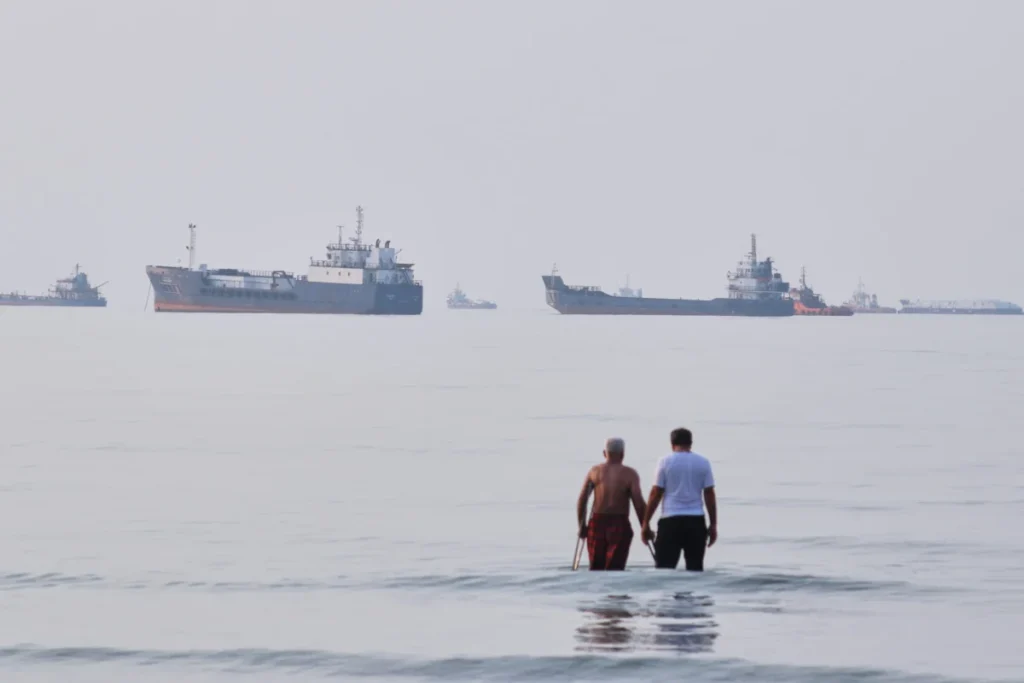
The photograph circulating in international media—depicting men wading in the shallow waters of the Strait of Hormuz with anchored vessels standing silent in the background—serves as a grim reminder of the status quo. The world’s economy is currently anchored in a zone of conflict, and as the regional infrastructure comes under fire, the global community waits with bated breath to see if the "red line" drawn by Tehran will be the final barrier before a total, catastrophic collapse of regional stability.
As the war enters its sixth day, the international community faces a sobering reality: the days of limited, surgical interventions appear to be over. The region is now bracing for a protracted struggle that may redefine the power dynamics of the 21st century.