The Sheinbaum Paradox: Two Years of Deference Disguised as Diplomatic Mastery
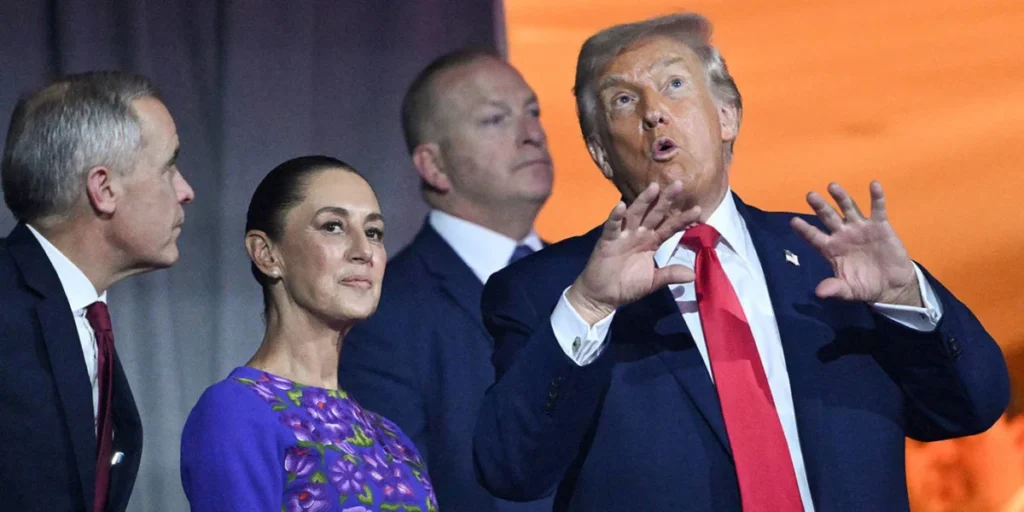
MEXICO CITY — As October 1, 2026, marks the conclusion of the second year of Mexican President Claudia Sheinbaum’s six-year term, a stark dichotomy defines her administration. Domestically and internationally, Sheinbaum is frequently lauded by diplomats, pundits, and political strategists for her seemingly unflappable management of relations with United States President Donald Trump. Yet, a closer examination of her bilateral statecraft reveals a complex reality: Sheinbaum has skillfully—and at times cynically—masked a profound policy capitulation behind a facade of nationalist rhetoric and diplomatic poise, effectively deferring to Washington on nearly every major issue.
While her international image remains burnished by her ability to avoid open geopolitical warfare with the White House, the view from within Mexico’s borders is far less forgiving. Her economic stewardship has yielded lackluster results, her administration’s approach to security and cartel violence remains mired in policy contradictions, and her institutional consolidation is increasingly viewed by legal scholars and civil society as a calculated march toward authoritarianism.
1. Main Facts: The Anatomy of a Dual Reality
The central narrative of Claudia Sheinbaum’s mid-term presidency rests on the tension between her external perception and internal performance.
- The U.S.–Mexico Dynamic: Facing an aggressive and transactional trade and immigration policy from Washington under Donald Trump, Sheinbaum has consistently chosen appeasement over confrontation. While maintaining public rhetoric that champions Mexican sovereignty, her administration has quietly acceded to stringent U.S. demands regarding border enforcement, tariff threats, and security cooperation.
- Domestic Economic Stagnation: Despite inheriting the social programs and populist momentum of her predecessor, Andrés Manuel López Obrador (AMLO), Sheinbaum has failed to stimulate meaningful economic growth. Gross Domestic Product (GDP) metrics remain sluggish, private investment has slowed due to regulatory uncertainty, and inflation continues to erode the purchasing power of the average Mexican worker.
- Security and the Rule of Law: Cartel dominance persists across large swaths of Mexican territory. Despite high-profile arrests and heavily publicized military deployments, the government’s security strategy lacks a coherent judicial framework, relying instead on militarized policing that has failed to dismantle the financial and operational infrastructure of organized crime.
- Democratic Backsliding: Under the banner of institutional "transformation," Sheinbaum has continued and deepened constitutional reforms that weaken independent regulatory bodies, subordinate the judiciary to the executive branch, and concentrate unchecked power within the ruling party, Morena.
2. Chronology: Two Years of Turning Points
To understand how Sheinbaum arrived at this critical juncture at the close of her second year, one must trace the trajectory of pivotal decisions and external pressures that have shaped her administration since October 2024.
Late 2024: The Transition and the Trump Factor
- October 1, 2024: Claudia Sheinbaum takes the oath of office, becoming Mexico’s first female president. She inherits a deeply polarized nation, an expansive constitutional reform package already in motion from the outgoing López Obrador administration, and the impending shadow of a newly elected Donald Trump in the United States.
- November–December 2024: Following Trump’s electoral victory, markets panic over threatened across-the-board tariffs. Sheinbaum initiates high-stakes backchannel communications, signaling a willingness to cooperate extensively on immigration containment to avert immediate trade penalties.
2025: Managing Crises and Consolidating Power
- March 2025: Facing intense pressure from Washington over fentanyl trafficking and border crossings, Sheinbaum deploys additional National Guard units to the northern and southern borders. While framed domestically as a sovereign security measure, intelligence leaks confirm the deployment was direct response to U.S. ultimatums.
- July 2025: The Mexican Congress, dominated by Morena and its allies, passes a series of controversial judicial overhauls initiated under AMLO but finalized under Sheinbaum. The reforms mandate the popular election of all federal judges, drawing sharp rebukes from international legal associations and economic partners who warn of compromised legal certainty.
- November 2025: Economic indicators for the third quarter confirm a prolonged stagnation period. Former Finance Minister Guillermo Ortiz and other independent economists publish damning analyses showing that per capita income has effectively plateaued, contradicting official administration claims of shared prosperity.
2026: The Mid-Term Realities
- March 2026: Bilateral tensions flare up regarding energy provisions under the United States-Mexico-Canada Agreement (USMCA). Sheinbaum’s administration quietly caves to U.S. demands regarding private energy arbitration panels, avoiding a formal trade dispute while sacrificing nationalistic energy rhetoric.
- September 2026: As the country approaches the two-year mark, violent clashes between rival cartels in central and northern states expose the limitations of the government’s "abos, no balazos" (hugs, not bullets) security philosophy, even as modified under Sheinbaum. Public discontent simmers beneath the surface of high presidential approval ratings.
3. Supporting Data and Economic Indicators
The disparity between Sheinbaum’s political insulation and Mexico’s objective structural challenges is starkly illustrated by empirical data compiled over the past 24 months.
Economic Performance Metrics
According to macroeconomic assessments by financial institutions and independent analysts like Guillermo Ortiz:
- GDP Growth: Projected growth for 2026 hovers near a mediocre 1.2% to 1.5%, significantly lower than the targets required to generate formal employment for the hundreds of youth entering the labor market annually.
- Private Investment: Gross fixed investment has contracted by approximately 3.4% year-over-year, largely driven by investor anxiety over judicial unpredictability and constitutional amendments that erode protections for foreign capital.
- Fiscal Deficit: The fiscal deficit inherited from the final years of the López Obrador administration remains stubbornly high, limiting Sheinbaum’s ability to finance infrastructure or expand social safety nets without risking credit downgrades.
Security and Institutional Metrics
- Homicide Rates: While showing marginal declines in specific urban pockets, national homicide rates remain near historic highs, with organized crime maintaining territorial control over roughly 30% to 40% of municipal jurisdictions.
- Judicial Independence: Freedom House and the World Justice Project report precipitous drops in Mexico’s Rule of Law Index rankings, citing the elimination of autonomous oversight bodies and the politicization of the judicial branch.
4. Official Responses and Institutional Perspectives
The divergence in how Sheinbaum’s administration is perceived is nowhere more apparent than in the contrasting statements of government officials, international observers, and domestic critics.
The Administration’s Defense
From the podium at the Palacio Nacional, President Sheinbaum and her cabinet consistently project an image of strength, sovereignty, and steady progress.
"Mexico is a free, independent, and sovereign nation that negotiates with all international partners on equal footing," Sheinbaum stated during a recent press briefing. "Our relationship with the United States is built on mutual respect and cooperation, not subordination. At the same time, our economic model continues to prioritize the well-being of the working class over the privileges of a select few."
Administration defenders point to sustained social spending, minimum wage increases, and the maintenance of social stability as proof of the government’s success. Regarding security, officials emphasize that structural change takes time and that addressing the root causes of poverty is the only sustainable path to lasting peace.
The Critics’ Counter-Perspective
Conversely, opposition leaders, economists, and human rights advocates argue that Sheinbaum’s administration represents a dangerous continuity of democratic erosion masked by a more technocratic and polished personal style.
Guillermo Ortiz and other policy experts argue that the government’s public relations triumph in handling Donald Trump is essentially a smoke-screen.
- "President Sheinbaum has mastered the art of semantic defiance," notes a senior political analyst in Mexico City who spoke on the condition of anonymity. "In public, she invokes national dignity and the legacy of Juárez. In private, whenever Washington exerts pressure on trade or migration, her administration folds almost immediately. It is pragmatic, yes, but it is deeply cynical because it preserves her political capital at home while quietly surrendering policy autonomy."
5. Implications: Whither Mexico’s Democratic Future?
As Claudia Sheinbaum crosses the threshold into the second half of her first presidential term, the long-term implications of her governance style extend far beyond her personal approval ratings.
Geopolitical Subordination
The persistent pattern of deferring to U.S. demands while projecting domestic defiance creates a fragile equilibrium. While it averts immediate economic shocks—such as devastating unilateral tariffs from Washington—it establishes a precedent of reactive compliance. Should future geopolitical crises erupt, Mexico’s negotiating leverage may be permanently degraded.
The Drift Toward Hegemonic Authoritarianism
Domestically, the consolidation of political power within the executive branch, combined with the neutering of autonomous regulatory agencies and the transformation of the judiciary, poses an existential threat to Mexico’s pluralistic democracy. Without institutional counterweights, the line between a dominant-party democracy and a soft authoritarian regime continues to blur.
Economic Vulnerability
By failing to address the fundamental structural bottlenecks holding back private investment and productivity, Sheinbaum risks locking Mexico into a prolonged cycle of low growth. The demographic dividend of a young workforce is being squandered amidst a business climate paralyzed by legal uncertainty and fiscal strain.
Conclusion
Two years into her historic presidency, Claudia Sheinbaum remains a political enigma. She has successfully navigated the treacherous waters of Trump-era diplomacy without suffering catastrophic bilateral fractures, winning the admiration of international observers who feared a complete diplomatic breakdown. Yet, this superficial triumph obscures a troubling domestic reality: an economy underperforming, security policies yielding diminishing returns, and democratic guardrails systematically dismantled. For Sheinbaum, the challenge of the next four years will not be how convincingly she can play the role of the defiant nationalist to domestic audiences, but whether she can arrest Mexico’s slide into institutional decay and economic stagnation before the contradictions of her governance catch up with her.