The Physical AI Revolution: How Gritt Is Automating the Global Solar Build-Out
As the world pivots toward renewable energy to combat climate change, a massive logistical bottleneck has emerged: the physical labor required to construct the infrastructure of the future. While global capital is flowing into solar arrays and battery storage, the construction industry faces a chronic, debilitating labor shortage. Now, a Carnegie Mellon-born startup named Gritt is stepping into the fray, betting that the next generation of artificial intelligence can solve the "dirty, dull, and dangerous" challenges that have long stymied industrial robotics.
The Collision of Infrastructure and Intelligence
For decades, the promise of industrial robotics was confined to the controlled, predictable environments of factory floors. In these "structured" settings, machines could perform repetitive tasks with pinpoint accuracy because every variable—the lighting, the positioning of parts, the floor surface—was rigidly defined.
Construction sites, by contrast, are chaotic. They are outdoor environments subject to shifting weather, uneven terrain, and unpredictable supply chain arrivals. Historically, robots simply could not handle this volatility. However, the advent of sophisticated generative AI models has fundamentally altered the paradigm.
Gritt, founded by Carnegie Mellon-trained roboticists CEO Puneet Puri and CTO Vishal Dugar, aims to turn this technological shift into an engine for rapid infrastructure development. The startup officially exited stealth mode this Tuesday, announcing a $26 million Series A funding round led by Obvious Ventures, with participation from Union Square Ventures and Active Impact Investment. This injection of capital brings the company’s total funding to $34 million, setting the stage for an aggressive scaling phase.
Chronology: From Concept to Construction Site
The story of Gritt began with a realization that the speed of the global energy transition is tethered to the pace of human construction.
- The Foundational Phase: Puri and Dugar, leveraging their backgrounds in robotics, recognized that the bottleneck wasn’t just a lack of interest in solar; it was the lack of scalability in physical installation. They secured initial seed funding from First Round Capital, Climactic, Congruent Ventures, and VSC Ventures to develop an intelligent software layer for heavy machinery.
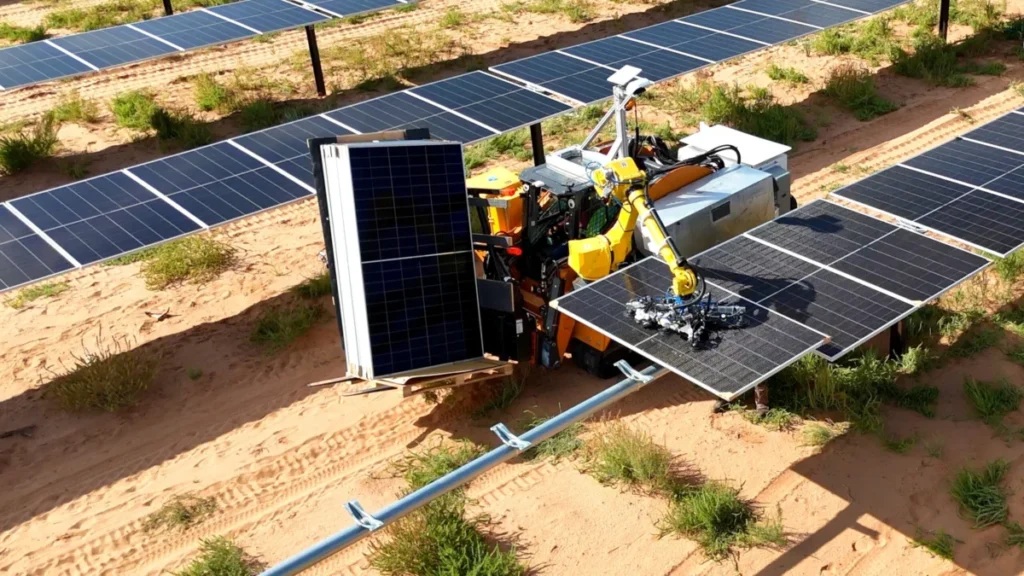
- The Pivot to Off-the-Shelf Hardware: Rather than spending years and millions of dollars designing proprietary robots, Gritt made a strategic decision to utilize existing, battle-tested industrial hardware. By integrating their AI models with rented skidders and robotic arms from established manufacturers like Kawasaki, they bypassed the "hardware hell" that plagues many robotics startups.
- Initial Deployments: The company transitioned from simulation to field trials. Their first objective: the heavy lifting of glass solar panels. The system was designed to unload panels, navigate to the mounting frames, and position them with sub-millimeter accuracy, allowing human workers to focus on the final, safer fastening tasks.
- The Series A Milestone: Following successful field testing and the establishment of a robust, scalable software architecture, Gritt secured its $26 million Series A. This funding signals a transition from R&D to mass deployment, with the company aiming to operate 48 systems within the next six months.
Supporting Data: Efficiency at Scale
The productivity gap between traditional crews and robot-augmented crews is stark. In a standard setup, an eight-person crew typically installs approximately 800 solar panels in a single workday. When equipped with Gritt’s robotic systems, that same crew can scale their output to between 3,000 and 4,000 panels per day—a nearly four-to-fivefold increase in efficiency.
This performance has caught the attention of industry giants. Gritt currently reports that it is under contract to assist in the installation of 2.8 gigawatts of solar capacity over the next 18 months. Their client list already includes three of the top 10 power construction firms in the United States.
The economic and safety data further validates the approach. By automating the most physically taxing part of the process—lifting 100-pound panels repeatedly—the system drastically reduces the potential for musculoskeletal injuries and fatigue-related accidents. For remote sites where attracting labor is a constant struggle, the robots provide a reliable, tireless alternative that can operate under conditions that might deter human crews.
Official Responses and Strategic Vision
Andrew Beebe, a partner at Obvious Ventures who spearheaded the Series A investment, frames Gritt’s success as a matter of "right-place, right-time" engineering.
"There are people who used to build rockets that went into space and had an infinite budget for the smallest little part, and then there are people who know what it means to get into dirty, dull, and dangerous jobs and scale them like mad," Beebe said. "These guys are in the second camp, and that’s a special kind of entrepreneur that has the technical chops, the AI, and the machine vision skills to make it work."
Puneet Puri, Gritt’s CEO, emphasizes that the startup’s goal is not to replace the human worker but to catalyze the entire civilization’s building capacity. "Our thesis is that if we truly want to speed up construction, you need an intelligence which can work in the outdoor, chaotic environments of these construction sites, and it has to be generalizable enough that it can work in these varied environments," Puri told TechCrunch.
Puri points to the rapid learning curve of their AI as a key differentiator. "Making a system for one solution was still possible five years ago," he noted. "But AI is now making that work generalizable." He illustrates this with a compelling example: while training a system to stack cinder blocks previously took weeks, the same software, leveraging the underlying AI pipeline, learned to tie rebar in just a single day.
Implications for the Industry and Beyond
Gritt’s emergence highlights a broader shift in the construction technology (ConTech) landscape. By competing against specialized, hardware-centric companies like Luminous Robotics, Cosmic, and China’s Trinabot, Gritt is taking a "software-defined" approach. This strategy could allow them to iterate faster and maintain a leaner cost structure, as they aren’t bogged down by the complexities of manufacturing their own robotic chassis.
Beyond Solar: A New "Physical AI" Layer
The long-term vision for Gritt extends far beyond solar panel installation. The founders intend to expand the system’s capabilities to include drilling, rack-building, and eventually, highly complex tasks like rebar tying for concrete foundations.
However, the most profound implication may be the integration of "site intelligence." Because the robots are equipped with an array of sensors and advanced machine vision, they effectively serve as the "eyes and ears" of the construction site. The company envisions a future where these systems act as site managers, flagging missing inventory, detecting hazards like open trenches before a storm hits, or monitoring project progress in real-time.
As Puri explains, "Gritt becomes now this layer of physical AI, which is doing this dextrous, labor-intensive task, plus it can help you take decisions on the site."
Challenges Ahead
Despite the optimism, the road ahead is not without hurdles. The construction industry is famously resistant to change, often prioritizing low initial costs over long-term automation efficiency. Furthermore, scaling from a few systems to dozens across various geographies presents significant maintenance and logistical challenges. Gritt will need to prove that its "generalizable" AI can handle the infinite variety of soil types, weather conditions, and site-specific anomalies that define the global construction industry.
Ultimately, if Gritt succeeds, it will do more than just install solar panels; it will provide a blueprint for how AI can revitalize the physical infrastructure of the modern world. In a time where the race to net-zero is defined by the speed of deployment, the ability to "build at scale" may become the most valuable commodity of the 21st century.