Navigating Your Golden Years: A Comprehensive Guide to Retirement Planning Software

As the horizon of retirement approaches, the financial complexity of one’s life tends to shift from accumulation to preservation and distribution. Whether you are decades away from leaving the workforce or currently in the midst of a transition into semi-retirement, the primary challenge remains the same: ensuring that your capital lasts as long as you do. While financial advisors have historically been the gatekeepers of these complex projections, the digital age has democratized access to sophisticated planning tools.
However, not all retirement calculators are created equal. These digital instruments operate on a diverse array of mathematical assumptions and methodologies, leading to varying outputs that can leave users confused. To navigate the current landscape of retirement software, one must understand both the utility of these tools and their inherent limitations.
The Evolution of Retirement Planning Tools
For years, the gold standard for retirement planning was a simple spreadsheet or a basic online calculator that projected a flat rate of return against a fixed retirement age. Today, the landscape has evolved into highly sophisticated software capable of running thousands of simulations in seconds.
The primary function of these tools is to bridge the gap between abstract savings goals and concrete life decisions. When an individual is early in their career, these tools serve as a compass for savings rates. As one approaches the "distribution phase," the focus shifts toward "safe withdrawal rates"—the science of spending down assets without risking insolvency.
Despite their technological sophistication, research consistently highlights that different software packages often yield starkly different results for the same financial profile. This discrepancy arises from varying assumptions regarding inflation, market volatility, tax treatment, and life expectancy. Because of this, financial experts frequently advocate for the use of multiple programs to triangulate a "consensus" plan before committing to any major life changes, such as early retirement or a shift in investment strategy.
Methodology: How These Tools Process Your Future
To understand the efficacy of a retirement calculator, it is essential to distinguish between the two primary methodologies used to project financial security:
- Monte Carlo Simulations: This approach runs thousands of possible market scenarios (considering different sequences of returns) to determine the probability of a plan succeeding. It is the most robust method for accounting for "sequence of returns risk," which is the danger that a market downturn early in retirement could deplete one’s portfolio prematurely.
- Consumption Smoothing: Championed by economists, this model assumes that an individual wants to maintain a consistent standard of living throughout their life. It calculates the maximum possible spending level that can be sustained by current assets and projected income, adjusting for inflation.
While both models are useful, the most effective planning software—like the ones reviewed below—often allows for a hybrid approach, giving users the ability to test their plans through both lenses.
Leading Retirement Planning Platforms
After years of utilizing various financial software solutions, three platforms have emerged as superior due to their user interface, depth of calculation, and accuracy.
1. Empower: The Best Free All-In-One Solution
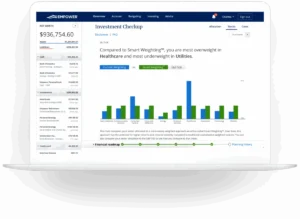
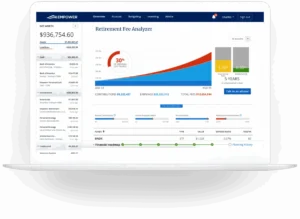
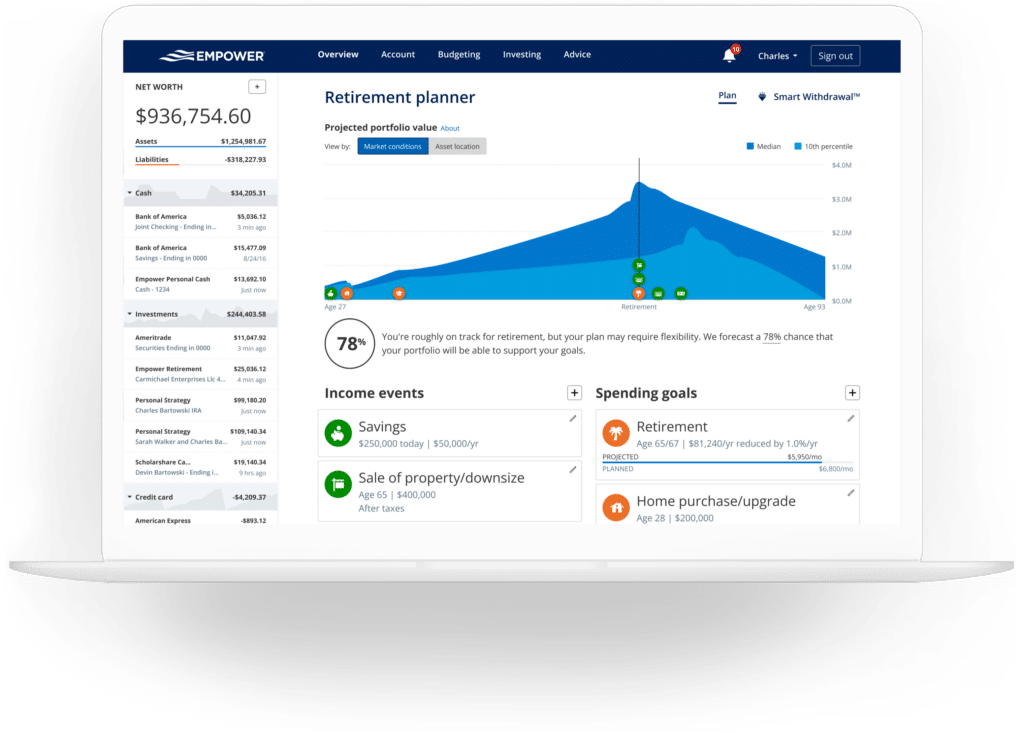
Empower’s Retirement Planner is arguably the most accessible yet powerful tool for the average investor. Because it integrates directly with your existing financial accounts, it eliminates the need for manual data entry, providing a real-time snapshot of your net worth and investment performance.
- Key Capabilities: The tool excels at "what-if" modeling. Users can simulate the impact of retiring at different ages, changing their savings rate, or adjusting their investment asset allocation. By running Monte Carlo simulations on your actual data, Empower provides a clear percentage-based likelihood of success.
- Best For: Individuals who are five or more years from retirement and want a low-friction, high-visibility way to track their progress.
2. Boldin: The Power User’s Choice
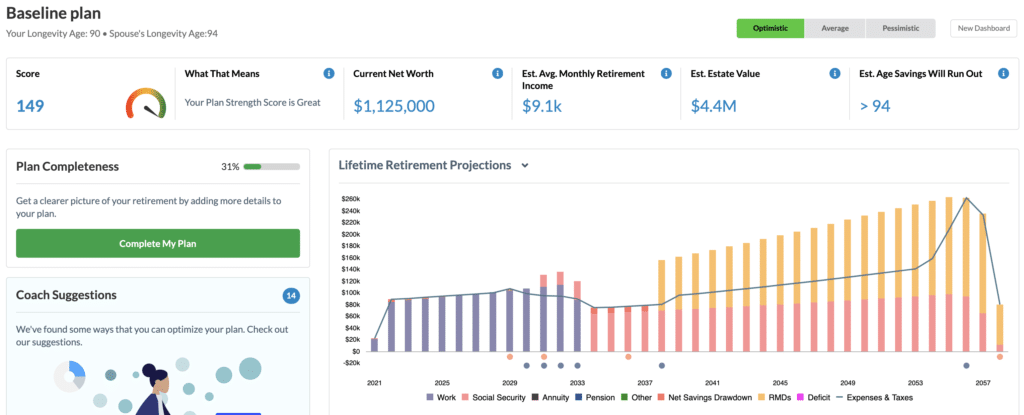
Formerly known as New Retirement, Boldin is designed for those who require granular control. It is less about high-level estimates and more about comprehensive life-modeling. It is the platform of choice for those already in the semi-retirement phase.
- Key Capabilities: Boldin allows for the modeling of complex variables that many other calculators ignore, such as Social Security claiming strategies, Medicare premium adjustments, and the intricacies of Roth IRA conversions. It handles both manual data entry and account syncing with equal ease.
- Best For: Individuals who want to model every specific nuance of their retirement, including tax-heavy strategies and complex income streams.
3. ProjectionLab: The Visual Strategist
ProjectionLab stands out for its exceptional user interface and its commitment to transparency in its mathematical models. Founded by software engineer Kyle Nolan, the platform is frequently updated and offers arguably the best visual data presentation on the market.
- Key Capabilities: Beyond standard projections, ProjectionLab is unique in its ability to model specific withdrawal strategies, such as the Guyton-Klinger guardrails or variable percentage withdrawals. Its tax analysis is rigorous, and it offers a superior "what-if" scenario builder.
- Best For: Data-driven individuals who want to visualize their financial trajectory through clear, interactive, and customizable charts.
A Comparative Look at Economic Philosophy: Maxifi
Maxifi represents a different school of thought. Based on the economic principle of "consumption smoothing," it prioritizes the idea that your spending power should be optimized across your entire lifetime. Unlike tools that simply ask how much you want to spend, Maxifi asks how much you can spend while maintaining a specific standard of living. While it has a steeper learning curve than Empower or ProjectionLab, it provides a unique, theoretically rigorous perspective for those who find standard calculators too simplistic.
The Implications of "Plan-B" Thinking
The most critical takeaway from the current software landscape is the necessity of "stress testing." A retirement plan that looks perfect on a spreadsheet can be derailed by a sudden medical expense, a market crash, or a change in tax law.
When utilizing these tools, users should not focus on a single number. Instead, they should:
- Model Extreme Scenarios: What happens to your plan if the market stays flat for a decade? What if you need to retire two years earlier than expected?
- Prioritize Tax Strategy: The software packages that allow for Roth conversion modeling (like Boldin and ProjectionLab) are inherently more valuable because they recognize that taxes are often a retiree’s single largest expense.
- Review Regularly: Retirement planning is not a "set it and forget it" activity. Life events—marriage, inheritance, job loss, or health changes—should trigger a revisit to your software at least annually.
Conclusion: Which Tool Is Right For You?
The "best" tool is the one you will actually use consistently. If you want simplicity and free access, Empower is the industry benchmark. If you are entering the complexities of retirement and need to optimize your tax and Social Security strategy, Boldin offers the most comprehensive toolkit. If you value a beautiful interface, modern web design, and advanced withdrawal strategy modeling, ProjectionLab is an exceptional choice.
Ultimately, these tools are not oracles; they are calculators. They provide a mathematical framework for your life goals, but the success of your retirement will depend on your discipline, your willingness to adapt to changing economic conditions, and your ability to look beyond the numbers to the lifestyle you truly wish to lead. As the research suggests, utilize multiple programs, compare the results, and create a plan that is resilient enough to withstand the inevitable surprises of the future.