The Great Disconnect: Why U.S. Consumer Sentiment Has Plummeted Amid Record Economic Prosperity
October 2, 2026
By Ben Carlson (Adapted and Expanded for Journalistic Analysis)
Introduction: The Great Economic Paradox
By almost every traditional macroeconomic indicator, the United States economy should be experiencing a golden age. The stock market routinely flirts with all-time highs, unemployment hovers at a remarkably stable 4%, household net worth has reached historic peaks, and the nation has avoided a genuine economic recession for nearly two decades.
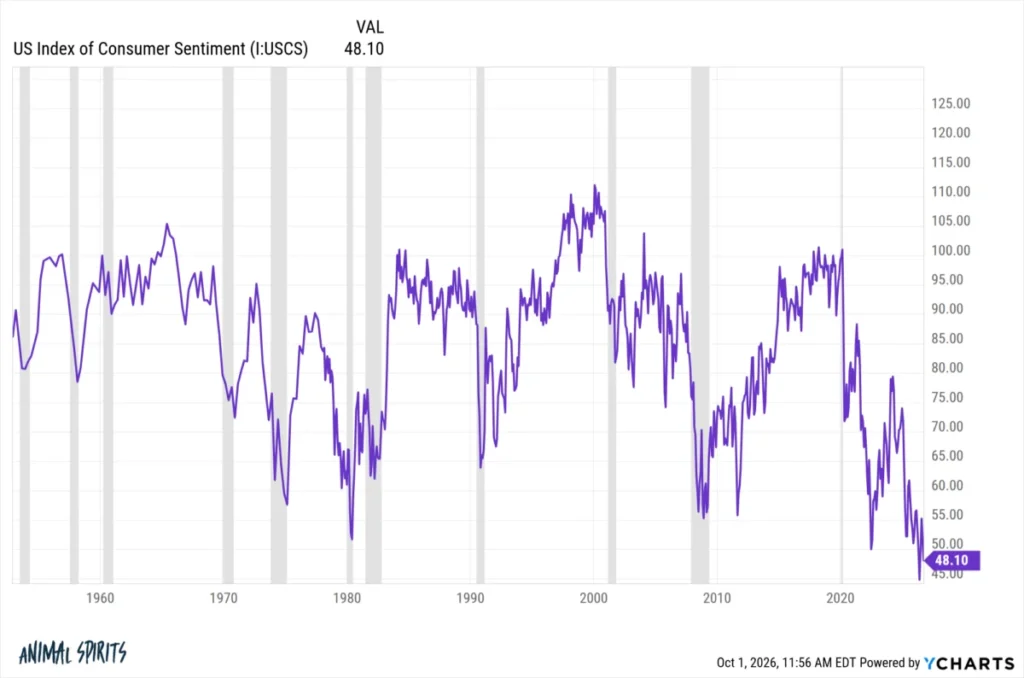
Yet, if you look at modern U.S. consumer sentiment indexes, you would think the country is teetering on the edge of a depression.
Data dating back to the early 1950s reveals a baffling paradox: reported consumer sentiment is currently lower than it was during several monumental historical crises. How is this profound disconnect possible? The answer lies in a complex matrix of rapid post-pandemic structural shifts, soaring price baselines, the psychological burden of modern housing markets, shifting sociopolitical landscapes, and—crucially—a fundamental evolution in how data is collected in the digital age.
Main Facts: The Reality vs. The Perception
To understand the current economic mood, financial analysts must first reconcile two vastly contradictory realities: the objective data and the subjective public experience.
- The Macroeconomic Blueprint: U.S. unemployment sits firmly at 4%. Household net worth is at an all-time high, bolstered by robust equity portfolios and real estate appreciation over the past decade.
- The Sentiment Crash: Despite these pillars of financial stability, consumer confidence indexes paint a grim picture, signaling deep-seated public dissatisfaction with the current state of affairs.
- The Inflation Shock: While the trailing 12-month inflation rate has cooled significantly to around 3.4%, cumulative inflation since the dawn of 2020 has driven consumer prices up by roughly 30%.
- The Methodology Shift: A critical, often-overlooked catalyst for these historically low sentiment numbers is the transition in data collection. In 2024, institutions like the University of Michigan transitioned their primary sentiment gathering from traditional phone interviews to online surveys, fundamentally altering how respondents communicate their financial anxieties.
Chronology of Discontent: How We Got Here
To trace the roots of today’s pervasive pessimism, we must look backward across key historical milestones that have shaped the modern economic psyche:
- Pre-2020 Stability: Consumer sentiment enjoyed a relatively predictable relationship with employment rates, GDP growth, and inflation metrics. Economic optimism generally tracked real-world financial gains.
- The 2020 Pandemic Shock: The outbreak of COVID-19 caused consumer sentiment to fall off a cliff. Unlike previous economic shocks, however, sentiment failed to bounce back to pre-pandemic baselines, even as government stimulus and swift monetary interventions propped up asset prices.
- The 2021–2023 Inflationary Surge: As the global economy reopened, supply chain bottlenecks and geopolitical conflicts—particularly in the Middle East—ignited severe inflationary pressures. Energy prices spiked, pushing national gas averages toward $5 a gallon and shocking consumers accustomed to years of price stability.
- The 2024 Survey Evolution: Recognizing that modern consumers rarely answer phone calls from unknown numbers, major sentiment trackers pivoted heavily toward digital and online polling methodologies, inadvertently capturing a more unfiltered, dramatic, and anonymous strain of public frustration.
- 2026—The Present Standoff: Today, the economy hums along at a steady clip, but the psychological scars of rapid inflation, locked housing markets, and digital polarization continue to depress official sentiment readings.
Supporting Data and Core Drivers of Pessimism
While it is easy for economists to dismiss low sentiment as irrational given strong equity and employment figures, the public’s grievances are rooted in tangible, lived experiences. Several primary drivers explain why the average citizen remains profoundly sour on the economy:
1. Cumulative Price Levels and "Sticker Shock"
Economists measure inflation over trailing 12-month periods, but normal households live on cumulative memory. While a 3.4% annual inflation rate sounds manageable on paper, consumers are acutely aware that everyday goods, automobiles, and services cost roughly 30% more than they did at the start of 2020.
Wages have risen to compensate, but wage growth rarely feels seamless or immediate. The velocity of the price increases gave people no time to acclimate. Lower prices from the pre-pandemic era remain fresh in the public consciousness, creating a perpetual sense of being financially squeezed.
2. The Housing Market Gridlock
Housing represents one of the most glaring points of friction in the modern economy. On the surface, America’s homeownership rate sits comfortably around 65%, meaning a majority of citizens are insulated from rising property values. However, this dynamic has created two major subsets of economic distress:
- Locked-Out Youth: Younger generations face an exceptionally brutal housing market characterized by soaring valuations and high borrowing costs, making the traditional milestone of homeownership feel increasingly out of reach.
- Trapped Homeowners: Millions of homeowners are locked into low-interest mortgages (such as 3%) secured during the pandemic era. With current mortgage rates hovering around 7.5%, moving has become financially prohibitive. Homeowners feel trapped in properties that no longer fit their lifestyle because the math of trading a 3% mortgage for a 7.5% mortgage is disastrous. Consequently, real estate activity has plummeted to financial-crisis levels.
3. Wealth Inequality
The perception of a rigged system plays a massive role in consumer sentiment. Data highlights a stark widening of the wealth gap: the top 0.1% of Americans now control roughly 15% of total household net worth, up dramatically from 8.6% in 1989. For workers struggling with daily living costs, the constant visibility of unchecked billionaire wealth creation breeds widespread resentment.
4. Sociopolitical Fatigue and Polarization
Everything in contemporary culture has been flattened into a hyper-partisan political issue. Citizens are perpetually nudged to view every headline through a tribal "us versus them" lens. Combined with declining institutional trust and unchecked political grifting, the sociopolitical ecosystem has become emotionally exhausting, directly bleeding into how people evaluate their personal well-being and national outlook.
5. The Echo Chamber of Social Media
Algorithms are engineered to reward sensationalism, doom-scrolling, and pessimism. Traditional journalism long operated under the maxim "if it bleeds, it leads," but social media has supercharged this dynamic. Continuous exposure to viral negativity warps individual perceptions of local economic safety, amplifying a sense of impending doom even when personal bank accounts are stable.
Official Responses and Expert Analysis
Financial commentators and market researchers have engaged in intense debates over how to interpret these anomalous sentiment readings.
Mainstream economists frequently argue that consumer sentiment has become disconnected from objective reality, serving more as a political proxy indicator than a reliable gauge of financial health. When asked about their personal finances, consumers often report being in decent shape, yet when asked about the national economy, their answers plunge into deep pessimism—a phenomenon heavily influenced by political affiliation and media consumption.
Furthermore, survey methodology experts point out that the shift from face-to-face or phone interviews to online-only models has introduced significant noise into historical trend lines. Online, human behavior changes: individuals are more likely to exaggerate, adopt an anonymous persona, vent frustrations anonymously, or express extreme viewpoints that do not accurately mirror their actual purchasing behavior or financial decisions.
Implications for the Future
The profound chasm between hard economic data and soft sentiment metrics carries serious implications for policymakers, financial institutions, and businesses alike:
- Unreliable Forecasting: If traditional consumer sentiment indexes are increasingly distorted by digital polling biases and partisan fatigue, central banks and policy planners risk misinterpreting public readiness for economic shifts.
- Political Fallout: Incumbent political parties face immense hurdles when trying to campaign on "strong economic indicators" (like low unemployment and high GDP) while the electorate experiences persistent sticker shock at the grocery store and gas pump.
- Behavioral Divergence: There is a fascinating divergence between what people say in surveys and what they do with their money. While consumer sentiment suggests widespread economic despair, actual consumer spending data remains remarkably resilient. People continue to travel, dine out, and purchase goods, proving that actions often speak louder than survey responses.
Conclusion
Ultimately, the argument that today’s economy is worse than the Great Financial Crisis or the stagflation era of the 1970s holds no water. Objectively, America is experiencing a period of immense structural wealth and employment stability.
Yet, dismissing the public’s frustration as purely irrational is a mistake. Between cumulative price shocks, a frozen housing market, widening wealth disparities, and the relentless onslaught of digital negativity, people have plenty of legitimate reasons to feel sore. Add in the methodological quirks of modern online surveys, and it becomes clear why consumer sentiment looks completely broken.
For analysts and observers navigating this landscape, the lesson is simple: take the headline numbers with a giant grain of salt, look past the digital noise, and remember that public mood in the 21st century is shaped as much by psychology and algorithms as it is by supply and demand.