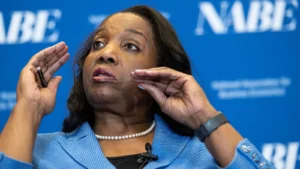
Beyond the Stress Test: Michelle Bowman Outlines a New Era of Federal Reserve Supervision

In a wide-ranging address delivered at a London luncheon this past Friday, Federal Reserve Governor Michelle Bowman—who serves as the Board’s Vice Chair for Supervision—offered a roadmap for the future of U.S. banking regulation. Her remarks provided a rare, high-level synthesis of two critical regulatory priorities: the long-awaited overhaul of bank stress testing and a candid, introspective analysis of the catastrophic collapse of Silicon Valley Bank (SVB) in 2023.
As the Federal Reserve prepares to "close the book" on what Bowman characterized as an opaque and unpredictable regulatory framework, her comments signal a pivot toward a more proactive, communicative, and rigorous supervisory regime. The implications of these shifts are immense, affecting everything from how global systemically important banks (G-SIBs) calculate capital surcharges to how examiners diagnose institutional fragility before it manifests in a liquidity crisis.
1. The Core Objectives: A New Regulatory Framework
Governor Bowman’s address primarily focused on the Federal Reserve’s upcoming final revisions to its stress-testing framework. For years, the banking industry has criticized the Fed’s stress testing process for its lack of transparency, often leaving executives in the dark regarding the specific models and assumptions that dictate their mandatory capital buffers.
The Upcoming Timeline
Bowman confirmed that the Federal Reserve expects to finalize its revisions to the stress-testing framework in the "coming weeks." This timeline also encompasses final changes to risk-based capital requirements and the G-SIB surcharge. These reforms are part of the broader post-financial-crisis regulatory evolution, though they have not been without controversy. Bowman’s announcement comes on the heels of a lawsuit filed last week by the advocacy group Better Markets, which alleges that the Fed’s process—specifically concerning capital-requirement rulemakings—has been tainted by opaque meetings with banking executives.
Refining the "Stress" in Stress Testing
To move away from what critics call a "black box" approach, Bowman highlighted two specific proposals currently under consideration for the final rule:
- The Balance Sheet Freeze: One proposal suggests implementing a specific date upon which a bank’s balance sheet would be "frozen" for the purpose of the annual stress-test simulation. Once the Fed releases its scenarios, the balance sheet would remain fixed, allowing for a more predictable and standardized assessment.
- Dual-Shock Scenarios: Another proposal recommends the creation of two distinct global market shock scenarios. Under this model, the scenario resulting in the larger loss would be utilized to calculate the bank’s Stress Capital Buffer (SCB), effectively creating a "worst-case" floor for capital planning.
Furthermore, Bowman signaled a move toward 2027 by inviting public comment on a revised model for evaluating noninterest income. This category—which includes fees from wealth management, investment banking, and market-making—has become a significant engine for bank revenue and, consequently, a critical area for systemic risk monitoring.
2. Chronology of Supervisory Reflection: The SVB Catalyst
The second pillar of Bowman’s address was a somber autopsy of the Silicon Valley Bank failure. By tying the proposed stress-test reforms directly to the failures observed in 2023, Bowman provided a compelling narrative: the regulatory tools of the past were insufficient to catch the vulnerabilities that brought down SVB.
The 2022 Window of Opportunity
The most striking revelation in Bowman’s summary of the independent review was the timeline of institutional failure. She noted that supervisory staff were, or at the very least should have been, aware of SVB’s precarious position as early as March 2022.
- March 2022: Initial internal awareness of SVB’s interest rate risk and deposit concentration begins to surface.
- Late 2022: Despite clear warning signs regarding the bank’s exposure to rising interest rates, no decisive corrective action was taken.
- Early 2023: The accumulation of unrealized losses on investment securities creates a terminal liquidity crisis.
Bowman’s analysis revealed a failure of institutional culture. She described a environment of "risk aversion" within the Fed’s supervisory ranks, where staff members feared that taking the "wrong" action was riskier than taking no action at all. Furthermore, a lack of clear internal governance meant that supervisors were often paralyzed by uncertainty regarding who possessed the authority to trigger a formal enforcement action.
3. Supporting Data: What the Models Would Have Shown
One of the most technically significant parts of Bowman’s address was her claim that a more robust stress-testing model would have identified SVB’s insolvency well before the March 2023 run on the bank.
"Had the Fed applied this type of analysis," Bowman stated, "supervisors could have measured the effect of a range of stressful scenarios on [SVB’s] portfolios." Specifically, she argued that a plausible recessionary scenario—modeled with rising interest rates and the fair-value measurement of investment securities—would have flagged the firm’s capital deficiency as early as the fourth quarter of 2021.
This is a critical admission. It suggests that the failure of SVB was not necessarily due to a lack of available data, but a failure of the application of that data within the existing stress-testing framework. By tying fair-value accounting to potential recession scenarios, Bowman is signaling that future Fed tests will be much less forgiving regarding the "held-to-maturity" investment accounting that obscured SVB’s losses.
4. Official Responses and Cultural Shifts
The "one-way exercise" critique was perhaps the most pointed part of Bowman’s speech. She argued that the current relationship between the Fed and the large banks it regulates is too detached.
The Need for Two-Way Dialogue
Bowman is advocating for a paradigm shift in how the Fed utilizes scenario analysis. She envisions a process where the interaction between the regulator and the regulated is iterative:
- Diagnostic Capability: The Fed’s tests should function as an early-warning system for vulnerabilities—both financial and nonfinancial—rather than just a binary "pass/fail" mechanism for capital requirements.
- Focusing Supervisory Attention: By identifying these vulnerabilities early, the Fed can allocate its own resources more effectively, focusing its limited supervisory bandwidth on firms exhibiting the most material risks.
- Institutional Accountability: Bowman emphasized that the SVB review is not an attempt to point fingers at specific individuals, but rather a "learning exercise" to address the systemic "shaking of public confidence" that occurred in the wake of the collapse.
5. Implications for the Banking Industry
The implications of Bowman’s vision are profound for the U.S. financial landscape.
A More Opaque-Free Future
If the Fed successfully "closes the book" on the current, opaque framework, large banks can expect a more standardized, if perhaps more rigorous, regulatory environment. While the requirements for capital may increase under the new stress-test models, the benefit to banks will be a clearer understanding of the "rules of the road," reducing the uncertainty that often hinders long-term capital allocation.
The Cost of Compliance
However, for the industry, this represents a significant increase in the complexity of compliance. Banks will need to build more sophisticated models to account for the new "dual-shock" scenarios and the granular analysis of noninterest income. This, in turn, will require deeper integration between a bank’s risk management teams and their internal treasury and capital planning departments.
The "Supervisory Culture" Shift
Perhaps the most lasting implication is the cultural change within the Federal Reserve itself. By publicly acknowledging the paralysis of supervisory staff during the lead-up to the SVB failure, Bowman is signaling that the Fed is entering a period of "supervisory accountability." Future examiners will likely be under greater pressure to demonstrate that they have identified and acted upon risks, rather than waiting for formal signals or consensus in an uncertain environment.
Conclusion: Lessons Learned
Governor Bowman’s address serves as a bridge between the failures of the recent past and a more disciplined future. By integrating the lessons of the Silicon Valley Bank collapse into the technical reforms of the stress-testing framework, the Federal Reserve is attempting to prove that it can learn from its own shortcomings.
As the "coming weeks" approach and the final rules are unveiled, the banking industry will be watching closely. The goal, as defined by Bowman, is a system that does more than calculate capital—it is a system that anticipates the "what-ifs" before they become the "what-happeneds." Whether these changes will be enough to restore full public confidence in the efficacy of bank supervision remains to be seen, but the intent—to replace opacity with clarity and paralysis with action—marks a significant turning point in the post-SVB era of American finance.