The Founding Fathers in the Cloud: Google’s “1776” Ad Sparks Debate on AI and History
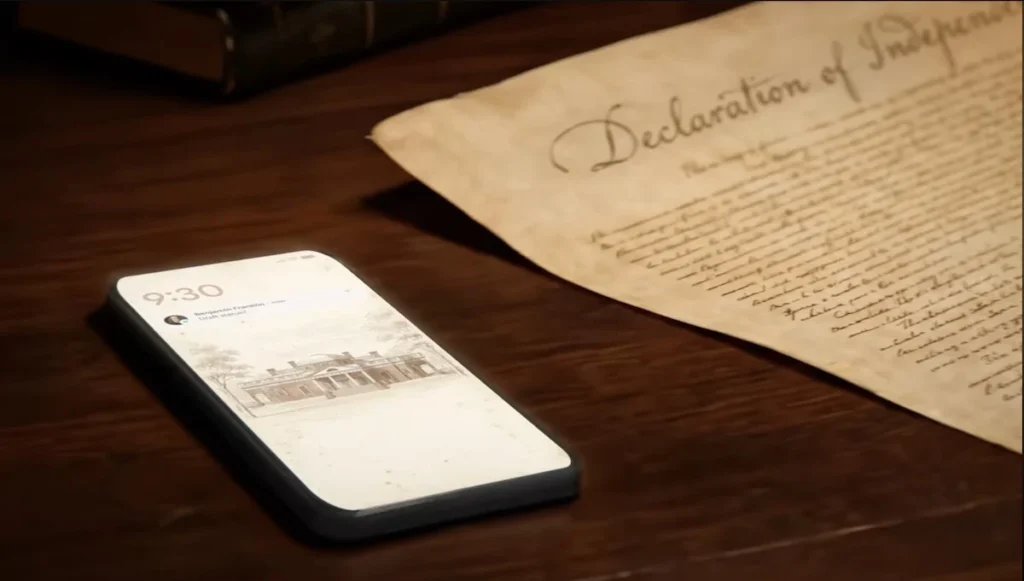
Two hundred and fifty years after the ink dried on the Declaration of Independence, the parchment has been replaced by pixels. In a new, high-concept commercial released this week, Google asks a provocative, albeit surreal, question: What if the Founding Fathers had access to Google Workspace?
Titled "Group Project, but make it 1776," the spot leans heavily into the tropes of modern office culture to recontextualize one of history’s most consequential moments. However, as the ad gains traction across social media, it has become a lightning rod for broader discussions regarding the role of Artificial Intelligence in creative work, the commercialization of American history, and the persistent "uncanny valley" of AI-generated content.
The Anatomy of an Anachronism: Main Facts
The commercial centers on a fictionalized Thomas Jefferson, who is seen laboring over a draft of the Declaration. Rather than quill and ink, he navigates a digital interface, managing a workflow that would look familiar to any remote corporate team. The narrative arc is driven by the frictionless, yet hyper-connected, tools of the Google ecosystem.
Key features highlighted in the ad include:
- Google Docs: Real-time collaboration where edits are suggested in the margin.
- Google Calendar: Scheduling high-stakes meetings with delegates.
- Google Meet: A remote video conference that serves as a modern stand-in for the Continental Congress—though, in a humorous nod to corporate tropes, every participant keeps their camera off.
- AI Integration: The use of Google’s "Help Me Visualize" tool to brainstorm the national seal, and Gemini, which serves as a virtual administrative assistant to summarize meetings and draft tactical responses to King George III.
The tone is undeniably tongue-in-cheek. Sam Adams interjects with requests for post-meeting beers, and the founders treat the British Empire’s grievances as a "document access request" that can simply be denied with the click of a button.
A Chronology of the "Founding Founders" Campaign
The rollout of the campaign coincides with the 250th-anniversary celebrations of the United States, a period that has seen a surge in "historical rebranding" by major tech firms.
- Early Development (Late 2025): Google’s marketing team began conceptualizing a way to demonstrate the utility of Gemini and Workspace within a high-stakes environment.
- The Creative Pivot: The concept of "Founding Fathers as remote workers" was finalized as a way to bridge the gap between legacy historical narratives and the company’s push into generative AI.
- Production (Early 2026): Utilizing a combination of traditional cinematography and generative video tools, the ad was produced to create an "uncanny" aesthetic that mirrors the digital nature of the product being advertised.
- The Launch (February 2026): The video debuted across major digital platforms, accompanied by a strategic social media push on YouTube and Instagram.
- The Backlash (Post-Launch): Within 48 hours of release, the conversation shifted from the product’s features to the ethics of using AI to recreate historical figures.
The AI Factor: Discretion vs. Saturation
In the landscape of 2026 advertising, AI is ubiquitous. However, Google’s approach here is notably different from its previous attempts. Many recall the 2024 commercial in which a father used Gemini to write a fan letter for his daughter—a spot that was widely criticized for promoting a "hollow" version of human connection.
In "1776," Google is careful not to suggest that AI "wrote" the Declaration of Independence. Instead, the AI is positioned as a productivity utility—a sophisticated secretary rather than a creative genius. Despite this, the most striking element of the ad remains its visual texture. To the trained eye, the footage possesses the telltale, fluid, and slightly synthetic glow of AI-generated video.
This creates a meta-commentary: Google is using AI to show AI helping the Founders, effectively wrapping the entire production in the very technology it seeks to sell.
Supporting Data and Social Media Response
Public reaction has been sharply polarized. On YouTube and Instagram, where engagement is often algorithmically curated to favor positive sentiment, comments are largely celebratory, focusing on the humor and the relatability of the "remote work" struggle.
However, the discourse on Bluesky has been starkly different. Critics have labeled the spot "cringey" and "stunningly tone-deaf," arguing that minimizing the gravity of the American Revolution to the level of a group project trivializes history.
The Historian’s Perspective
Historian Angus Johnston, a vocal critic of the ad, provided a succinct analysis that has gained significant traction. Johnston noted the irony of the ad’s production: "It is amazing how little of this is actually AI," he observed, pointing to the fact that the "AI-driven" narrative is largely a marketing facade.
Johnston’s critique went deeper than just the aesthetics: "Even in a corny fantasy joke, it’s impossible to make the case that AI is a useful tool for political organizing, writing, or human collaboration. By trying to force a 21st-century corporate workflow onto an 18th-century revolution, the ad inadvertently highlights the limitations of AI—it lacks the human passion, the stakes, and the grit that actually defined the founding of this nation."
The Implications of "Tech-Washing" History
The Google ad represents a broader trend in Silicon Valley known as "tech-washing"—the attempt to retroactively validate modern software by projecting its necessity onto the past.
1. The Erosion of Historical Gravity
When a company as powerful as Google frames the Declaration of Independence as a "group project," it inevitably shifts the public perception of that history. By focusing on the mechanics of the work—scheduling, editing, summarizing—the ad strips away the ideological danger and personal sacrifice inherent in the American Revolution.
2. The Normalization of AI in Public Discourse
By embedding Gemini into the narrative of the Founding Fathers, Google is attempting to normalize the presence of AI in our most sacred civic and intellectual spaces. The implication is that if AI is good enough for Jefferson, it is good enough for your business, your education, and your personal life.
3. The Future of Creative Advertising
The commercial serves as a bellwether for the creative industry. As AI video tools become more accessible, we are likely to see an increase in "synthetic history." Brands will continue to leverage historical figures to sell modern tech, creating a blurred reality where the line between historical fact and algorithmic fantasy becomes increasingly difficult to discern.
Conclusion: A Miscalculation or a Masterclass?
Whether the ad is viewed as a brilliant piece of brand positioning or a tone-deaf marketing blunder depends on the viewer’s relationship with history and technology. For Google, the goal was likely to showcase the utility of their suite in a way that felt fresh and culturally relevant.
However, the backlash highlights a growing public fatigue regarding the forced integration of AI into every facet of human experience. The "Group Project" may have been a clever pun, but it also served as a reminder that some things—namely the foundational moments of human history—are perhaps better left to the quill, the ink, and the messy, un-automated struggle of human beings.
As the 250th anniversary of the United States continues, this commercial will likely be remembered not for the features of Google Workspace, but as a defining moment in the early, experimental, and often contentious era of AI-integrated media.