The Billionaire’s Digital Butler: Is the $6,880 Vertu Alphafold More Than Just a Status Symbol?
In an era where the smartphone industry has devolved into a frantic, hyper-competitive arms race to cram generative AI into every device, most manufacturers are focusing on the mass market. Samsung, Google, and Apple are all betting that AI-enhanced photography and predictive text will drive the next upgrade cycle for the average consumer.
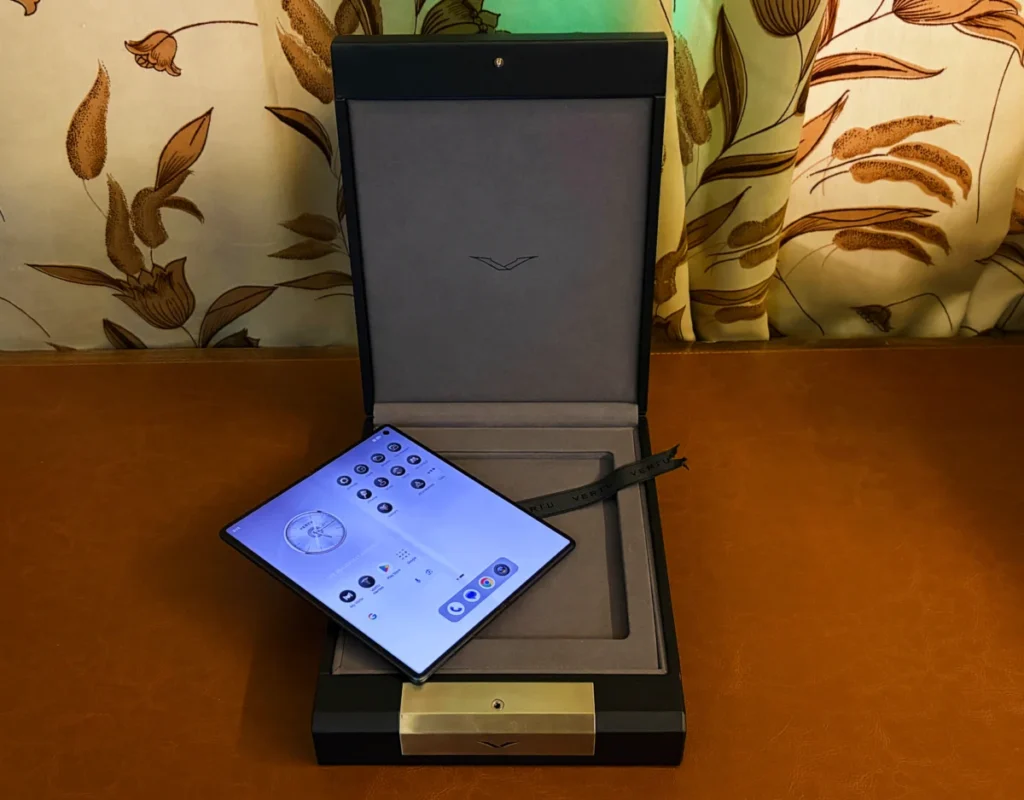
Vertu, however, has never been a company concerned with the "average" consumer. The UK-founded luxury brand, historically famous for hand-finished devices that command five-figure price tags, is taking a starkly different path. Its latest offering, the Alphafold, is not trying to win the spec wars. It is not competing on benchmark scores or pixel density. Instead, it is selling a promise of elite efficiency—a foldable smartphone designed specifically for the C-suite, pairing high-end calfskin and titanium with the "Hermes Agent," an AI designed to automate the grueling logistics of an executive’s workday.
With a starting price of $6,880, the Alphafold is a polarizing statement piece. It raises a fundamental question: Is this truly an evolution of the professional workstation, or is it simply a gilded shell for off-the-shelf technology?

The Anatomy of Luxury: A Closer Look at the Hardware
Physically, the Alphafold is an exercise in tactile indulgence. Where mainstream foldables rely on the sterile coldness of glass and aluminum, the review unit provided for this analysis was encased in genuine calfskin leather with titanium accents. The weight—a substantial 264 grams—feels intentional, a deliberate "heft" that signals permanence and quality.
However, the illusion of bespoke engineering begins to fade upon closer inspection. The device bears a striking resemblance to the $1,100 ZTE Nubia Fold. From the placement of the microphones and speakers to the hinge geometry and the specific layout of the fingerprint reader, the lineage is unmistakable. System diagnostics further confirmed the presence of ZTE identifiers embedded within the firmware.
When pressed for comment, Vertu was transparent regarding this partnership. The company confirmed that the Alphafold was developed through a specialist supply-chain collaboration utilizing ZTE/Nubia’s hardware platform and production engineering. Vertu maintains that its value proposition lies in the "last mile" of luxury: the premium materials, the curated software experience, the stringent quality control, and, most importantly, the proprietary AI layer. This strategy mirrors Vertu’s historical approach, where the company often adapts established high-performance hardware to serve as the chassis for its opulent design language.

The Hermes Agent: An AI for the C-Suite
The centerpiece of the Alphafold experience is the Hermes Agent, a pre-installed AI interface built atop the open-source Hermes project. Unlike standard AI assistants that function primarily as search engines or text generators, Hermes is designed to be an orchestrator. Vertu’s vision is to provide an agent that can analyze complex files, navigate multi-step workflows across disparate applications, and, when the machine reaches its logical limit, hand off the task to a human concierge.
To test this, I eschewed the typical review metrics of gaming performance and camera dynamic range. Instead, I lived with the Alphafold as an executive assistant. I tasked the device with the messy, unscripted realities of a business day: parsing legal contracts, managing travel logistics, and automating daily schedules.
Chronology of the Testing Phase
- Days 1–2: Initial configuration and onboarding. The system struggled with local file recognition and failed to trigger the human concierge service.
- Day 3: A critical software patch was pushed to the device. The update successfully restored the previously broken connectivity with the concierge team.
- Days 4–6: Stress-testing the AI on document analysis and complex multi-tasking requests.
- Days 7–8: Comparison testing against the Samsung Galaxy Z Fold 7 running Google’s Gemini, focusing on accuracy, autonomy, and follow-up capabilities.
Comparative Performance: Hermes vs. Gemini
The differences between the Alphafold’s Hermes Agent and the industry-standard Gemini were both fascinating and revealing.

In a test involving a last-minute airport departure, I asked both phones to message a contact, navigate to the terminal, enable "Do Not Disturb," and set a reminder for 15 minutes later. The Alphafold’s Hermes Agent was aggressive in its autonomy: it sent the message, activated the focus mode, and opened Google Maps immediately. However, it failed to trigger the navigation itself and set the reminder for the wrong time entirely, seemingly confused by the 2:32 a.m. timestamp.
In contrast, the Samsung Galaxy Z Fold 7 running Gemini was more cautious. It asked clarifying questions—which airport? Which app should host the reminder? While this slowed the workflow, it ensured that the outcome was 100% accurate. Hermes was the "go-getter" who sometimes trips over its own feet; Gemini was the meticulous clerk who requires guidance but delivers precision.
When analyzing financial spreadsheets, the results were equally mixed. Hermes impressed by summarizing Q2 data quickly, but it proved to be "forgetful." When returning to the conversation 48 hours later, it insisted that it could not access the local file, requiring a re-upload. Gemini, by contrast, retained the context of the document, allowing for a deep-dive conversation days later without needing to re-ingest the data.

Implications for Security and Privacy
For the target audience—CEOs and high-net-worth individuals—security is not a feature; it is the entire product. A smartphone that analyzes private contracts and financial plans is a massive liability if the data is being harvested for public model training.
Vertu claims that all conversations with the Hermes Agent are encrypted and strictly excluded from public training datasets. The device features an "A5" security chip, designed to provide hardware-level protection for digital credentials and sensitive communications. While independent verification of this hardware is nearly impossible, the claim is central to Vertu’s pitch. For enterprises, the company offers private infrastructure deployments, allowing organizations to maintain complete control over their sensitive data. This is the "hook" that justifies the price for some, though, as with the hardware, the lack of transparency in these security claims will be a point of friction for many IT departments.
The Verdict: A Solution in Search of a Problem?
The Alphafold is an ambitious, beautiful, and deeply flawed experiment. It succeeds in creating a sense of occasion—the packaging alone, which mimics a high-end jewelry case, makes it clear that you are buying an object of desire.

However, the "AI-first" promise remains an aspiration. As it stands, the Hermes Agent is an evolving, sometimes inconsistent platform. It possesses a commendable level of autonomy, but it lacks the reliability that an executive, who values time above all else, requires. When you are running a company, you cannot afford for your AI to "hallucinate" a flight schedule or forget a contract you discussed yesterday.
Furthermore, the comparison to the Samsung Galaxy Z Fold 7 is devastating. Samsung provides a more mature software ecosystem, superior integration with professional apps, and a more comfortable form factor for a significantly lower price. With the Galaxy Z Fold 8 looming on the horizon, the Alphafold’s value proposition—already precarious—looks increasingly difficult to defend.
Ultimately, the Alphafold is a luxury product for the individual who wants their phone to feel as exclusive as their watch or their car. It is a status symbol that incorporates the latest AI trends to stay relevant in a tech-obsessed world. But for the serious executive, the most efficient "AI assistant" currently remains a human one, aided by the reliable, albeit less glamorous, tools that the rest of the world is already using.

Vertu has built a beautiful machine, but until the software catches up to the craftsmanship, the Alphafold will remain a device that is better at starting conversations in the boardroom than it is at finishing the work that happens inside them.