Regional Stability Collapses: Gulf Crisis Deepens as Iran-U.S. Conflict Spreads to Civilian Infrastructure
By International Affairs Desk
The tenuous peace that briefly characterized the Persian Gulf has officially evaporated. Following the total collapse of a short-lived ceasefire one week ago, the conflict between the United States and the Islamic Republic of Iran has spiraled into an all-out regional conflagration. Saturday marked the seventh consecutive night of U.S.-led airstrikes against Iranian military installations, prompting a swift, retaliatory wave of Iranian missile and drone strikes targeting critical U.S. assets and civilian infrastructure across the Gulf Cooperation Council (GCC) states.
As the conflict intensifies, the humanitarian cost is mounting rapidly, with power grids, desalination plants, and transportation hubs now squarely in the crosshairs of both warring parties. Global markets have reacted with alarm, as the specter of a prolonged blockade of the Strait of Hormuz—the world’s most critical energy chokepoint—sends oil prices to their highest levels in over a month.
The Escalation: A Chronology of the Last 48 Hours
The latest round of violence represents a significant deviation from previous tactical engagements, characterized by a move toward asymmetric warfare against essential civilian services.
Saturday’s Offensive
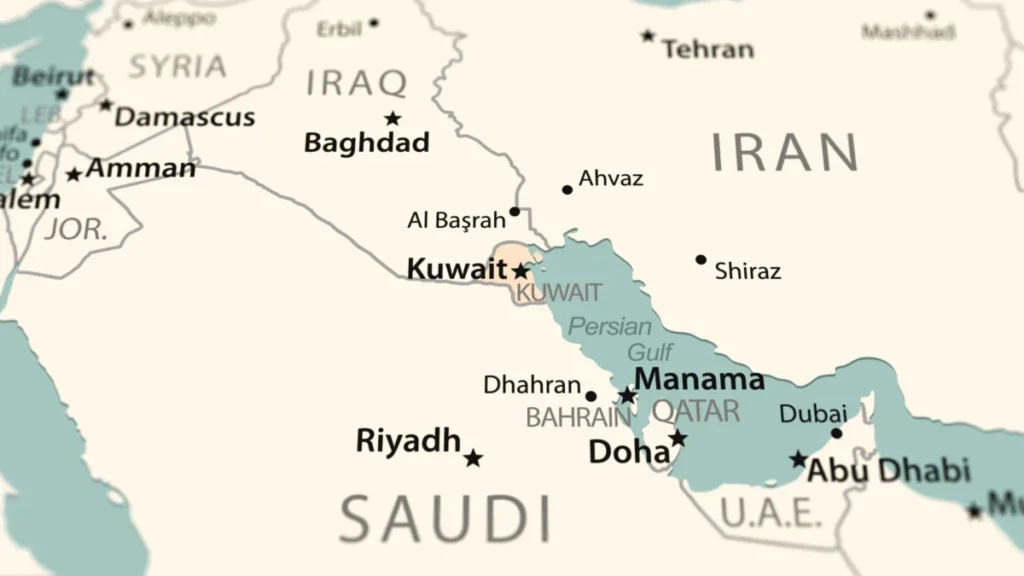
In the early hours of Saturday, the Islamic Revolutionary Guard Corps (IRGC) executed a multi-front assault on U.S. positions across the Gulf. According to Iranian state media, the IRGC claimed to have successfully struck the U.S. military support center at Camp Arifjan in Kuwait and destroyed a key radar facility at the Ali Al Salem Air Base. Simultaneously, the IRGC reportedly targeted Sheikh Isa Air Base in Bahrain, hitting an intelligence data center and facilities housing U.S. combat aircraft.
Perhaps most significantly, Iranian state television reported a devastating strike on the Al Azraq base in Jordan. The IRGC claimed the destruction of at least two U.S. fighter aircraft and three additional support vessels. While these reports remain unverified by Reuters or independent international observers, the sheer scope of the claimed operation indicates a concerted effort by Tehran to project force far beyond its own borders.
The U.S. Response
The U.S. Central Command (CENTCOM) confirmed that its seventh consecutive night of operations targeted Iranian logistics, underground weapons depots, and maritime surveillance capabilities. The U.S. strategy appears focused on degrading Iran’s ability to coordinate long-range strikes, yet the persistence of the Iranian response suggests that Washington’s efforts have, thus far, failed to deter the regime’s resolve.
Civilian Infrastructure Under Fire
The most disturbing development in this latest escalation is the targeting of civilian infrastructure, a move that legal experts warn may constitute a violation of international humanitarian law.
The Water Crisis in Kuwait and Iran
Kuwait has found itself at the epicenter of the current hostilities. The country’s Ministry of Electricity, Water, and Renewable Energy confirmed that a desalination facility was struck during the Saturday morning barrage. This follows another attack on a similar facility just 24 hours prior. With Kuwait International Airport forced to suspend all operations due to the persistent missile and drone threats, the nation is facing a dual crisis of logistics and resource security.
The suffering is mirrored on the Iranian side of the Gulf. Local officials in the southern city of Jask reported that missile strikes decimated power facilities and water desalination pumps. According to the Tasnim news agency, approximately 10,000 residents across 20 villages are currently without access to potable water, highlighting the devastating impact of the conflict on non-combatant populations.
Devastation of Transportation Networks
The impact on regional infrastructure extends to vital transportation links. In Iran’s Hormozgan Province, state media reported the destruction of two bridges and a road tunnel, with a civilian death toll of three and eight others wounded. These strikes follow a series of U.S.-led attacks on Friday that disabled at least five bridges in the south, hit a train station in Bandar Khamir, and crippled an airport in Iranshahr.
Official Responses and Diplomatic Stagnation
The international community has watched the escalation with growing trepidation. U.N. Secretary-General Antonio Guterres issued a sharp rebuke regarding the targeting of civilian infrastructure, calling for an immediate de-escalation. Through a spokesperson on Friday, Guterres expressed deep concern that the conflict is transcending military boundaries and inflicting irreparable damage on the regional civilian population.
The IRGC, however, remains defiant. In an official statement, the organization cited a "Quranic command" to justify the broadening of their targets: "Since there is no international institution to prevent the savagery of the U.S. military, we have no path before us except the Quranic command: ‘Whoever attacks you, attack them in the same manner.’" The group has warned U.S. allies in the region that they should expect no respite until the U.S.-led strikes cease.
Meanwhile, the political stakes for the White House are reaching a boiling point. President Donald Trump, who has publicly threatened broad-based strikes on Iranian infrastructure and refused to rule out a ground invasion, is facing immense pressure. With the U.S. midterm elections approaching in November, the Republican Party is struggling to maintain its grip on power as the surge in oil prices—a direct result of the conflict—threatens to destabilize the domestic economy.
Strategic Implications: The Energy Market and Regional Stability
The economic consequences of this war are already being felt globally. The Strait of Hormuz, through which roughly one-fifth of the world’s oil supply flows, has become a secondary battlefield. On Friday, both the U.S. and Iran took aggressive steps to exert control over shipping. The U.S. announced the enforcement of a naval blockade, while Iran targeted vessels it claimed were violating its navigational regulations.
The 4% Oil Price Spike
The combination of the blockade and the destruction of energy-related infrastructure has sent global oil prices climbing more than 4%—the sharpest increase in over a month. Market analysts warn that if the conflict continues to target desalination plants and power grids, the resulting regional instability could lead to a permanent shift in energy security policies among Gulf nations.
The Risk of a Wider War
The current trajectory suggests that Washington and Tehran are testing the absolute limits of escalation. U.S. officials have maintained that the strikes on southern Iran are designed to provide the White House with strategic options, including potential ground operations against Iranian islands or coastal territories. However, these moves carry the inherent risk of triggering a massive Iranian counter-response, potentially involving regional proxies in Yemen who have the capability to further disrupt shipping in the Red Sea.
As the conflict enters its second week post-ceasefire, there is little evidence of a diplomatic off-ramp. With civilian services crumbling, the U.S. military committed to a campaign of attrition, and Iran signaling a willingness to expand the theater of war to the heart of the Gulf, the region stands at a precarious precipice. Whether through a return to the negotiating table or a further descent into total war, the next few days will likely prove decisive for the future of the Middle East and the stability of the global energy market.