The Architecture of Inequality: Unmasking the Radical Finance Behind America’s Public Schools
In the quiet corridors of American policy discourse, few topics are as frequently relegated to the "too technical" pile as school finance. It is a realm dominated by spreadsheets, municipal bond ratings, and opaque budgetary line items—a landscape often designed to exclude the very parents, educators, and citizens it most directly affects.
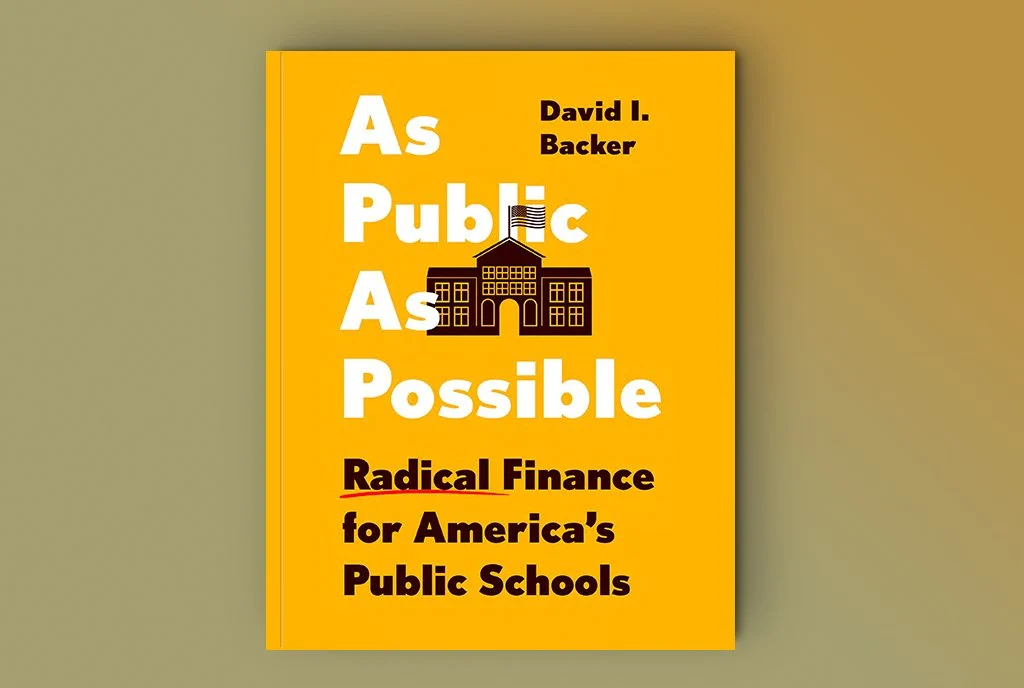
However, in his new book, As Public as Possible: Radical Finance for America’s Public Schools, author and analyst David Backer argues that this perceived complexity is a feature, not a bug. By pulling back the veil on how schools are funded, Backer exposes a structural framework that is less a neutral administrative process and more a deliberate, value-laden system that reinforces historical inequities. From the "theft" of resources through unequal tax structures to the uncomfortable entanglement of school bond markets with the firearms industry, Backer’s work provides a radical roadmap for rethinking the economic foundations of public education.
The Evolution of an Idea: From Substack to The New Press
The origins of As Public as Possible can be traced back to 2020. As the global pandemic brought the world to a sudden, jarring halt, Backer launched a Substack newsletter titled Schooling in a Socialist America. The forced stillness of the era provided the intellectual space for him to dive deep into the mechanics of finance and economics.
What he found was a field guarded by a specialized, inaccessible language. Recognizing that this exclusivity served to insulate financial systems from democratic scrutiny, Backer committed to a weekly practice of "translation." For three years, he broke down the intersection of public education and finance, turning jargon into accessible analysis. After years of building a digital archive of reporting and policy critique, a connection with an editor at The New Press allowed him to synthesize these ideas into a cohesive framework. The result is a text that aims to arm advocates and lawmakers with the tools to understand why schools are chronically underfunded and, more importantly, how they might be saved.
Challenging the Technocratic Narrative: A Case Study
To understand the structural failures of current school finance, Backer points to the West Contra Costa Unified School District in Northern California. Conventional, "technocratic" wisdom often approaches struggling districts by asking, "What did the district do wrong?" This narrative inevitably leads to punitive solutions: firing staff, slashing programming, closing schools, or targeting teachers’ unions.
Backer rejects this premise entirely. "West Contra Costa exists within structures it didn’t create," he explains. Factors such as racialized property markets, the legacy of deindustrialization, and systemic segregation dictate a district’s financial reality long before a local administrator ever drafts a budget.
In the 1990s, when California imposed the nation’s first school district receivership on West Contra Costa, the state provided financial relief—but only at the cost of predatory interest rates. While the official history focused on the "mismanagement" of local leaders, the story that matters, according to Backer, is the community response. Residents marched to the state capital and staged a month-long hunger strike, eventually forcing lawmakers to slash the loan’s interest rate. This serves as a vital reminder: while districts may lack control over housing markets or corporate policy, organized communities possess the agency to rewrite the rules of the game.
The Language of Theft vs. The Passive Frame of Inequity
A central thesis of Backer’s work is that the word "inequity" is far too passive to describe the current state of school funding. It suggests a systemic drift—an accidental imbalance that occurred over time. Instead, Backer advocates for the language of "theft."
Drawing on the work of scholar Esther Cyna, who has explored the "kleptocracy of school finance," Backer points to historical debates from the 1970s in Halifax County, North Carolina. When wealthier, predominantly white districts fought to keep an ad valorem property tax system, they were not merely seeking efficiency; they were effectively lobbying to siphon public resources away from diverse, working-class communities.
"Calling that ‘inequity’ makes it sound accidental," Backer notes. "The language of theft forces us to ask who made those decisions, who benefited, and who lost." By reframing the issue, the solution shifts from charitable intervention to political restitution.
The Hidden Cost: Teachers and the Financial Burden
The chronic underfunding of schools has shifted the burden of systemic failure onto the shoulders of individual educators. Backer points to the viral 2023 incident in South Dakota where teachers were filmed scrambling for dollar bills on a hockey rink—a spectacle intended as entertainment that instead served as a harrowing visual of systemic neglect.
When schools lack the funds for basic supplies, teachers are expected to fill the gap with their own meager salaries. When they inevitably burn out or leave the profession, the system blames the individual rather than the conditions. "Experienced teachers become better educators over time," Backer explains. "Policies that make it harder for them to remain in the classroom ultimately hurt students as much as teachers."
The "Minnesota Miracle" and Regional Sharing
Is there a better way? Backer highlights the 1971 "Minnesota Miracle" as a beacon of what is possible when communities prioritize regional solidarity over isolated competition. Through the Fiscal Disparities Act, the Twin Cities region began pooling 40 percent of the growth in commercial and industrial property tax bases, redistributing those funds to communities where growth was stagnant.
This model rejects the notion that municipalities are isolated islands in competition with one another. It recognizes that economic prosperity is a shared regional enterprise. Since its inception, the act has reduced tax-base wealth disparities by approximately 20 percent. While not a panacea, it demonstrates that when political will aligns, the structure of school finance can be radically reconfigured to promote equity rather than competition.
The Bond Market and the Gun Industry Connection
Perhaps the most startling revelation in Backer’s work is the role of the municipal bond market in shaping school life. Because districts cannot rely solely on operating budgets for capital expenses like school construction or technology upgrades, they must issue bonds. This saddles them with debt; on average, school districts spend 8 to 10 percent of their annual budgets just on interest payments.
This financial dependency creates a hierarchy of priorities. In a budget crisis, districts can slash classroom resources, but they are legally obligated to pay their bondholders first. Furthermore, the financial institutions underwriting these bonds—giants like JPMorgan Chase and Wells Fargo—are often the same entities financing the firearms industry.
Backer recounts how, after the Parkland shooting, activists pressured banks to divest from gun manufacturers. However, when states like Texas threatened to blacklist banks that refused to fund the gun industry, the banks quickly pivoted back to their lucrative relationship with firearms makers. "The same financial institutions helping school districts build schools are also helping finance the industry that produces many of the weapons used in school shootings," Backer says. "This creates a self-reinforcing cycle."
Implications: A New Political Economy for Education
As the nation grapples with climate change and the need for modern, sustainable infrastructure, Backer sees a potential solution in "green banks." These institutions, capitalized by public and private funds, could finance energy-efficient school upgrades, effectively bypassing the traditional bond market’s predatory incentives.
By leveraging public dollars to attract private investment for the common good, green banks represent a departure from the neoliberal push toward privatization. Backer suggests that by connecting these banks with public pension funds—what he calls "green fiscal mutualism"—we could fund school modernization in a way that is democratically controlled and socially responsible.
Ultimately, As Public as Possible is a call to action. It posits that the systems governing our schools are not immutable laws of nature, but the results of deliberate political choices. By demystifying the finance of education, Backer provides the necessary intellectual foundation to reclaim these institutions. If we want schools that truly serve the public, we must first be willing to confront the hidden financial architecture that currently serves everyone but the students.