The $25,000 Gamble: Inside Slate Auto’s Bold Bid to Democratize the EV Market
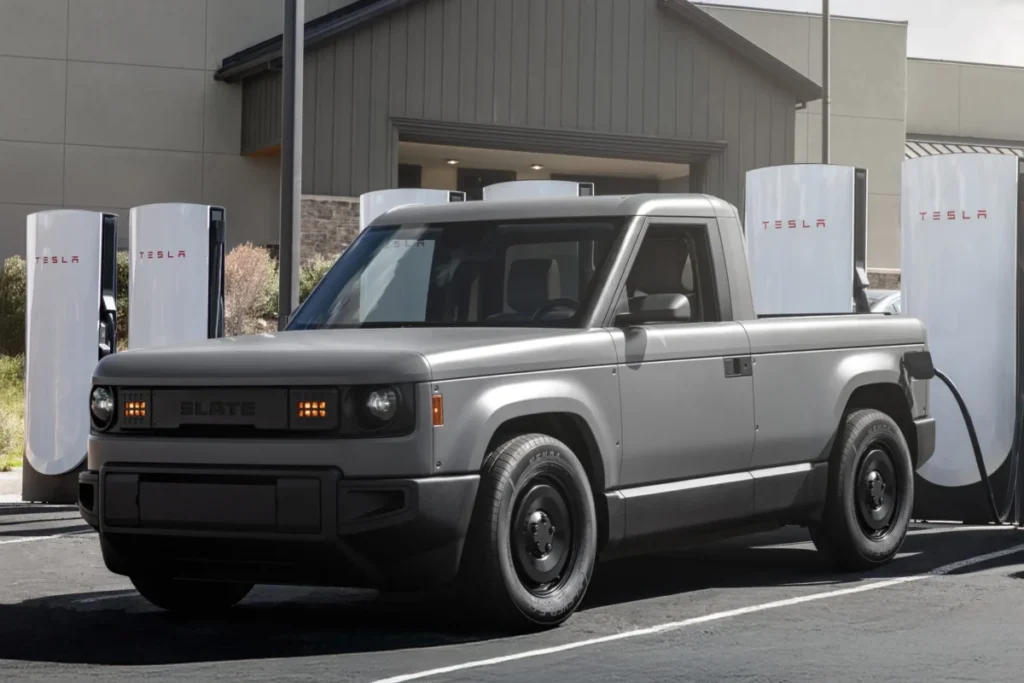
In an automotive landscape currently defined by high interest rates, cooling demand, and the withdrawal of federal subsidies, one startup is betting that minimalism is the ultimate luxury. Slate Auto, the enigmatic electric vehicle venture backed by billionaire Jeff Bezos, has officially pulled the curtain back on its flagship product, announcing a starting price of $24,950 for its base electric truck.
This aggressive pricing strategy, which brings the vehicle in at roughly half the average transaction price of a new car in the United States, is not merely a marketing maneuver—it is a foundational philosophy. By stripping away the bells and whistles that have bloated modern vehicle costs, Slate is attempting to create the "Model T" of the electric era, a utility-first machine designed for accessibility, modularity, and longevity.
The Financial Reality of the Slate Truck
The $24,950 price tag is undeniably disruptive, yet the company is quick to clarify that this figure is a base MSRP. It excludes a laundry list of inevitable costs, including destination charges, taxes, title, registration, and documentation fees, as well as any optional equipment a buyer might choose to add. Despite these caveats, the pricing positions Slate to capture a segment of the market that has been largely abandoned by legacy automakers: the budget-conscious buyer seeking a new, warrantied vehicle.
To put this in perspective, the Chevrolet Bolt—long considered the benchmark for affordable EVs—starts near $29,000, while the Nissan Leaf sits closer to $32,000. Even Ford, a titan of the industry, has only teased a potential $30,000 electric truck for 2027. Slate is arriving on the scene years ahead of the competition, and with a price point that puts it in direct competition with used internal combustion engine (ICE) vehicles.
Crucially, the company has also announced an upgrade to its performance specifications. The base model, originally estimated to offer 150 miles of range, has been bumped up to an estimated 205 miles, significantly enhancing the truck’s utility for daily commuting and light work tasks.
Chronology: From Stealth to Production
The journey to this price reveal has been a calculated, multi-year process.
- Early 2025: TechCrunch reports that Slate Auto, a company operating in total secrecy, is developing a low-cost electric vehicle backed by high-profile investors, including the Bezos family office. The goal: to build an "affordable" EV in the mid-$20,000 range.
- Mid-2025: The company emerges from stealth mode, slowly revealing its modular design. The vehicle is designed as a "transformer," starting as a two-seater pickup but capable of being converted into a five-seater SUV.
- Late 2025 – Early 2026: Slate begins building a community around the product, showcasing "Slate University"—a series of DIY instructional videos that demystify the conversion process, from swapping body panels to installing aesthetic upgrades.
- June 2026: News breaks that Slate has granted a share purchase warrant to Carvana, signaling a potential partnership that could bypass traditional dealership networks.
- Current Day: Slate officially opens pre-orders and confirms the $24,950 starting price, marking the transition from a concept-heavy startup to a consumer-facing automaker.
Modular Minimalism: A New Paradigm
Slate’s approach to cost-cutting is radical. The vehicle lacks the "tech-first" identity of modern EVs. There is no complex infotainment system, no high-end synthetic leather, and, perhaps most notably, no paint shop.
The vehicles ship in a uniform gray composite material. If a customer wants a different color, they are encouraged to apply a wrap. This decision alone saves the company hundreds of millions of dollars in capital expenditure, as traditional automotive paint facilities are among the most expensive components of a vehicle assembly plant. By relying on hand-crank windows and a modular, "bare-bones" architecture, Slate is stripping away the overhead that has prevented other manufacturers from bringing sub-$30,000 EVs to market.
The "Slate University" initiative is the final piece of this puzzle. By empowering owners to perform their own conversions and modifications, Slate is shifting the role of the car buyer from a passive consumer to an active participant in the vehicle’s lifecycle.
Market Implications and the Political Headwind
Slate’s launch comes at a precarious time for the electric vehicle industry. The political climate in the United States has shifted dramatically, with the second Trump administration and a Republican-controlled Congress taking a firm stance against the previous federal support for electrification.
The elimination of the $7,500 federal EV tax credit has left many major automakers scrambling to recalibrate their portfolios. Companies like Ford and GM have significantly delayed or shelved plans for new EV models, citing a lack of consumer demand and unfavorable economic policies. In this context, Slate’s mission becomes even more ambitious. By building a car that is inherently cheap to manufacture—without needing to rely on government subsidies to reach a competitive price—the company is attempting to "future-proof" itself against political volatility.
However, the lack of a dealership network remains a hurdle. Slate has confirmed it will sell directly to consumers, following the path paved by Tesla, Rivian, and Lucid. The potential tie-up with Carvana could be the "missing link" here. By leveraging Carvana’s massive logistics and online sales infrastructure, Slate could potentially scale its distribution without the gargantuan cost of building a proprietary network of service centers and showrooms.
Supporting Data: The Investor Backing
Despite the skepticism that often follows hardware startups, Slate has successfully raised roughly $1.4 billion across three funding rounds. This level of capitalization is rare for a startup, even one with high-profile backers.
The cap table is a "who’s who" of both the tech and finance worlds. Beyond the Bezos family office, the roster includes:
- TWG Global: Led by Guggenheim Partners CEO Mark Walter, whose investment in both Slate and Carvana suggests a strategic synergy.
- General Catalyst: A venture capital firm with a long track record of backing high-growth tech disruptors.
- Slauson & Co.: A Los Angeles-based firm known for its focus on overlooked markets and consumer-facing technology.
- Diego Piacentini: A former senior executive at Amazon who brings a deep understanding of scaling complex logistics networks.
This financial cushion is essential. The "Valley of Death"—the period between prototyping and mass production—has claimed many EV startups that lacked the runway to reach scale. With $1.4 billion, Slate has the resources to survive the initial manufacturing ramp-up, provided they can master the complexities of automotive supply chain management.
The Road Ahead
Slate Auto is attempting something that hasn’t been done in the modern era: producing an electric vehicle for the masses, for the working class, and for the pragmatist. By focusing on utility over prestige, they are challenging the industry’s obsession with ever-increasing range and computing power, which has driven EV prices into the stratosphere.
The ultimate question is whether the average consumer is willing to trade the comfort and tech-integration of a modern car for the utilitarian simplicity of a Slate truck. If the company can successfully execute its production targets and navigate the shifting regulatory landscape, it may well prove that the future of the electric vehicle is not in the premium, feature-laden segment, but in the accessible, modular, and affordable.
As pre-orders begin, the automotive industry will be watching closely. Whether Slate becomes the next great American automaker or another cautionary tale of the EV boom remains to be seen. But one thing is clear: the $24,950 price tag has officially changed the conversation about what an electric vehicle can be.