Navigating the Storm: Governance and Risk in an Era of Institutional Turbulence
In the landscape of 2026, the mission-driven sector—nonprofits, foundations, and educational institutions—finds itself in a state of profound, unprecedented disturbance. As federal administration policies target the foundational language of equity and inclusion, organizational leaders and board members are no longer merely debating policy; they are engaged in a high-stakes struggle to define the integrity of their institutions under fire.
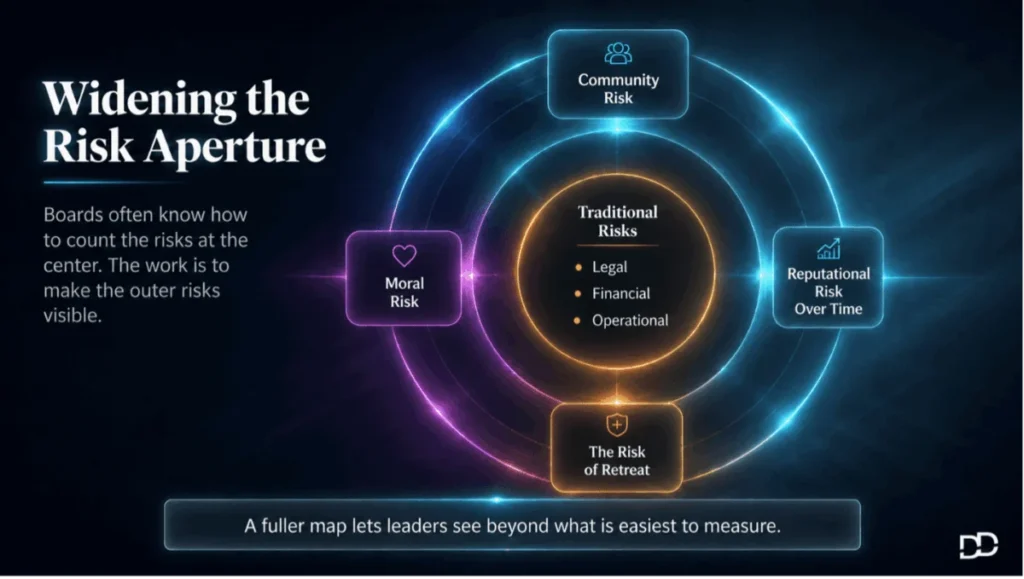
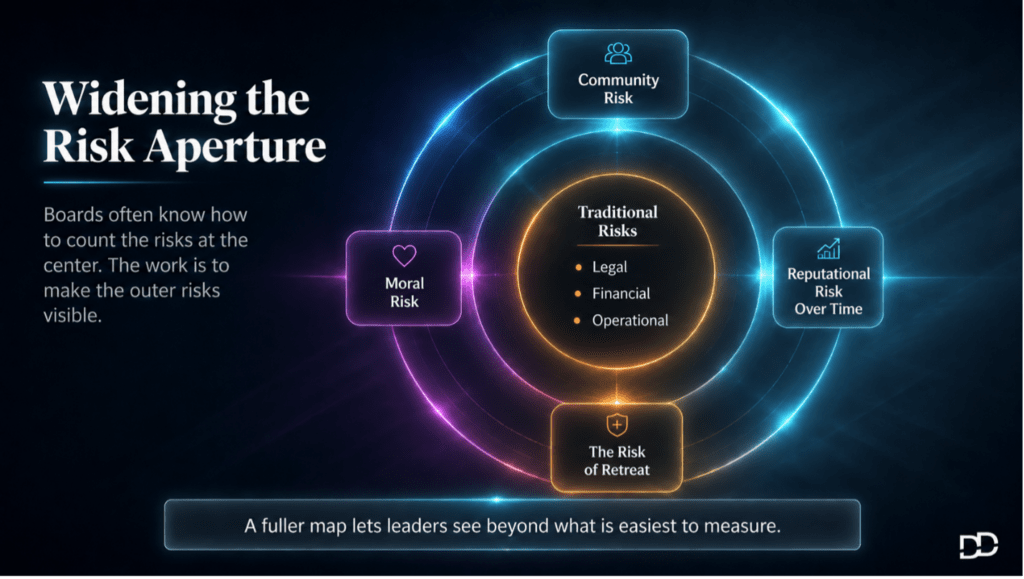
For Dax-Devlon Ross, a strategist and advisor to mission-driven organizations, the current climate is not just a series of legal hurdles. It is a fundamental stress test of institutional character. “When our organizational values are tested in real time by executive orders and legal threats,” Ross notes, “boards often turn to the language they know—legal and financial risk. But that often blinds them to the deeper, more volatile risks of retreating from the very mission they were founded to serve.”
The Anatomy of a Three-Wave Disruption
To understand the current volatility, one must look at the strategy deployed by the administration, which has unfolded in three distinct, calculated movements.
The first wave, which hit in early 2025, served as a blunt-force trauma to the federal bureaucracy. This involved the shuttering of federal Diversity, Equity, and Inclusion (DEI) offices and the codification of biological definitions regarding gender. By the second wave, the administration moved into the classrooms and courtrooms, effectively revoking disparate impact protections and setting the stage for nationwide legal shifts. The third wave, currently ongoing, aims to "cleanse" the private sector, targeting everything from artificial intelligence guardrails to the fiduciary duties of major investment firms.
For nonprofits and universities, this created a climate of manufactured chaos. Institutions that had spent years centering equity in their operations were forced to reckon with a new reality: the language they used to describe their mission had, in the eyes of federal regulators, become a target.

Chronology of the Pressure Cooker
The shift from professional debate to existential threat accelerated rapidly in the spring of 2025. On April 3, the Department of Education issued a sweeping certification demand tied to federal funding. This move, which required educational institutions to swear they were not engaging in “illegal DEI,” effectively extended the logic of the Supreme Court’s Students for Fair Admissions v. Harvard ruling into the K–12 space.
For the nonprofit sector, the message was clear: no one was flying under the radar. Boards that had previously viewed anti-racism and equity commitments as moral imperatives suddenly saw them as liabilities. As Ross recalls, the mood in boardrooms across New York City and Washington, D.C., shifted overnight. Terms like "systemic barriers" and "culturally responsive," which had once signaled institutional conviction, were suddenly perceived as "heat maps" for federal investigation.
The "Risk Posture" Spectrum
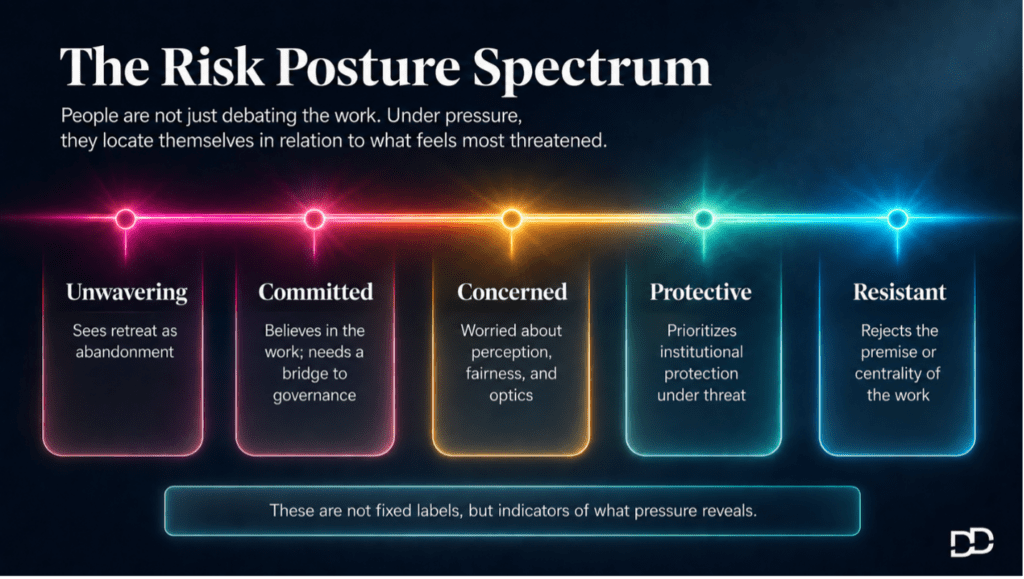
In his work facilitating board retreats, Ross identified a consistent pattern: when pressure rises, board members instinctively adopt different "risk postures." These postures are not fixed labels, but indicators of how internal anxiety and external pressure collide.
The Five Postures of Governance:
- The Unwavering: For these members, backlash is confirmation that the work is essential. They view retreat as a fundamental breach of mission.
- The Committed but Seeking Clarity: These individuals believe in the mission but lack the "governance muscle" to translate those values into protection against legal or financial exposure. They require translation, not persuasion.
- The Concerned Interpreters: Heavily focused on optics, donors, and political narrative, this group worries about how the organization is perceived by those who do not share its values.
- The Protective Reticent: Often fluent in fiduciary language, they argue that lowering visibility or softening language is a necessary act of stewardship to protect the organization’s survival.
- The Resistant: Fewer in number, this group views equity and DEI as inherently divisive or outside the scope of the organization’s mandate.
Ross argues that these postures are not merely opinions; they are "internal maps" of how members interpret the world. If a facilitator does not make these postures visible, the board remains trapped in a cycle of defensive, uncoordinated decision-making.
Supporting Data: Why "Resilience" is More Than Endurance
The word "resilience" has become a buzzword in the nonprofit sector, but in the context of the current administration’s pressure, its traditional definition—"enduring the blow"—is insufficient. Research into ancient societies that survived environmental and demographic collapse suggests that true resilience comes from the ability to learn from disturbance.
Societies that recovered from drought or conflict were not those that simply "held on." They were those that developed new collective habits—new ways of sharing resources and telling stories about their survival. For the nonprofit sector, this means that disruption is only useful if it leads to collective learning. If a board simply scrubs its website or softens its language, it has failed to learn; it has merely retreated.
Implications for Future Governance
The implications for the sector are grave. When boards allow fear to mask itself as "organizational judgment," they risk long-term damage to staff trust and community credibility. The "hidden risks" of such retreats include:
- The Loss of Staff Trust: When leaders abandon core values under pressure, they signal to employees that their commitment to equity was performative, leading to talent drain and demoralization.
- The Erosion of Community Credibility: The populations these organizations serve often bear the brunt of the political climate; when institutions retreat, they break the social contract with the people they exist to support.
- Mission Drift: By shifting focus from impact to survival, organizations become unmoored from their founding purpose, eventually becoming unrecognizable to themselves.
A Path Forward: Widening the Aperture
To move beyond the panic of the moment, Ross suggests that boards must stop viewing differences in opinion as conflicts to be smoothed over. Instead, these differences should be treated as vital data points.
"The goal is not to force consensus," Ross explains. "The goal is to create a room where board members can name their fears without letting those fears dictate the organization’s entire strategy."
By facilitating conversations that begin with locating where each board member stands on the risk posture spectrum, leaders can move to the next stage: widening the aperture. This means asking uncomfortable, fundamental questions:
- What are we protecting, and why is it worth protecting?
- What are we avoiding by changing our language?
- If we retreat now, what is the long-term cost to the people we serve?
The final phase, deciding, becomes far more grounded once the board has clarity on its own internal dynamics.
As the nonprofit sector moves into the latter half of the decade, the lesson is clear: navigating a hostile environment requires more than just legal counsel or public relations strategy. It requires the internal courage to be "intelligible to oneself." Organizations that can look at their own fears, identify their own biases, and align their actions with their values—even under the weight of federal intimidation—are the only ones that will emerge from this disruption with their integrity intact.
The question for boards is no longer simply "How do we survive?" but "Who are we becoming in the process of surviving?" For those willing to do the hard work of internal discernment, the answer to that question may be the difference between obsolescence and enduring relevance.