Legal Maneuvers and Logistical Fumbles: Federal Trial for Luigi Mangione Delayed to 2025
NEW YORK — The legal odyssey surrounding Luigi Mangione, the 28-year-old Ivy League graduate accused of the brazen assassination of UnitedHealthcare CEO Brian Thompson, took an unexpected turn on Monday. In a Manhattan courtroom, U.S. District Judge Margaret Garnett announced that the federal trial against Mangione would be postponed until January, citing the practical impossibility of juggling the defendant’s upcoming state murder trial with federal proceedings.
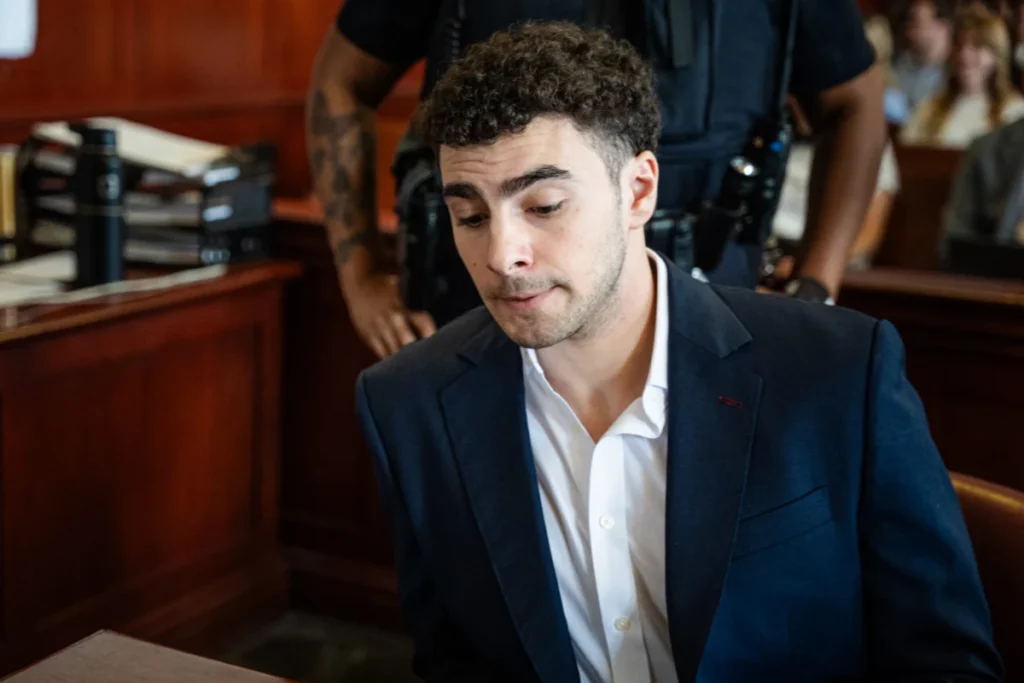
The hearing itself was marked by a touch of the absurd: the proceedings were delayed by 20 minutes because Mangione, the primary defendant in one of the most high-profile murder cases in recent memory, was trapped in a malfunctioning courthouse elevator. When he finally arrived—clad in a beige jail uniform—he appeared bemused, offering a brief, inscrutable gaze toward a gallery packed with supporters.
The Revised Judicial Calendar
The rescheduling marks a significant shift in the timeline of a case that has captivated the public imagination and sparked intense debate regarding the American healthcare system. According to Judge Garnett, jury selection for the federal case will now commence on January 5, 2026, with opening statements and the presentation of evidence set to follow on January 25. The original schedule had slated the federal trial for this coming fall.
Judge Garnett, who previously expressed “undue optimism” regarding the feasibility of an autumn trial, conceded that the overlap with the state case made the original timeline untenable. “In my view, it is simply impossible to be moving through the jury selection process in this case while the defendant and his counsel are fully occupied by conducting the state trial,” she stated.
To maintain the integrity of the process, the judge also ruled that the juror questionnaire will remain under seal until the jury panel is finalized. Garnett argued that allowing the questionnaire to circulate online for months before selection would “only make what promises to be a difficult task more difficult,” a nod to the intense media scrutiny and the polarized public sentiment surrounding the defendant.
Chronology of a High-Stakes Legal Battle
The legal trajectory of the Mangione case has been defined by administrative friction and complex jurisdictional challenges.
- December 4, 2024: Brian Thompson, 50, is shot and killed in a targeted attack as he walks toward a Manhattan hotel for UnitedHealth Group’s annual investor conference. Surveillance footage captures a masked gunman approaching from behind. Police later note that the ammunition recovered from the scene bore the words “delay,” “deny,” and “depose”—a cynical reference to industry criticisms of insurance claim practices.
- December 9, 2024: Following a five-day nationwide manhunt, Mangione is apprehended at a McDonald’s in Altoona, Pennsylvania, approximately 230 miles west of New York City.
- January 2026 (Pre-trial Rulings): Judge Garnett issues a pivotal ruling: while she removes the death penalty as a sentencing option, she allows prosecutors to introduce critical evidence seized from Mangione’s backpack at the time of his arrest. This includes a 3D-printed pistol allegedly linked to the murder and a notebook containing explicit declarations of his intent to target an insurance executive.
- June 16, 2026: A state court hearing is delayed by a full day due to a clerical failure: prosecutors neglected to inform the jail that Mangione was required to appear in court.
- June 22, 2026: Monday’s hearing results in the formal postponement of the federal trial to January 2026 to accommodate the state trial starting on September 8.
The Defense’s Constitutional Argument
Mangione’s legal team, led by high-profile defense attorneys Karen Friedman Agnifilo and Marc Agnifilo, has consistently argued that the dual-track prosecution strategy violates their client’s constitutional rights.
The defense has maintained that forcing Mangione to defend himself in two separate, complex trials—one in state court and one in federal court—is an exercise in redundancy and exhaustion. Mangione himself articulated this frustration during a February hearing, telling the judge, “It’s the same trial twice. One plus one is two. Double jeopardy by any commonsense definition.”
While the legal doctrine of dual sovereignty generally allows both state and federal governments to prosecute an individual for the same act if it violates both jurisdictions’ laws, the practical burden on the defense is significant. The defense’s initial attempt to pivot toward a psychiatric defense in the state case—arguing extreme emotional disturbance—was quickly retracted, highlighting the volatile and often unpredictable nature of the defense strategy. It is worth noting that such a defense is not permitted under federal law.
Supporting Data and Evidence
The prosecution’s case against the 28-year-old rests on a foundation of digital and physical evidence. Federal charges allege that Mangione orchestrated the murder by leveraging modern technology to track and stalk the CEO. Prosecutors claim he utilized cellphones, the internet, and interstate highway networks to coordinate his movements, eventually securing lodging at a hostel catering to out-of-state travelers.
The 3D-printed firearm remains a centerpiece of the evidence. Forensic investigators have suggested that the weapon matches the ballistics from the crime scene, potentially linking Mangione to the act with high statistical probability. The notebook recovered at the time of his arrest, in which he allegedly detailed his plan to “wack” an executive, provides the prosecution with a compelling narrative of premeditation.
Public Sentiment and the “Free Luigi” Movement
Perhaps the most unusual aspect of this case is the transformation of the defendant into a symbol of anti-corporate sentiment. Despite the gravity of the charges—which carry a potential life sentence—Mangione has garnered a dedicated base of supporters.
An online fundraiser for his legal defense has eclipsed the $1.5 million mark, providing his legal team with substantial resources. Outside the courthouse, supporters are frequently spotted wearing “FREE LUIGI” T-shirts and donning green clothing, a symbolic nod to the Nintendo character Luigi. This “cause célèbre” status has created a pressurized environment for the court, as the trial has become less a simple criminal proceeding and more a focal point for public anger toward the health insurance industry.
Implications for the Healthcare Industry
The assassination of Brian Thompson has sent shockwaves through the corporate world, particularly within the healthcare sector. The phrases inscribed on the ammunition—delay, deny, depose—have served as a grim reminder of the public’s mounting frustration with insurance bureaucracies.
Corporate security experts have noted a marked increase in executive protection protocols across the insurance industry in the wake of the murder. The trial, when it eventually proceeds, is expected to delve deep into the systemic frustrations that may have motivated the defendant. While the court will focus strictly on the criminal act and the evidence at hand, the cultural backdrop of the case ensures that the proceedings will be watched by millions, many of whom see in Mangione a mirror reflecting their own grievances against the healthcare establishment.
As the court moves toward the September state trial, the legal system faces a daunting task: maintaining a veneer of dispassionate justice while the case remains tethered to one of the most volatile socio-political issues of the decade. For now, the elevator delay in Manhattan is but a minor footnote in a saga that will continue to unfold in the public eye well into 2026.