Google Vids Evolves: Personal AI Avatars and Gemini Omni Redefine Workplace Video Creation
By TechCrunch News Desk
Updated: July 16, 2026
In a significant pivot for its creative productivity suite, Google has unveiled a suite of transformative updates to Google Vids, its AI-powered video creation platform. While the broader industry reels from the sunsetting of OpenAI’s experimental Sora platform earlier this year, Google is betting heavily that the demand for high-quality, synthetic video production remains high—provided it is anchored in enterprise-grade utility and ethical safeguards.
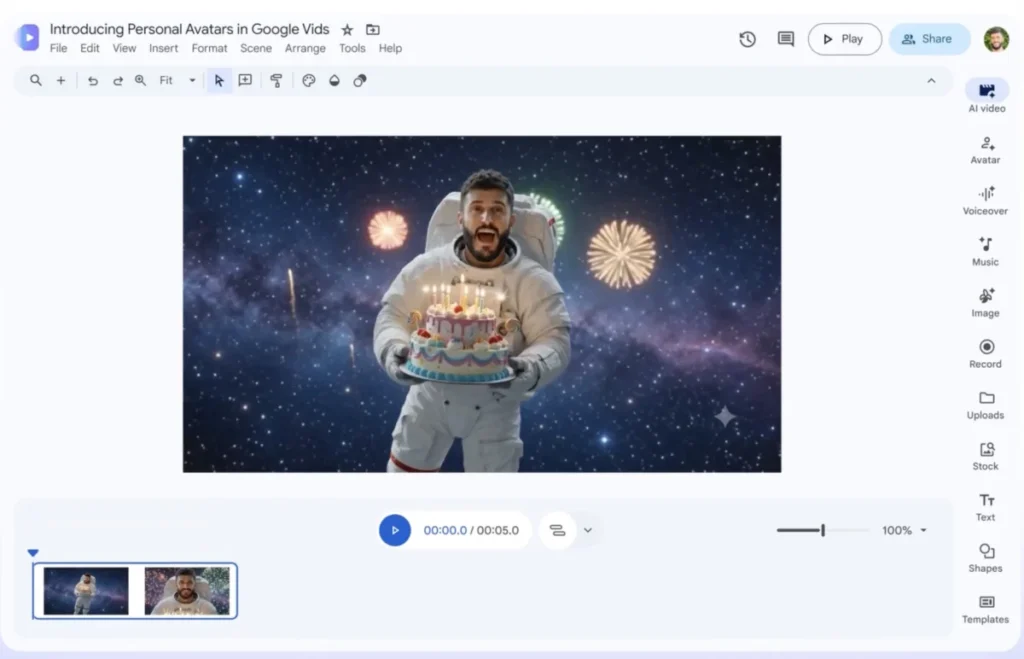
The latest update, announced Thursday, introduces "Personal Avatars" and the deep integration of Google’s multi-modal powerhouse, Gemini Omni. These features transition Google Vids from a simple presentation tool into a robust, all-in-one video production powerhouse, positioning the company to compete directly with specialized AI-video startups like HeyGen, Synthesia, and Captions.
Main Facts: The New Capabilities
The core of this update centers on personal expression and creative flexibility. By allowing users to create hyper-realistic digital versions of themselves, Google is lowering the barrier for entry for professionals who need to record training modules, corporate updates, or asynchronous communications without the need for high-end studio equipment.
The Personal Avatar Feature
Users can now generate a custom digital twin. The process is designed for accessibility: a user uploads a brief selfie and a voice recording. The system then synthesizes these inputs to create an avatar capable of speaking whatever text the user inputs. This feature is strictly gated to ensure security, requiring users to be at least 18 years of age and limiting access to specific regions, reflecting a cautious approach to deepfake risks.
Gemini Omni Integration
Beyond the avatar, the integration of Gemini Omni represents a leap in generative workflow. Users can now leverage a hybrid input method, combining written prompts with reference imagery. Omni acts as the "director," synthesizing these disparate assets into a cohesive video file. Furthermore, the model handles post-production tasks—such as background replacement, lighting adjustments, and stylistic color grading—directly within the browser interface.
A Chronology of the AI Video Landscape
To understand the significance of this shift, one must look at the rapid evolution of the sector over the past eighteen months.
- Early 2024: The AI video space was dominated by "wow-factor" demos. OpenAI’s Sora captured the public imagination with its high-fidelity, long-form video generation, though it remained largely inaccessible to the public.
- March 2026: A major industry correction occurred when OpenAI officially shut down the Sora project. The move signaled a shift in the market; investors and developers began moving away from "black box" video generators and toward utilitarian, integrated workflows that fit into existing productivity suites.
- May 2026: Google introduced Gemini Omni, a multi-modal model capable of processing and generating video, audio, and text in real-time. This provided the technical architecture required for the current Vids update.
- July 2026: Google officially integrates these capabilities into Google Workspace, marking the transition of generative video from a niche research project to a standard enterprise commodity.
Supporting Data and Technical Implementation
The technical backbone of this update is a sophisticated layering of AI safety and generative models. Unlike early AI video tools that were prone to "hallucinations" or lack of structural coherence, the Gemini Omni implementation allows for step-by-step editing.
The Edit-as-You-Go Workflow
Previously, AI video tools operated on a "regenerate from scratch" model. If a user disliked a specific frame or a lighting choice, the entire video had to be re-rendered. The new "step-by-step" capability allows users to modify individual elements—such as swapping a background or adjusting the tone of a voiceover—without discarding the entire project. This iterative process is crucial for the enterprise market, where precision is paramount.
Security and Provenance
A key component of this release is the deployment of SynthID, Google’s watermarking technology. Every video generated via these new tools is invisibly watermarked. This is a critical preemptive strike against the misuse of AI-generated avatars. By tying the avatar’s likeness strictly to the user’s authenticated Google account, the company is attempting to build a "chain of custody" for digital likeness, theoretically preventing the impersonation of high-profile figures or corporate leadership.
Official Responses and Strategic Positioning
Google’s positioning of Vids as a "Workspace" tool rather than a "Creative" tool is intentional. By situating these features within the ecosystem where employees already manage email, calendars, and documents, Google is removing the friction that typically prevents businesses from adopting new media formats.
In a statement accompanying the release, Google highlighted that the intent is to "empower every employee to communicate more effectively." While the company did not explicitly name competitors, the move is a direct challenge to the "AI-video as a service" companies that have proliferated recently.
Market analysts suggest that by offering this functionality to Google Workspace subscribers, the tech giant is effectively "commoditizing" the offerings of smaller startups. Companies that previously paid thousands of dollars in annual licensing fees to platforms like Synthesia or HeyGen may now find that Google Vids provides sufficient, if not superior, utility for internal communications.
Implications: The Future of Enterprise Communication
The End of the "Talking Head" Production
The most immediate implication of this update is the death of the costly "corporate video." Traditionally, creating a company-wide update required a professional camera, lighting crew, and post-production editor. With these tools, a manager can record a script and have an AI avatar deliver it with perfect posture, lighting, and pacing, all within minutes.
The Ethical Minefield
Despite the implementation of SynthID, the rollout of personal avatars will inevitably reignite debates surrounding digital consent and the future of work. If an employee can be "replicated" by an AI, what happens to their image rights? While Google has limited the scope to the account holder’s own likeness, the normalization of digital twins could lead to uncomfortable workplace dynamics.
Competition and Market Consolidation
For startups in the AI-video space, Google’s move is both an validation of their market and an existential threat. These startups must now differentiate themselves through superior quality, niche features (such as professional-grade lip-syncing or multi-language localization), or by focusing on industries where Google Workspace is not the primary ecosystem.
A New Standard for Productivity
Ultimately, the evolution of Google Vids signals that generative AI is moving into its "maintenance and productivity" phase. The novelty of simply creating a video is gone; the new standard is how well that video integrates into existing business processes.
As businesses begin to adopt these tools, we can expect to see a drastic increase in the volume of video content within internal corporate networks. The challenge will no longer be how to make a video, but what to say, as the technical hurdles to production continue to vanish.
The era of the "AI-powered workplace" is no longer a futuristic concept—it is being written in the code of the tools we use every day. As Google continues to refine Gemini Omni, the line between reality and synthetic production will only continue to blur, making the role of authentication and digital provenance the next great frontier in the tech industry.