Beyond the Fable: Reimagining Leadership Through the Lens of Ruby Bridges and Barbara Henry
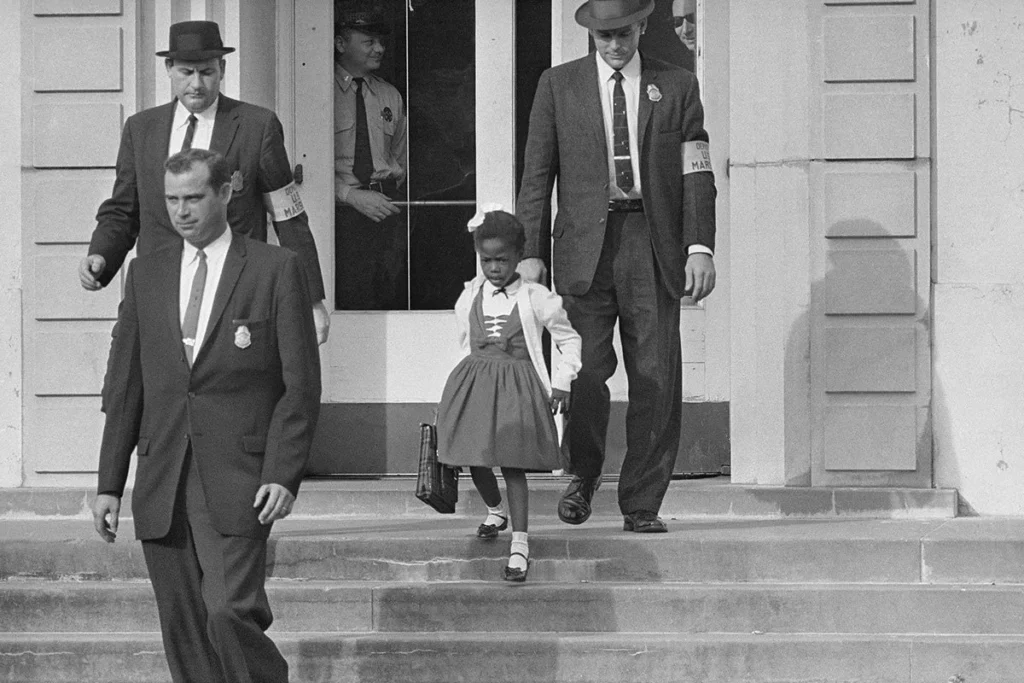
The image is etched into the collective American consciousness: a six-year-old Black girl, dressed in a pristine white dress with a hairbow, walking stoically into William Frantz Elementary School in New Orleans, flanked by imposing federal marshals. This 1960 photograph of Ruby Bridges is more than a historical artifact; it is an icon of the Civil Rights Movement. Yet, in our rush to canonize the "heroic" struggle, we often flatten the story into a digestible fable of individual courage.
By peeling back the layers of this iconic moment, we uncover a more nuanced, complex reality—one that challenges our contemporary definitions of leadership. As we navigate an era of hyper-individualized, "hero-centric" leadership models, the true story of Ruby Bridges and her teacher, Barbara Henry, offers a necessary corrective. It suggests that effective leadership is not found in the mythical "rugged individual," but in the quiet, persistent, and often radical act of connection.
The Myth of the Solitary Hero
Modern organizational culture is saturated with a specific, Western-dominated archetype of leadership: the fearless, solitary visionary who moves through the world with absolute certainty. This "hero’s journey" narrative—gaining wisdom through slaying personal dragons—is frequently presented as a universal truth.
However, scholars like Laura Morgan Roberts, Anthony J. Mayo, David A. Thomas, and the late bell hooks have argued that these archetypes are deeply rooted in patriarchal and Eurocentric norms. By fixating on the "great man" (or woman) theory, we erase the decentralized, group-centered networks that actually drive meaningful social change. Insisting on "certainty" as a leadership virtue assumes that complex human crises have simple, binary answers. In reality, this obsession with certainty makes it nearly impossible for leaders to admit mistakes, build authentic trust, or create the psychological safety required for collective growth.
Chronology: A Path to the Ninth Ward
To understand the true nature of the leadership displayed in 1960, one must look at the trajectory of Barbara Henry’s life, which led her to that pivotal classroom in New Orleans.
Born in Boston in 1932, Henry was a product of the Girls’ Latin School, a public institution that prided itself on being a microcosm of the city’s socio-economic and cultural diversity. The faculty there treated every student with an egalitarian respect that profoundly shaped Henry’s worldview.
In 1958, at age 26, Henry took a teaching post at the Dreux Air Force Base School in France. It was here that she first navigated the complexities of a desegregated classroom, teaching the children of U.S. Air Force personnel. This experience, followed by a stint in Germany, provided her with a unique perspective on the power of education as a tool for social cohesion.
When she returned to the United States and moved to New Orleans, she was eager to continue her career. A phone call from the city’s school superintendent changed the trajectory of her life. He informed her of a position at an elementary school that was slated for integration. When he asked, "Would that make a difference to you?"—implying the racial volatility of the assignment—Henry’s acceptance was immediate. She was not seeking to be a hero; she was simply answering the call of her profession.
The Reality of the "Brave Ruby" Story
The popularized version of the story focuses on the danger and the bravery of the child. But the unredacted truth is far more grueling. The integration of William Frantz Elementary was not merely a moment of triumph; it was a period of systemic failure and personal devastation.
While Ruby Bridges walked into that school, her family suffered immense consequences. Both of her parents lost their jobs, and her grandparents were evicted from the Mississippi farm where they had worked for 25 years. The "heroic" narrative often omits the reality that the school, while technically desegregated, remained deeply fractured.
In a revelatory moment, Henry discovered that other children—white children—were being taught in the basement by a teacher who refused to interact with Ruby. Upon discovering this, Henry did not wait for institutional permission; she demanded to know why those children were being excluded from a communal learning environment.
"I never taught them reading," Henry recalled. "The other teacher kept them in the mornings, and then I had all the kids in the afternoon. And so, in the afternoons, we desegregated the school, literally and factually."
Implications for Modern Leadership
What does this tell us about leadership in the 21st century?
First, it highlights the failure of institutional support. Henry navigated the presence of federal marshals, an unsupportive administration, and an isolated faculty. Her leadership was not validated by her superiors; it was actively hindered by them. This reality check is crucial for modern professionals: true leadership often occurs in the "gaps" where institutional systems fail to provide guidance or safety.
Second, it redefines leadership as a relational act. When interviewed by an organizational strategist, Henry initially rejected the label of "leader." She viewed herself as a teacher, a risk-taker, and a participant. Yet, her actions—creating a shared space for children who had been separated by hate—epitomize the highest form of leadership: the ability to build bridges where others have built walls.
Third, it emphasizes the power of the "long game." The friendship between the six-year-old student and her 28-year-old teacher has lasted over six decades. This longevity proves that the most impactful leadership is not a singular, dramatic event, but a sustained commitment to human dignity.
A Human-Centered Approach
The fable of the "superhero leader" is a seductive fantasy, particularly for those who feel marginalized by dominant cultural narratives. It suggests that if we are "special" enough, we can solve systemic problems through individual willpower. But as Henry’s story illustrates, the reality is more grounded and more hopeful.
Leadership, in its most effective form, is a messy, exhausting, and collaborative endeavor. It requires us to abandon the desire for a "clean" narrative and embrace the ambiguities of the human experience. It demands that we acknowledge our traumas, leverage our strengths, and—most importantly—recognize that we are never truly walking the path alone.
As Henry noted during her reflection, "You really are a leader when you’re a teacher… You definitely have to be." This is not a call to hold a title or occupy a corner office. It is a call to be present, to be rigorous in one’s values, and to be the person who, when faced with an unjust room, decides to open the door.
By dismantling the fables of the past, we allow ourselves to build a more authentic framework for the future. We learn that leadership is not a performance for an audience, but a quiet, daily commitment to the people beside us. In the end, Ruby Bridges and Barbara Henry were not just integrating a school; they were modeling a form of leadership based on empathy, shared humanity, and the refusal to accept the status quo. That is a lesson that remains as relevant today as it was in 1960.