AI Boom Goes Global: Reshaping Investment Landscapes Beyond U.S. Shores
June 5, 2026 – The exhilarating, often dizzying, ascent of artificial intelligence (AI) is no longer a story solely dominated by a handful of Silicon Valley giants. What began as a concentrated surge in U.S. technology stocks, famously driven by the "Magnificent Seven" and the Nasdaq 100, has rapidly evolved into a truly global phenomenon, redrawing the contours of investment landscapes worldwide. As humanity grapples with the profound implications of this technological innovation boom, the financial markets are already reflecting a significant geographical rebalancing, with emerging markets and key Asian economies taking center stage in the global AI buildout.
For over a decade, the U.S. stock market stood as the undisputed titan of global finance, consistently outperforming its international counterparts. However, recent data suggests a compelling shift, indicating that the AI trade has now transcended national borders, ushering in a new era of distributed growth. The underlying infrastructure, components, and intellectual capital required to power the AI revolution are dispersed across the globe, creating unexpected beneficiaries and presenting novel opportunities for investors.
The Global AI Ascent: A Chronology of Shifting Market Leadership
The narrative of AI’s financial impact initially revolved around the pioneering software and platform companies primarily domiciled in the United States. These firms, with their immense market capitalization and rapid innovation cycles, captured the lion’s share of investor attention and capital in the initial phases of the AI boom, particularly throughout 2023. The Nasdaq 100, heavily weighted towards these tech behemoths, became the de facto benchmark for AI-driven gains.
Early Dominance and Shifting Tides
The early stages of the AI revolution saw significant capital flows into established American technology companies. Investors sought exposure to firms developing foundational AI models, cloud infrastructure, and consumer-facing AI applications. This period cemented the perception that AI wealth creation would be largely an American story, reinforcing the decade-long trend of U.S. market outperformance.
However, as the AI buildout progressed from conceptualization and software development to the tangible, hardware-intensive requirements of training and deploying sophisticated models, the global supply chain began to assert its critical importance. The sheer computational demands of AI necessitated a massive expansion in semiconductor manufacturing, advanced packaging, and specialized components – areas where many non-U.S. nations hold a dominant position.
Key Milestones in Market Performance
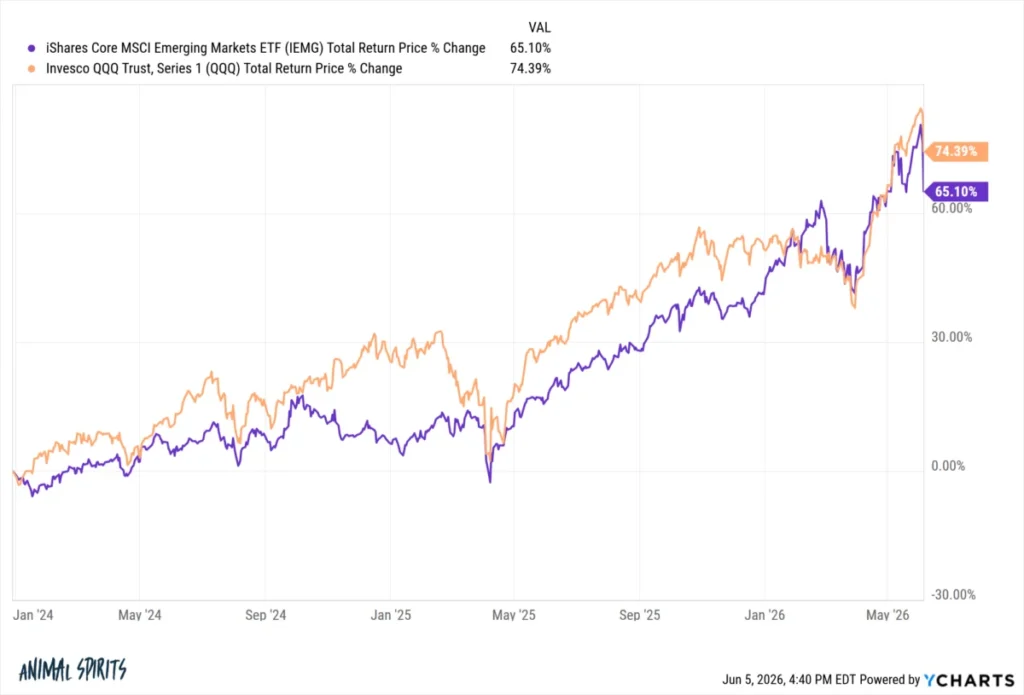
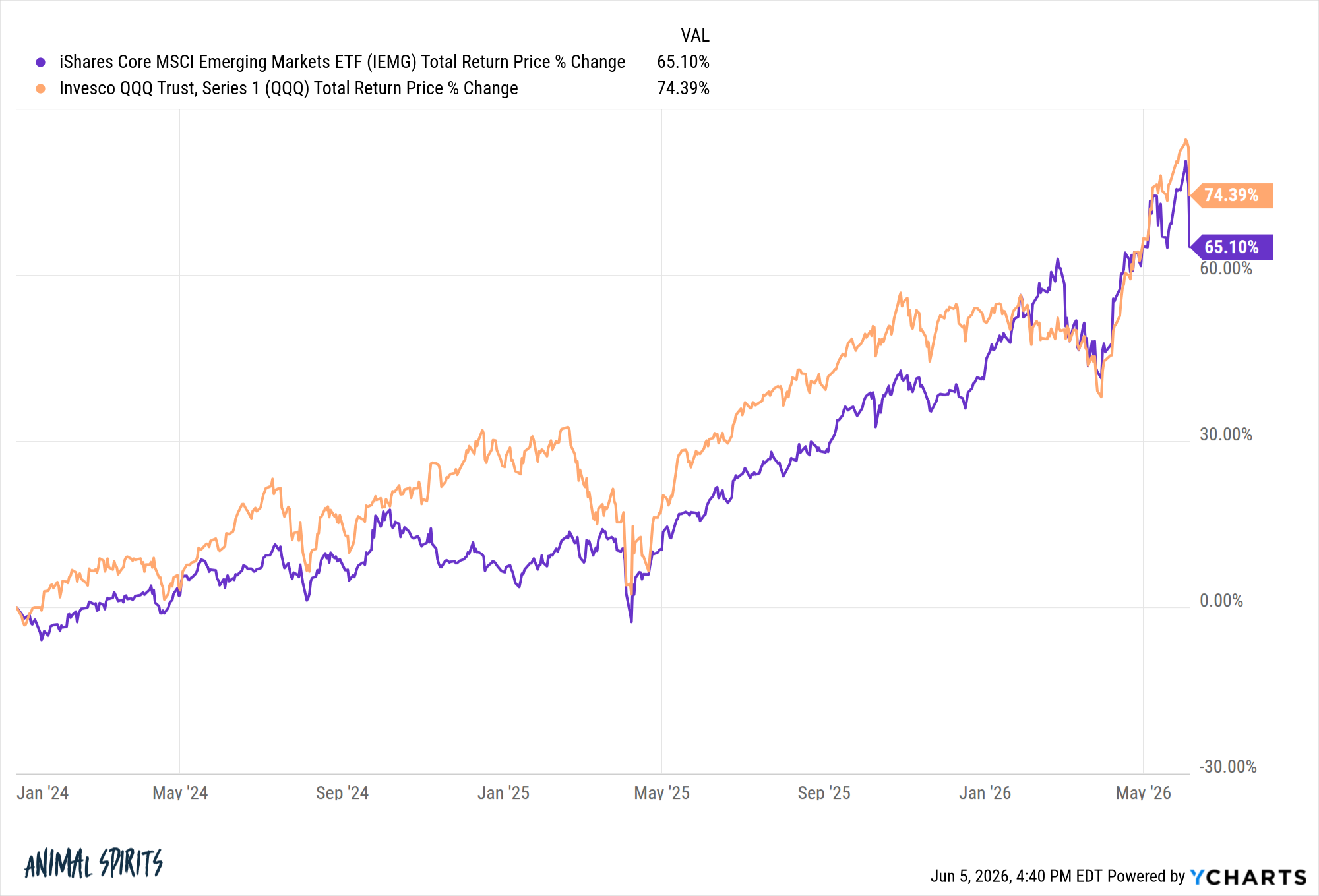
The turning point, according to market analysts, became increasingly evident from the start of 2024. This period marked a crucial phase where the performance of broader emerging markets began to run "neck-and-neck" with the previously unassailable Nasdaq 100. This convergence was not merely a statistical anomaly but a reflection of deep structural shifts in where AI value creation was accumulating.
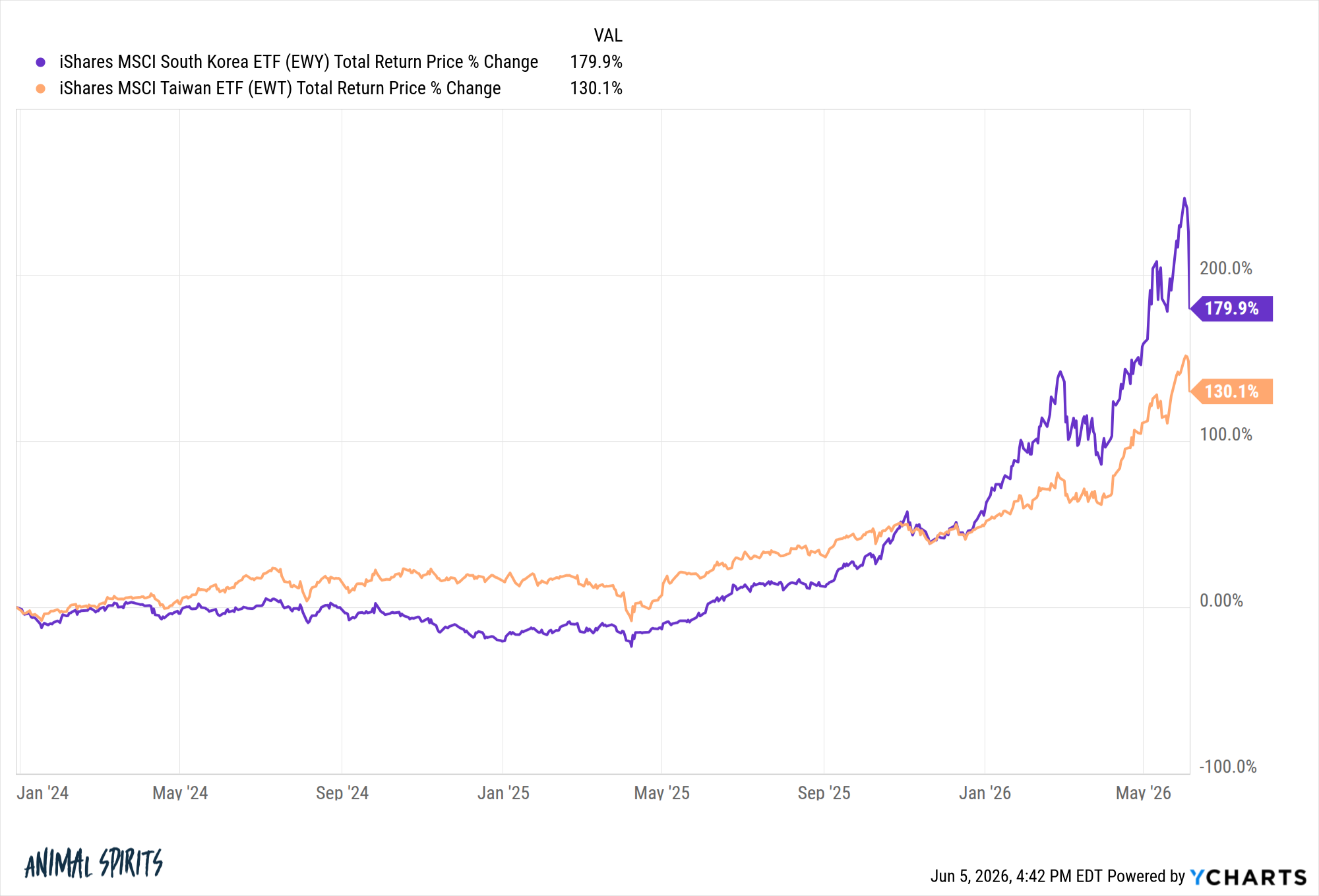
Leading this charge were the economies deeply embedded in the semiconductor ecosystem. South Korea and Taiwan, in particular, witnessed an unprecedented surge in their stock markets, driven by their pivotal roles in manufacturing the advanced chips indispensable for AI. Over the past twelve months, South Korea’s benchmark index has skyrocketed by nearly 180%, while Taiwan’s has climbed by more than 100%. These astounding figures starkly contrast with the robust, but comparatively modest, gains of 25% for the S&P 500 and 34% for the Nasdaq 100 over the same period.
Beyond these two semiconductor powerhouses, other Asian markets also demonstrated significant, AI-influenced growth. China’s stock market, despite facing various internal and external headwinds, posted an impressive gain of almost 60% over the past year, fueled by domestic AI innovation and robust government support for the sector. Japan, a global leader in robotics and advanced materials, saw its market rise by 28%, while Thailand, an emerging hub for electronics manufacturing, registered a 41% increase.
This broad-based global rally, however, is not without its inherent volatility. The exuberance seen in many of these hottest markets experienced a notable reversal on Friday, June 4, 2026, serving as a timely reminder that even transformative technological booms are subject to market corrections and investor sentiment shifts. South Korea, for instance, experienced a 14% drop, and Taiwan fell 7% on that single day, highlighting the concentrated risks within these high-flying sectors.
Supporting Data: Unpacking the Global AI Trade
The notion that the AI investment thesis has gone global is substantiated by compelling data from various financial institutions. The shift from a U.S.-centric narrative to a truly international one underscores the complex, interconnected nature of modern technological innovation.
Beyond the "Mag 7": A Diversified Landscape
For much of 2023, discussions about AI investments were almost exclusively focused on a select group of mega-cap U.S. technology companies. These firms, often dubbed the "Magnificent Seven," demonstrated unparalleled growth and innovation in AI software, cloud services, and specialized processors. However, the subsequent phase of AI development revealed that the physical infrastructure underpinning these advancements—the microchips, memory, and networking components—is produced by a diverse set of companies globally.
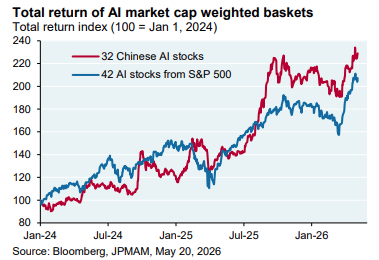
Michael Cembalest of J.P. Morgan provided a critical comparative analysis, pitting a basket of Chinese AI stocks against a similar basket within the S&P 500. While the specific performance metrics of his comparison would typically be visualized, the essence of his finding was that significant, albeit distinct, AI-driven growth was occurring simultaneously in different major economic blocs. This highlights that AI innovation is not monolithic; it encompasses various applications, hardware, and software developments tailored to different market needs and regulatory environments. Chinese companies, for instance, are heavily investing in domestic AI capabilities, often with state backing, focusing on areas like smart manufacturing, surveillance, and large language models catering to Mandarin speakers. This parallel development demonstrates that the AI market is robust enough to support multiple centers of excellence, each contributing uniquely to the global technological mosaic.
Emerging Markets: A New Epicenter
The performance of emerging markets (EM) as a whole, represented by indices like the iShares Core MSCI Emerging Markets ETF (IEMG), in keeping pace with or even surpassing the Nasdaq 100 since early 2024, is a strong indicator of this global shift. This parity suggests that the growth engines of the global economy are diversifying, with AI acting as a potent catalyst.
The primary drivers of this EM surge are unequivocally South Korea and Taiwan. These two nations collectively now constitute approximately half of the weight in many broad emerging market indices, a testament to their outsized influence in the global technology supply chain. Their market indices, such as the iShares MSCI South Korea ETF (EWY) and the iShares MSCI Taiwan ETF (EWT), have registered phenomenal gains:
- South Korea (EWY): Up nearly 180% in the past 12 months.
- Taiwan (EWT): Up more than 100% in the past 12 months.
These figures dwarf the performance of even the best-performing U.S. indices during the same period, with the S&P 500 up 25% and the Nasdaq 100 up 34%. The reason for this extraordinary outperformance is the heavy concentration of critical AI supply chain components within these economies. Companies like SK Hynix (South Korea), Samsung Electronics (South Korea), and Taiwan Semiconductor Manufacturing Company (TSMC) (Taiwan) are not merely participants but foundational pillars of the AI buildout. These three giants alone often account for more than 20% of their respective country’s stock market capitalization, reflecting their global dominance in memory chips, logic chips, and advanced foundry services.
While the U.S. stock market is often criticized for its concentration in a few mega-cap tech stocks, the degree of concentration in some of these Asian markets is even more pronounced. This heavy weighting in a few key AI-related stocks makes their market performance highly sensitive to developments in the semiconductor industry.
Broader Asian and Global Participation
The global nature of the AI trade extends beyond the semiconductor heartlands. Other significant players have also shown remarkable growth:
- China: A 60% increase over the past year underscores its domestic push in AI, from software applications to hardware manufacturing and research. Chinese tech giants are investing heavily in AI capabilities, aiming for technological self-sufficiency and leadership in specific AI domains.
- Japan: With a 28% rise, Japan leverages its strengths in industrial automation, robotics, and high-precision manufacturing. Japanese companies are critical suppliers of specialized equipment and materials vital for chip production and advanced AI systems.
- Thailand: A 41% surge highlights its growing role in the broader electronics manufacturing supply chain, potentially benefiting from increased demand for various components and assembly services spurred by the AI boom.
The "global" aspect is not just about where the growth is occurring, but also about the intricate interdependencies. A chip designed in the U.S. might be manufactured in Taiwan, assembled in Southeast Asia, and integrated into a product sold globally. This complex web ensures that the benefits of the AI revolution are distributed across numerous economies. The Friday market correction, however, serves as a crucial reminder that while the AI trade is global, so too are the risks of volatility and profit-taking in overheated sectors.
Official Responses and Expert Commentary
The global redistribution of AI-driven economic growth has not gone unnoticed by policymakers, economists, and market strategists. The discourse now frequently includes assessments of how this technological wave is influencing national economic strategies and international trade relations.
Analyst Perspectives on Market Rebalancing
Market strategists from leading investment banks and research firms have increasingly acknowledged the paradigm shift. "The decade-long dominance of the U.S. market was exceptional, but history teaches us that market leadership is cyclical," noted a recent report from a prominent global asset manager. "The AI revolution, by its very nature, demands a global supply chain and diverse talent pool, naturally leading to a more distributed wealth effect." Analysts highlight that while the U.S. continues to lead in foundational AI research and software, the manufacturing prowess required to scale AI infrastructure resides predominantly in Asia.
Economists have emphasized the interconnectedness of the global tech supply chain, asserting that no single nation can monopolize the AI buildout. "The sheer complexity and capital intensity of semiconductor manufacturing mean that collaboration, rather than isolation, is the most efficient path to progress," commented Dr. Lena Singh, a senior economist specializing in technology at a multinational financial institution. "This inherently global nature of AI production is a powerful force for rebalancing capital flows and economic influence."
Policy Implications and Investment Flow
Governments in nations like South Korea and Taiwan have long recognized their strategic positioning in the global semiconductor industry. Official statements from their respective ministries of economy and finance frequently underscore their commitment to fostering innovation, investing in R&D, and attracting foreign direct investment to maintain their competitive edge. "Our nation’s expertise in advanced manufacturing is a cornerstone of the global digital economy, and we are committed to strengthening this advantage for the AI era," stated a representative from Taiwan’s Ministry of Economic Affairs in a recent press briefing. Similar sentiments have been echoed by South Korean officials, who view their robust semiconductor industry as a national strategic asset.
International financial organizations, such as the International Monetary Fund (IMF) and the World Bank, have begun to analyze the implications of increased capital flows into emerging markets driven by AI. Their reports often point to the potential for these investments to diversify global portfolios, enhance economic resilience in developing nations, and reduce over-reliance on a few dominant markets. However, they also caution about the need for robust regulatory frameworks and transparent governance to manage potential volatility and ensure equitable distribution of benefits.
Warnings and Volatility
Amidst the enthusiasm, some veteran market observers have sounded notes of caution. "While the global spread of AI investment is a positive sign for diversification, the rapid gains in certain concentrated markets warrant careful scrutiny," warned a seasoned hedge fund manager. "The sharp corrections seen recently, even if temporary, remind us of the speculative fervor that can accompany transformative technologies. Investors must differentiate between genuine long-term value and short-term speculative bubbles." Regulators globally are also grappling with the implications of such rapid wealth concentration and market movements, examining potential systemic risks and the need for updated financial oversight in a rapidly evolving technological landscape.
Implications: A New Global Financial Landscape
The global expansion of the AI investment boom carries profound implications, not just for financial markets but for broader economic development, wealth distribution, and even geopolitical dynamics. The possibility that AI could "level the playing field" extends far beyond stock market performance, potentially reshaping global economic power structures.
Leveling the Financial Playing Field
Ben Carlson’s insightful observation that "AI is going to level the playing field" suggests a significant departure from the concentrated economic power observed over the past few decades. A more distributed AI value chain means that innovation and wealth generation are less likely to be confined to a single geographical region. This could lead to a more diversified global economy, reducing over-reliance on a few dominant markets for innovation and growth. Countries that possess critical components of the AI ecosystem – be it raw materials, advanced manufacturing capabilities, specialized talent, or burgeoning domestic markets – stand to benefit substantially. This shift could foster increased competition, accelerate innovation through diverse approaches, and lead to a broader distribution of economic benefits globally.
Democratization of Stock Ownership
A compelling long-term implication relates to the potential for increased global stock market participation. As Paul Kedrosky’s chart on household stock ownership clearly illustrates, the United States has historically led the world in the percentage of households owning stocks. This high level of financial inclusion has been a significant driver of capital formation and wealth accumulation in the U.S.
If the AI-driven economic boom continues to generate significant wealth and attract investment into non-U.S. markets, particularly emerging economies, it could incentivize more households abroad to participate in their local stock markets. Sustained, visible growth in domestic companies, driven by global technological demand, can build confidence and draw in retail investors who might otherwise shy away from equity markets. This "democratization of stock ownership" could lead to several positive outcomes:
- Increased Financial Inclusion: Bringing more individuals into the formal financial system.
- Broader Capital Formation: Providing domestic companies with more accessible capital for expansion and innovation.
- Local Wealth Accumulation: Enabling more citizens to participate directly in their nation’s economic growth.
However, realizing this potential also presents challenges, including the need for improved financial literacy, robust regulatory protections for retail investors, and accessible market infrastructure in many emerging economies.
Risks and Opportunities in a Concentrated AI Market
While the AI trade has gone global, it has not necessarily become less concentrated. As seen in South Korea and Taiwan, a few dominant companies (SK Hynix, Samsung, TSMC) still hold immense sway over their national markets. This presents both opportunities and risks. For investors, it offers targeted exposure to critical components of the AI supply chain, potentially leading to outsized returns. However, it also means that these markets are highly susceptible to company-specific challenges, industry downturns, or geopolitical tensions impacting these key players. A single point of failure or a significant shift in the semiconductor cycle could have pronounced effects.
For sophisticated investors, the opportunity lies in strategic diversification beyond traditional U.S. tech. Identifying the next wave of AI beneficiaries in different sectors (e.g., specialized robotics, AI-driven logistics, advanced materials) and geographies (e.g., specific niches in Southeast Asia, parts of Europe) becomes crucial.
Geopolitical and Economic Ramifications
The global AI boom is not just an economic phenomenon but a geopolitical one. The competition for semiconductor leadership and AI dominance is intensifying, leading to new trade alliances, strategic investments, and sometimes, technological protectionism. Nations are increasingly viewing their role in the AI supply chain as a matter of national security and economic sovereignty. This could lead to shifts in global economic power, increased demand for skilled labor in AI-related fields worldwide, and new patterns of international trade and technological partnerships. The long-term impact on global GDP growth and productivity, fueled by AI’s transformative potential across industries, is expected to be substantial, creating new avenues for economic development in regions previously considered peripheral to the tech revolution.
The Future Outlook
Predicting the precise trajectory of any technological innovation boom is notoriously difficult. As Ben Carlson aptly notes, "Will anyone be right about what the future of AI looks like? Probably not." The market’s recent volatility, including the significant Friday correction, serves as a stark reminder of the inherent uncertainties. The future of the global AI trade will likely be characterized by continued innovation, intense competition, periodic market corrections, and evolving geopolitical dynamics. Investors and policymakers alike will need to maintain adaptability, conduct continuous analysis, and embrace a long-term perspective to navigate this rapidly changing landscape. What is clear, however, is that the era of AI-driven growth is a global one, promising to reshape financial markets and economies in unprecedented ways for years to come.