The AI Capital Super-Cycle: History’s Biggest Bet, Market Vulnerabilities, and the Agony of Uncertainty
By Financial Markets Desk
Published: October 2026
Main Facts: The Trillion-Dollar Infrastructure Gamble
Market risk rarely originates from the quarters where investors keep their eyes fixed. History shows that the greatest financial hazards are often hiding in plain sight—or building quietly beneath the surface while the crowd looks the other way.
Today, however, the financial world faces a rare exception: the single largest risk to global markets is universally recognized, heavily scrutinized, and blindingly obvious. It is artificial intelligence (AI), and it is dominating financial discussions by a mile.
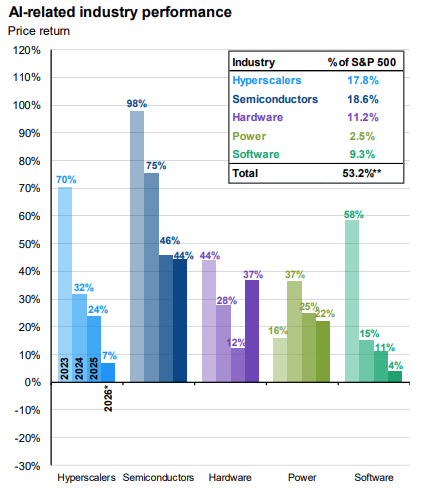
The current AI infrastructure build-out checks every historical box of a classic capital expenditure (capex) boom destined to end in a bust. A web of interconnected tech giants—often referred to as hyperscalers—is pouring trillions of dollars into data centers, specialized silicon chips, energy grids, and next-generation model training.
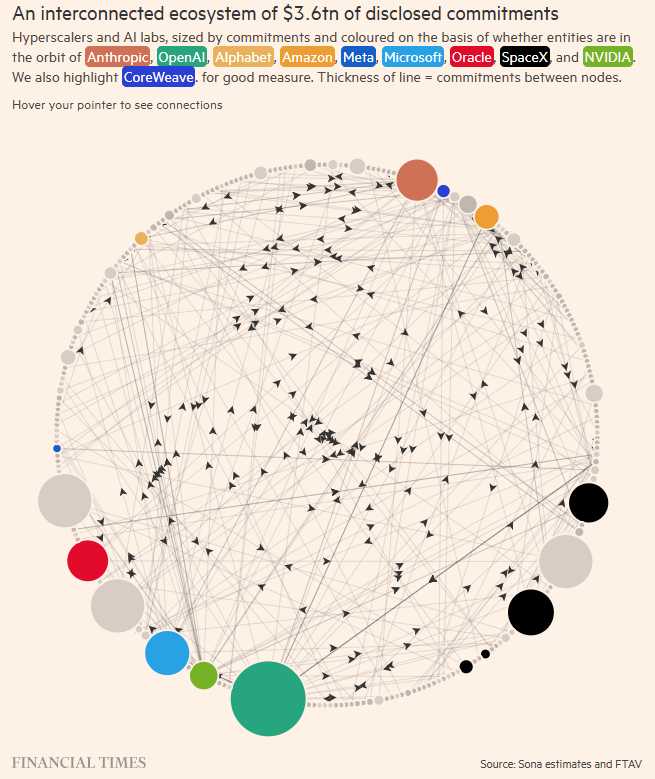
Back-of-the-envelope calculations estimate that the core ecosystem of these hyperscalers commands a staggering combined market capitalization of $22 trillion to $25 trillion. These corporate behemoths are bound together by a complex network of cross-investments, supply chain dependencies, and strategic partnerships. Essentially, they have leaped out of an aircraft holding hands, entirely reliant on the momentum of the fall, with various CEOs openly warning that spending too little is an existential threat far worse than overspending. They are entirely, irreversibly all-in.
Chronology: The Anatomy of a Capex Boom
To understand where the current AI market cycle stands, financial historians and analysts look back at past technological revolutions—most notably the late 1990s dot-com boom and the 19th-century railway manias.
[Phase 1: Inception]
   └── Breakthrough tech emerges; early adopters invest heavily in foundational infrastructure.
[Phase 2: Hyper-Capex Buildout]
   └── Hyperscalers pour staggering capital into physical assets (chips, data centers, fiber).
[Phase 3: Market Peak (Current Paradox)]
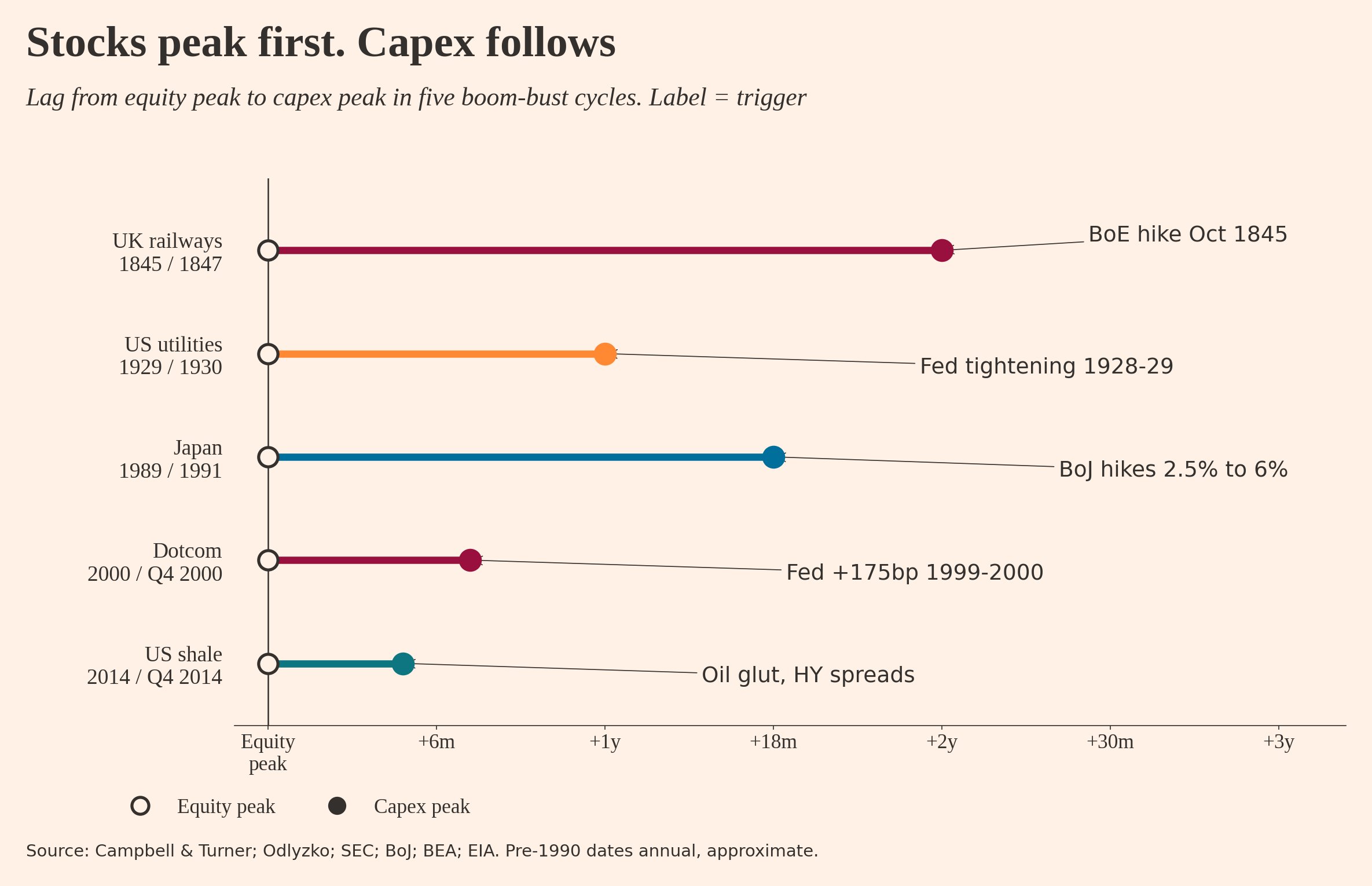
   └── Historically, equity markets peak *before* capital expenditures slow down.
[Phase 4: The Reckoning]
   └── Overcapacity meets flattening demand; debt burdens mature as returns stall.
1. The Historical Blueprint of Capex Cycles
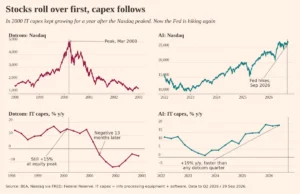
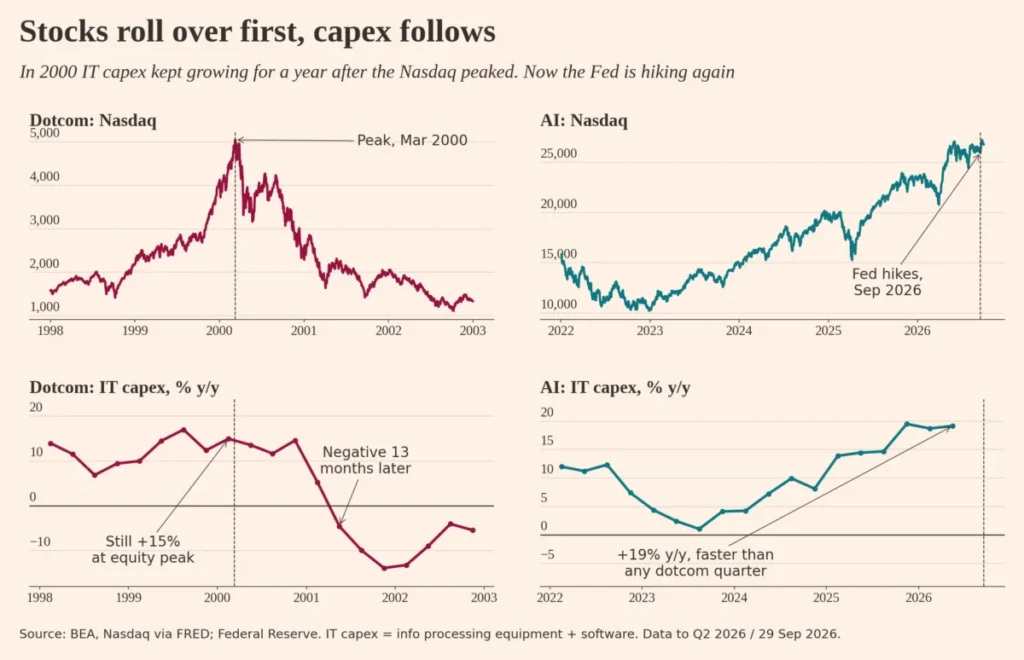
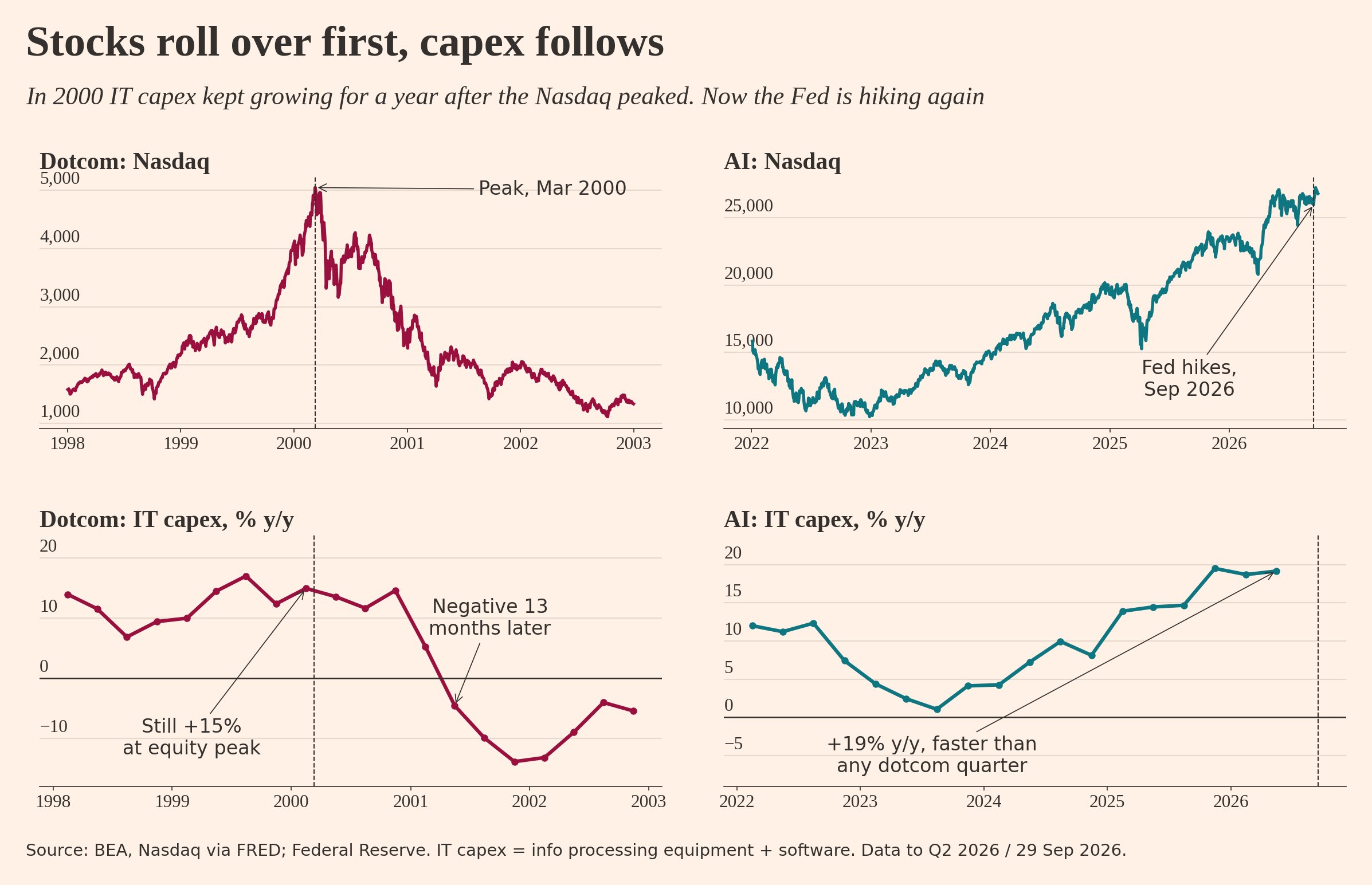
A study of historical booms reveals a recurring timeline: corporate capital expenditure scales aggressively as a new technology captures the public and institutional imagination. However, the stock market—forward-looking by nature, even if prone to excess—frequently peaks well before the physical spending binge actually slows down.
When mapping historical dot-com-era infrastructure spending against today’s data center and GPU accumulation, the similarities are striking. In previous cycles, the moment when corporate management teams declare their absolute commitment to "future-proofing" through endless spending often coincides with the late innings of the valuation expansion, rather than the beginning.
2. Transition from Cash Flow to Corporate Debt
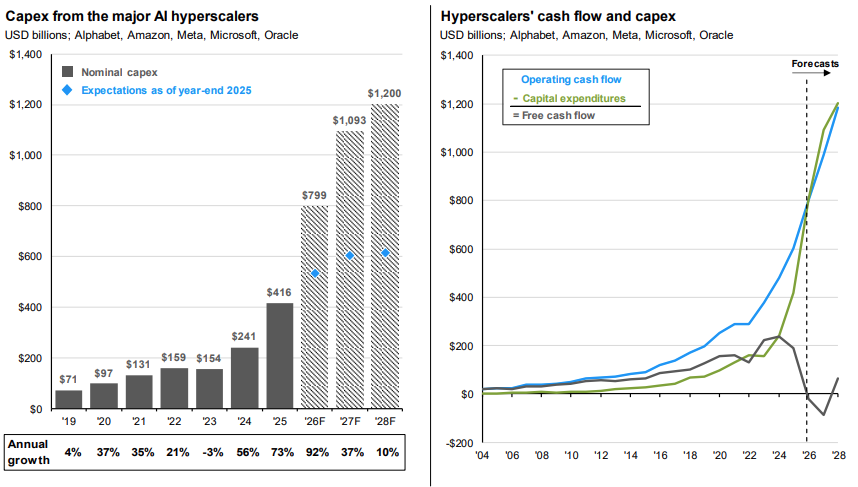
In the initial stages of the AI revolution, the primary funding mechanism was organic. Hyperscalers generated immense, unprecedented free cash flows from their legacy cloud, search, and social media businesses, using these cash reserves to fund early AI research and hardware purchases.
However, as the scale of the required infrastructure expanded from billions to hundreds of billions of dollars, cash flow alone stopped being enough. Recent data from institutional asset managers like Vanguard reveals a fundamental shift: the AI build-out has officially migrated to the corporate bond market. The volume of tech-sector debt issuance linked to AI infrastructure is surging, claiming an unprecedented share of total corporate debt markets. With billions more in debt issuance projected over the coming quarters, the financial risk profile is shifting from equity dilution to balance-sheet leverage.
Supporting Data: Concentration, Valuations, and the Nvidia Paradox
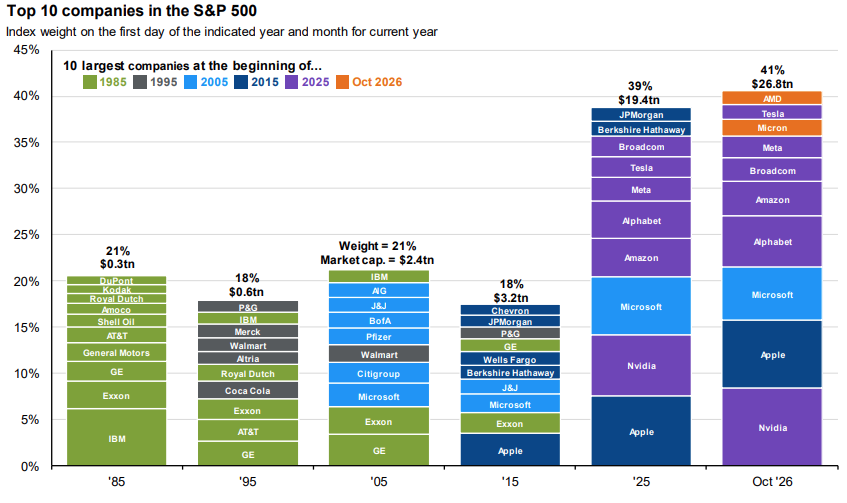
Data from JPMorgan and other leading financial institutions highlights several unprecedented characteristics of the current market environment:
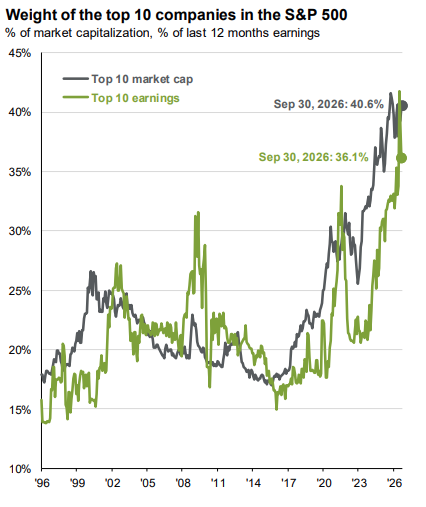
- Extreme Market Concentration: The top 10 companies in the S&P 500 account for a historic percentage of the index’s total market capitalization—levels not seen in more than 40 years. More critically, these same companies generate the lion’s share of index profits, leaving investors with far less diversification than traditional index weightings suggest.
- Sector-Wide AI Integration: AI-related dependencies now permeate a majority of S&P 500 sectors, meaning even non-tech portfolios are directly exposed to the success or failure of the AI thesis.
- The Scale of Capital Allocation: The sheer velocity of spending is unprecedented in corporate history, dwarfing previous infrastructure build-outs relative to global GDP.
The Nvidia Valuation Puzzle
Paradoxically, the single most important bellwether of the AI trade—Nvidia—presents data that complicates the simple "bubble" narrative.
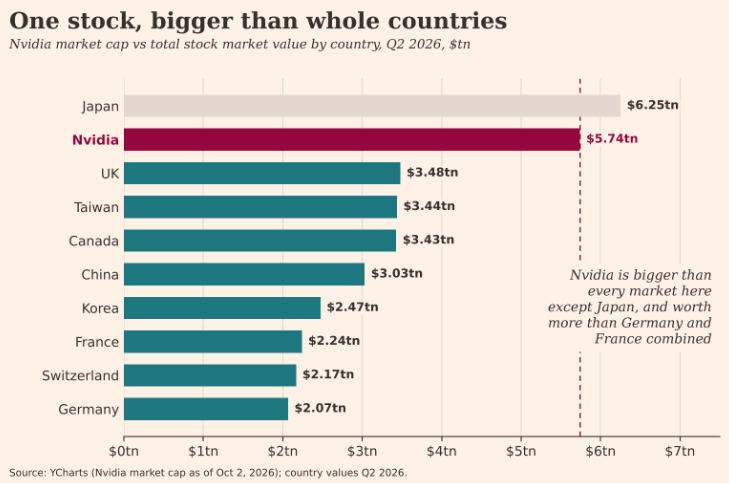
Nvidia’s market capitalization has ballooned to a scale where it exceeds the total equity market value of most developed nations. Yet, when examining forward price-to-earnings (P/E) ratios through metrics tracked by analytical firms like Exhibit A, a strange dynamic emerges: Nvidia’s valuations are actually compressing.
Because the company’s profit growth has systematically outstripped even its stratospheric share price gains, its forward P/E ratio has dropped to some of the lowest levels seen this decade. This decoupling of earnings growth from multiple expansion runs counter to textbook bubble behavior, leaving many quantitative analysts deeply divided.
Official Responses and Industry Perspectives
Wall Street executives, institutional strategists, and macroeconomic commentators remain deeply polarized regarding the durability of the AI expansion.
- The Tech Optimists: Proponents of the current spending cycle argue that comparing AI to the dot-com bubble misses the point. Unlike 1999—when money was funneled into unprofitable startups with no revenues—today’s AI spending is driven by hyper-profitable, cash-rich enterprises delivering tangible enterprise software tools, automation breakthroughs, and cloud services. Leaders in the space argue that under-investing in compute capacity represents an existential risk to market share.
- The Prudent Skeptics: Conversely, fixed-income managers and credit analysts warn that relying on debt-funded data center expansion introduces systemic vulnerabilities. If enterprise adoption rates fail to monetize fast enough to service the mounting bond yields, a classic overcapacity cycle could trigger a rapid repricing of tech credit risk.
- The Macro Historians: Reflecting on past cycles, veteran market observers frequently cite Warren Buffett’s famous maxim: "If past history was all that is needed to play the game of money, the richest people would be librarians." While historical parallels to railway booms and telecom fiber-optic overbuilding offer valuable context, the structural velocity of modern technological adoption may invalidate historical playbooks altogether.
Implications for Investors and Global Markets
The implications of this multi-trillion-dollar capital bet extend far beyond Silicon Valley and Wall Street.
- Macroeconomic Sensitivity to Tech Earnings: Because index concentration is heavily skewed toward a handful of AI-linked behemoths, broader retirement portfolios, pension funds, and passive index investors are implicitly tied to the continued profitability of generative AI. A severe correction in these select equities would have immediate ripple effects across the broader economy.
- The Risk of Overcapacity: If the projected productivity gains and enterprise revenue streams materialize as promised, the massive capital expenditure will be vindicated. However, if enterprise demand plateaus or pricing power deteriorates under intense competitive pressure, the resulting oversupply of compute capacity could lead to an aggressive write-down of corporate assets.
- The Psychological Toll of Perpetual Crisis: Ever since the Great Financial Crisis of 2008, global investors have operated under a perpetual state of defensive risk management, constantly asking, "What can go wrong next?" Rarely do market participants ask the inverse question: "What can go right?" This persistent anxiety often clouds objective analysis, pushing investors either into reckless FOMO (Fear Of Missing Out) or paralyzing skepticism.
Conclusion: Embracing Uncertainty
As market cycles accelerate and technological disruption compresses decades of economic evolution into mere years, investors are forced to confront the limits of forecasting. Are we witnessing the foundational architecture of the next economic era, or are we riding the final, euphoric wave of a historic capex bubble?
Perhaps the most intellectually honest—and professionally uncomfortable—stance for anyone attempting to handicap today’s market can be summarized in three simple words:
- I
- Don’t
- Know