The Great Disconnect: Why U.S. Consumer Sentiment Is Plunging Amid Record Wealth and Economic Growth
October 2, 2026
By Ben Carlson (Adapted for Journalistic Publication)
Main Facts
By nearly every traditional macroeconomic metric, the United States economy should be inspiring a wave of optimism. The stock market is hovering near all-time highs, the unemployment rate remains remarkably stable at 4%, overall household net worth has climbed to unprecedented levels, and the broader economy has avoided a true recession for nearly two decades.
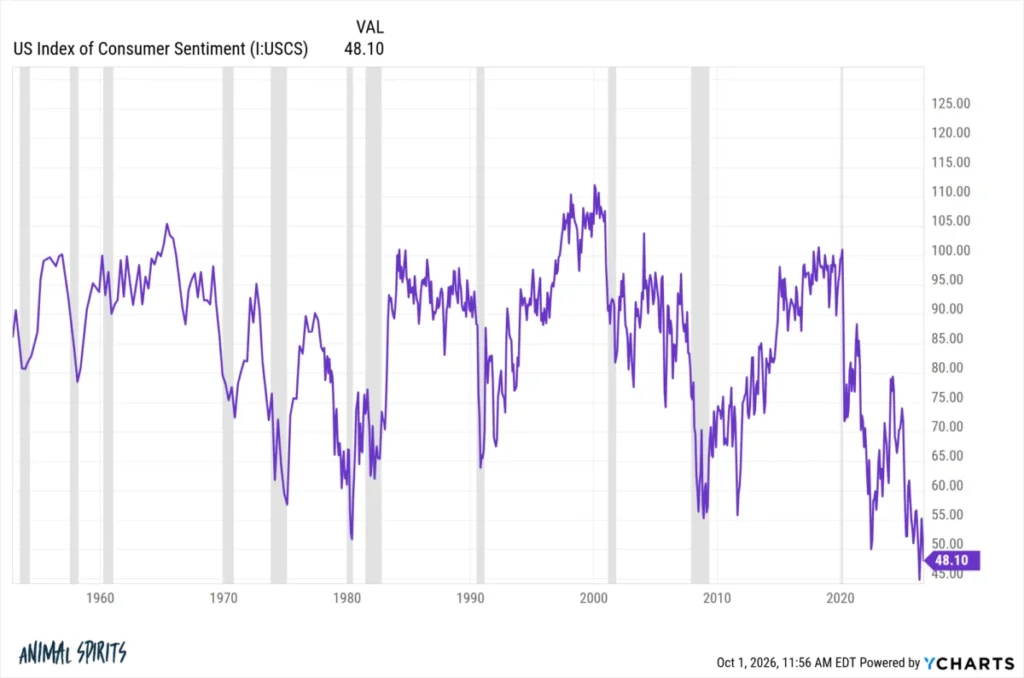
Yet, according to long-running tracking metrics, U.S. consumer sentiment sits at bafflingly depressed levels—lower, by some historic indices, than during periods of severe economic distress. This striking contradiction has puzzled economists, financial analysts, and policymakers alike. While tangible indicators point to a robust and resilient financial landscape, the public mood is overwhelmingly sour.
Analysts suggest this deep disconnect is driven by a complex web of compounding factors, including the lingering psychological shock of rapid post-pandemic inflation, a frozen housing market, widening wealth inequality, relentless political polarization, and the amplification of doom-scrolling on social media. However, financial commentators increasingly argue that the numbers themselves may be suffering from a fundamental flaw: a shift in survey methodology that captures modern digital cynicism rather than real economic behavior.
Chronology
To understand the current state of consumer psychology, it is necessary to examine how economic milestones and societal changes have shaped public perception over the past several decades:
- The Early 1950s – 2000s: For decades, consumer sentiment surveys—most notably the University of Michigan’s Index of Consumer Sentiment—functioned as reliable barometers of economic health, closely tracking recessions, job markets, and recovery phases using traditional, direct communication methods.
- The 2007–2009 Great Financial Crisis: A historic nadir for consumer confidence, marked by staggering job losses, a collapsing housing market, and widespread foreclosures that permanently scarred a generation of investors and workers.
- The 2020 COVID-19 Pandemic: Consumer sentiment experienced a vertical drop-off as global lockdowns paralyzed commerce. Unlike past recoveries, however, public sentiment never truly rebounded to pre-pandemic baselines, even as fiscal stimulus and monetary policy engineered a rapid economic bounce-back.
- 2021–2023 (The Inflation Surge): Consumer prices accelerated rapidly, accumulating a cumulative increase of roughly 30% from the start of 2020. This sudden shift inflicted deep psychological damage on households, regardless of wage growth.
- 2024: Citing declining response rates to traditional phone calls, the University of Michigan updated its foundational consumer sentiment survey methodology, transitioning primarily to online polling to capture a larger sample size.
- October 2026: Consumer sentiment data continues to hit puzzling lows, triggering intense debates among economists regarding whether the data reflects true economic misery or simply a broken measurement tool in a digital age.
Supporting Data and Economic Realities
The juxtaposition between hard economic data and soft sentiment metrics highlights a profound paradox in modern American life.
1. The Shock of Cumulative Inflation
While mainstream financial reporting often highlights trailing 12-month inflation rates cooling to more manageable levels (such as 3.4%), households do not experience inflation on an annualized, trailing basis. Instead, they feel the cumulative impact. Prices for everyday goods, automobiles, and housing are up roughly 30% since the beginning of 2020.
Although wages have risen alongside prices, the human brain struggles to quietly acclimate to such a steep, sudden cost-of-living adjustment. Lower historical price points remain fresh in the public memory, creating widespread sticker shock. As economic observers note, people universally despise inflation because it feels like an unearned tax on their daily existence.
2. The Housing Trap
The housing market presents a classic tale of two demographics. With a national homeownership rate hovering around 65%, a significant majority of Americans are insulated from rising property values and high borrowing costs because they locked in historically low mortgage rates (such as 3%) years ago.
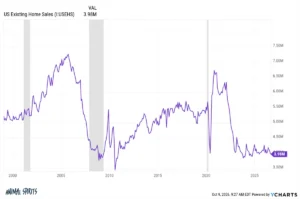
However, this dynamic has created a secondary crisis: a severely frozen housing market. A subset of the population—particularly younger generations attempting to buy their first home—finds themselves entirely priced out. Meanwhile, existing homeowners feel financially trapped in place. Moving means trading a 3% mortgage for a 7.5% mortgage, effectively halting residential mobility and pushing housing activity down to levels typically seen during financial panics.
3. Wealth Inequality and the Perception of Fairness
Even as aggregate household net worth reaches record highs, the distribution of that wealth remains a major pain point. Data indicates that the top 0.1% of American households now control approximately 15% of total household net worth, up significantly from 8.6% in 1989. When struggling families watch the ultra-wealthy amass unprecedented fortunes regardless of broader economic headwinds, it breeds a persistent sense of unfairness and economic alienation.
Societal and External Pressures
Beyond purely financial ledgers, the modern American psyche is buffeted by non-economic stressors that inevitably bleed into how people evaluate their personal well-being:
- Political Polarization: Public discourse has turned into an exhausting, hyper-partisan team sport where every daily challenge is weaponized for political gain. With public trust in institutions near historic lows and political grifting running rampant, the constant exposure to negativity wears down public optimism.
- Social Media Amplification: Algorithms are explicitly designed to reward sensationalism, outrage, and pessimism. The old journalistic adage "if it bleeds, it leads" has been hyper-charged by social media feeds, ensuring that users are continuously fed a steady diet of economic and societal doom.
- Geopolitical Instability and Energy Costs: Ongoing international conflicts have triggered recurring spikes in global energy prices, pushing national gas averages toward the painful $5-per-gallon threshold. High fuel costs serve as an inescapable daily reminder of global instability, reinforcing the public’s sour mood.
Methodological Shifts: Are We Measuring Sentiment or Digital Cynicism?
Faced with an economy boasting a 4% unemployment rate, record stock portfolios, and steady growth, financial experts are forced to ask a critical question: Is the economy genuinely failing everyday people, or are we looking at a broken thermometer?
A compelling argument can be made that the crisis in consumer sentiment is, at least in part, a statistical artifact of changing survey methodologies.
For decades, organizations like the University of Michigan gathered sentiment data via telephone interviews. In an era of rampant robocalls and spam filters, expecting everyday citizens to pick up the phone for an unknown caller is unrealistic. Consequently, major survey bodies transitioned to online polling methods in 2024 to expand their sample sizes.
However, online environments fundamentally change human behavior. In anonymous or digital-first formats, respondents are far more likely to exaggerate, lean into sensationalism, or express grievances they would never voice in a direct conversation with a live interviewer. The internet encourages a performative pessimism—a stark contrast between an individual’s actual spending habits (which remain robust) and their online persona. When asked to click boxes on a digital form, people vent about everything from geopolitical wars and housing prices to broader societal frustrations, resulting in artificially depressed sentiment scores.
Implications for Policy and Markets
The disconnect between consumer sentiment and hard economic data carries significant implications for policymakers, investors, and political strategists:
- Misleading Economic Signals: If central bankers and federal policymakers rely too heavily on sentiment surveys that may be skewed by digital negativity, they risk misjudging the true underlying strength of the consumer base. Consumer spending—which drives roughly 70% of U.S. economic activity—has consistently outperformed what survey data would logically predict.
- Political Volatility: An electorate that feels persistently aggrieved, regardless of objective macroeconomic indicators, creates an unpredictable political landscape. Politicians find it difficult to run on "accomplishments" like low unemployment when voters are experiencing psychological exhaustion from cumulative price increases and housing unaffordability.
- The Need for Nuance: Financial analysts and market participants must learn to separate real economic distress—such as the genuine struggles of first-time homebuyers and lower-income families—from generalized societal grumbling amplified by modern media channels.
Ultimately, while legitimate grievances regarding inflation, wealth concentration, and housing costs cannot be dismissed, the apocalyptic tone of modern consumer sentiment indices should be taken with a heavy dose of skepticism. The American consumer may be venting online, but their actual behavior tells a far more resilient story.