From Resistance to Resilience: The 60-Year Legacy of the Compton’s Cafeteria Riot
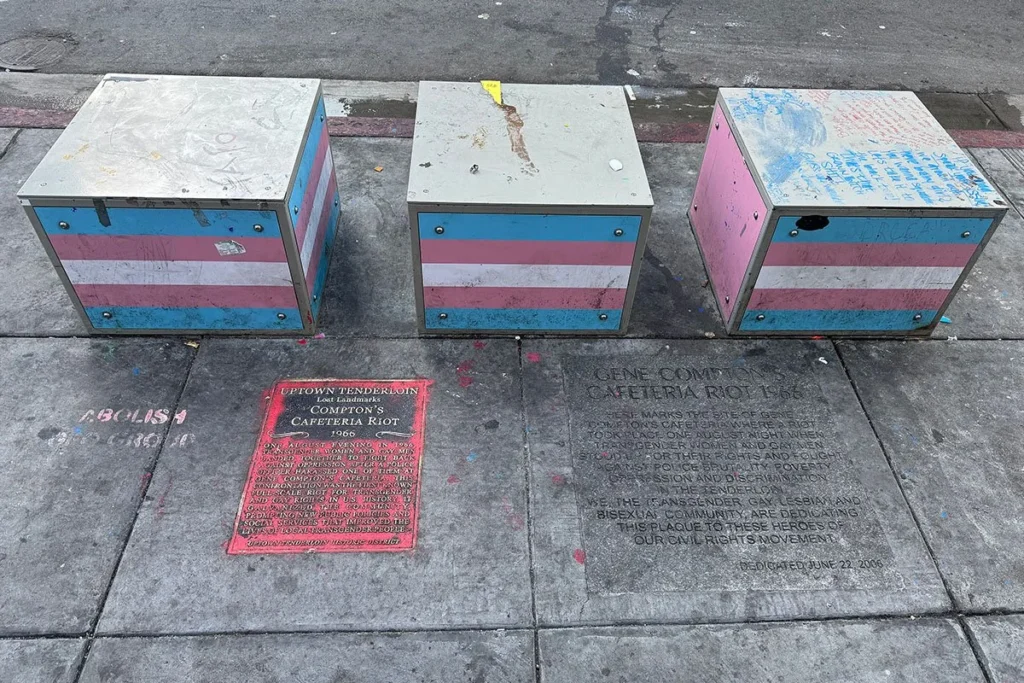
Sixty years after a trans woman at a San Francisco diner ignited the first well-documented queer uprising in United States history, local activists are once again mobilizing to support individuals and families fleeing state-level attacks on trans existence. This ongoing crisis serves as a stark reminder that American liberty has never been a passive guarantee; it is a hard-won right demanded by communities that resist not only through protest, but through the patient, strategic construction of care and defense networks.
The 1966 Compton’s Cafeteria Riot—which predates the better-known Stonewall Uprising by three years—is finally securing its rightful place in the national consciousness. It was more than a singular moment of defiance; it was a catalyst for a groundbreaking ecosystem of trans-affirming services built by and for the community. Today, as transphobic policies escalate across the nation, the work of San Francisco’s trans organizers is not merely symbolic—it is a vital, tactical response to systemic hostility that echoes the same urgency felt six decades ago.
The Crucible: Discrimination as a Catalyst for Uprising
To understand why a diner in the Tenderloin became the flashpoint for a revolution, one must first confront the crushing prejudice that marginalized trans people in the mid-1960s. Before the Castro District became the global icon of LGBTQ+ life, San Francisco’s queer population was largely confined to the Tenderloin, a densely populated, low-income neighborhood that functioned as an informal containment zone.
Even within this "gay ghetto," those who defied gender norms—disproportionately young people of color—faced a double exclusion. They were shut out of stable housing, traditional employment, and even the established gay businesses of the era. They existed on the absolute margins of a society that viewed their very identity as a criminal act.
Police harassment was the baseline of daily life. Law enforcement weaponized statutes against "female impersonation," public loitering, and the use of the "wrong" restroom to justify constant surveillance, physical beatings, and arbitrary arrests. In this environment, Gene Compton’s Cafeteria served as a rare, late-night refuge where trans women, drag queens, and street-based youth could find warmth, food, and a sense of community.
However, even this refuge was compromised. Management eventually hired private security to harass regulars, implemented arbitrary seating fees to deter "undesirables," and frequently summoned the police to clear the premises. This persistent discrimination caught the attention of Vanguard, a fledgling gay youth liberation group sponsored by the nearby Glide Memorial Church. When Vanguard began picketing the diner in July 1966, the stage was set for a confrontation.
A Chronology of Defiance
The timeline of the uprising is one of the most significant, yet historically obscured, chapters in queer history.
- August 1966: Tensions reached a breaking point. Accounts suggest that after management called the police to remove customers, a confrontation ensued. When an officer attempted to arrest a trans woman, she threw a cup of hot coffee in his face. The reaction was instantaneous: tables were flipped, windows were shattered, and police were forced into the street. The riot lasted through the night and flared up repeatedly over the subsequent days.
- The "Lost" History (1966–1990s): Because local newspapers ignored the event and police claimed no records existed, the riot remained largely absent from official historical narratives for nearly 30 years.
- 1990s–2005: Historian Dr. Susan Stryker, while researching the 1972 San Francisco Gay Pride program in the GLBT Historical Society archives, discovered a fleeting reference to the riot. Her multi-year investigative project culminated in the 2005 documentary Screaming Queens, which verified the event and restored it to the American political canon.
- 2017: Three Black trans women founded the Transgender District in the Tenderloin, the world’s first legally recognized transgender cultural district.
- 2024–Present: San Francisco officially declared itself a sanctuary city for gender-affirming care, and the site of the riot was officially listed in the California and National Historic Registers.
Institutionalizing the Struggle: What the Riot Built
In the aftermath of the uprising, San Francisco’s trans activists didn’t just protest; they organized. A pivotal moment occurred when activist Louise Ergestrasse engaged Sergeant Elliott Blackstone, the nation’s first police liaison to the gay community. By providing him with Dr. Harry Benjamin’s foundational text, The Transsexual Phenomenon, Ergestrasse helped turn an ally into a champion.
Together, they bypassed municipal indifference. They pressured the Department of Health to provide gender-affirming care and secured the creation of the first identification cards that allowed trans people to work, rent housing, and open bank accounts under their chosen names. By 1967, the community had launched Conversion Our Goal (COG), the nation’s first formal trans organization, which quickly evolved into the National Transsexual Counseling Unit (NTCU). This peer-led infrastructure became the blueprint for the modern queer nonprofit sector.
Supporting Data and Current Trends
The urgency of this history is underscored by current statistics. According to Honey Mahogany, Director of the Office of Transgender Initiatives, San Francisco has seen a 40 percent increase in participation across trans-serving organizations. This surge is directly linked to an influx of individuals fleeing restrictive legislative environments in other states.
The economic and social infrastructure built by the Transgender District is currently addressing three primary pillars:
- Housing Security: Combating displacement in the Tenderloin to ensure long-term residency for vulnerable trans populations.
- Healthcare Access: Maintaining a robust network of providers in a city that now treats gender-affirming care as a fundamental human right.
- Economic Empowerment: Facilitating job training and legal advocacy for those with criminal records stemming from historical discriminatory policing.
Official Responses and Strategic Policy
San Francisco’s government has moved from a position of active hostility in 1966 to one of institutional protection today. The creation of the Office of Transgender Initiatives and the establishment of the Drag Laureate position—currently held by transgender Mexican-American artist Per Sia—signify a total shift in municipal priorities.
Furthermore, city supervisors are currently debating the expansion of the "Fair Chance Ordinance." This policy would extend vital employment and housing protections to individuals with criminal convictions related to gender expression—a direct legislative effort to undo the damage caused by decades of discriminatory "cross-dressing" laws. As Mahogany notes, the goal is simple: "To ensure that the discrimination they faced in their home towns doesn’t follow them here."
The Ongoing Battle for the Site of Memory
Despite these victories, the physical site of the riot remains a point of contention. The building that housed Compton’s Cafeteria is currently owned by the GEO Group, a private prison corporation and major ICE contractor. The irony of a carceral institution owning the birthplace of a trans uprising against police brutality has not been lost on the community.
The Comptons x Coalition is currently engaged in a strategic campaign to remove GEO Group from the property, aiming to transform the space into a community-stewarded hub for culture and care. This effort is mirrored by the Tenderloin Museum’s live production, The Compton’s Cafeteria Riot, which reconstructs the event in a functioning diner replica, ensuring that the history of the uprising remains a living, breathing part of the neighborhood’s identity.
Implications: A Model for Future Resistance
The sixty-year trajectory from the Compton’s Cafeteria Riot to the modern sanctuary status of San Francisco proves that the most effective political defense is the one that is locally rooted and institutionally supported. By moving beyond reactive protest into the creation of permanent cultural districts, health programs, and legal protections, the trans community in San Francisco has created a model for resilience that is being studied by organizers across the globe.
As the nation faces a new wave of anti-trans rhetoric, the legacy of the women who stood their ground in 1966 serves as a guide. They proved that when a community decides that its existence is not negotiable, it can transform the very institutions that once sought to erase it. The riot was the debut of the transgender community on the stage of American political history, but the decades of organizing that followed have ensured that the community is no longer just on that stage—it is writing the play.