The Tremor in Saxony-Anhalt: How Chinese Industrial Competition and Economic Anxiety Are Reshaping German Politics
By Dalia Marin
Published: September 18, 2026
Dateline: Munich
For decades, the bedrock of Germany’s post-war stability rested upon a singular, implicit social contract: high-value manufacturing would reliably generate secure, well-paying jobs, robust export revenues, and broad-based national prosperity, while stable political institutions would translate this economic engine into lasting social cohesion.
Today, that foundational bargain is being shaken to its core. A tectonic shift in global trade, spearheaded by unrelenting industrial competition from China, has exposed the vulnerabilities of the German economic model. This financial pressure is no longer confined to corporate balance sheets or boardroom discussions in Frankfurt and Wolfsburg; it has migrated decisively into the ballot box, threatening to redraw the nation’s political landscape entirely.
Main Facts: A Political Earthquake in Eastern Germany
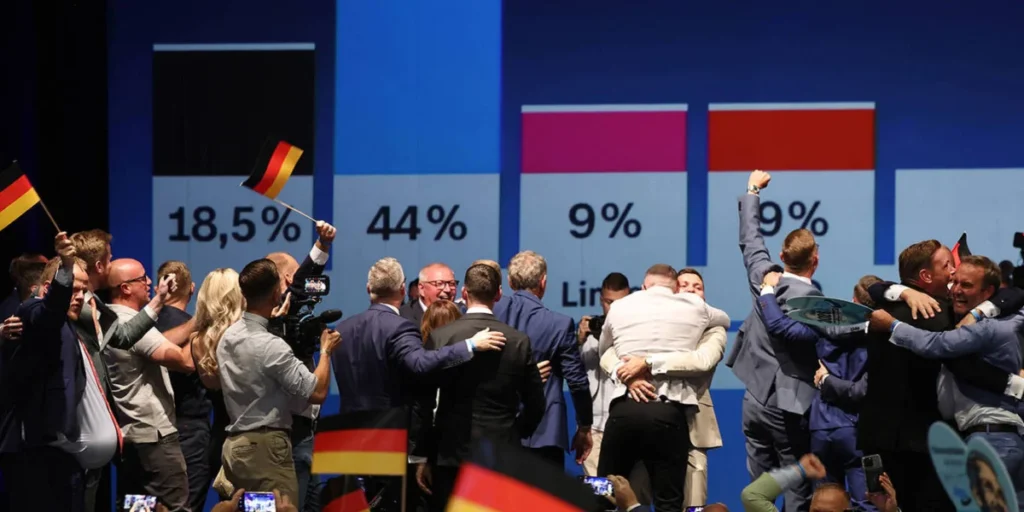
September 6, 2026, may well be remembered as a pivotal turning point in Germany’s post-war political history. In the regional state election in Saxony-Anhalt, the far-right populist party, Alternative für Deutschland (AfD), surged to a historic and alarming victory, coming within just three seats of securing an absolute majority.
Capturing an astonishing 43.8% of the popular vote, the AfD more than doubled its performance compared to the previous state election held in 2021. This meteoric rise came largely at the expense of the center-right Christian Democratic Union (CDU)—traditionally the dominant political force in the region and the party of incumbent federal Chancellor Friedrich Merz. The CDU suffered a catastrophic collapse, plunging from 37.1% in 2021 to a meager 17.2% in the September 2026 ballot.
The implications of the Saxony-Anhalt vote extend far beyond local governance. They serve as a glaring referendum on the federal government’s ability to navigate compounding crises: sluggish domestic growth, soaring energy costs, a crumbling infrastructure, and, above all, the existential threat facing Germany’s crown jewel—its industrial manufacturing sector.
Chronology of a Crisis: From Economic Model to Electoral Upheaval
To understand how Saxony-Anhalt arrived at this political tipping point, one must trace the convergence of long-term structural decay and rapid external shocks over recent years.
- Pre-2020: The Golden Era of Export-Led Growth
For decades, Germany enjoyed an economic golden age built on the "Deutschland AG" model. Powered by cheap Russian natural gas and an insatiable appetite from China for German machinery, automobiles, and chemical products, the country maintained massive trade surpluses. Eastern states like Saxony-Anhalt integrated into these supply chains, albeit often as lower-cost manufacturing and assembly hubs rather than high-margin R&D centers. - 2022–2023: The Energy Shock and the Beginning of the End
The outbreak of the war in Ukraine and the subsequent severing of cheap Russian gas pipelines delivered the first major blow. Energy-intensive industries—chemicals, steel, and glass—faced unprecedented cost hikes. Simultaneously, Chinese competitors began moving up the value chain, transitioning from importing German goods to producing high-end industrial machinery, electric vehicles (EVs), and green tech domestically at a fraction of the cost. - 2024–2025: The Slow-Motion Deindustrialization
As German automakers struggled to pivot effectively toward affordable electric mobility amid fierce competition from Chinese giants like BYD, automotive suppliers across eastern Germany began laying off workers. Economic forecasts turned bleak, with Germany experiencing consecutive quarters of stagnation. Chancellor Friedrich Merz’s administration, grappling with strict domestic debt-brake rules and fractured coalition dynamics, struggled to deliver a coherent industrial rescue package. - September 6, 2026: The Saxony-Anhalt Election
Against a backdrop of rising inflation, job insecurity, and public disillusionment with mainstream parties, voters in Saxony-Anhalt handed the AfD a near-majority. The election crystallized a growing sentiment in eastern Germany: that the traditional political establishment is indifferent, or powerless, to stop the erosion of regional prosperity.
Supporting Data: The Anatomy of Decline
The political earthquake in Saxony-Anhalt did not occur in a vacuum; it is underpinned by stark economic realities and statistical shifts that illustrate the deep malaise gripping Germany’s industrial heartland.
- The Vote Shift: The AfD’s jump to 43.8% represents a staggering gain of more than 20 percentage points from 2021. Meanwhile, the CDU’s freefall to 17.2% marks one of the worst defeats for a governing conservative party in a German state election in modern history.
- The Manufacturing Squeeze: According to recent data from the German Federal Statistical Office (Destatis), industrial production in Germany has contracted for three consecutive years. Energy-intensive sectors have seen output drop by nearly 15% compared to pre-2022 levels.
- The China Factor: In key sectors such as automotive manufacturing and industrial automation, German global market share has steadily eroded. China has not only closed the technological gap in internal combustion engines and advanced robotics but has decisively taken the lead in the global electric vehicle market, undercutting German marques both at home and abroad.
- Regional Disparities: Eastern German states like Saxony-Anhalt continue to lag behind western counterparts in terms of median wages, corporate headquarters density, and private wealth accumulation. This structural lag made the population acutely sensitive to macroeconomic shocks, transforming economic anxiety into volatile political behavior.
Official Responses: Defiance, Concern, and Soul-Searching
The seismic outcome in Saxony-Anhalt has triggered immediate and turbulent reactions across the German political spectrum.
In Berlin, Chancellor Friedrich Merz addressed the press in an emergency briefing, acknowledging the severity of the defeat while urging caution against populist oversimplifications. "The result in Saxony-Anhalt is a clear, unmistakable warning signal to the federal government," Merz stated. "People are anxious about their economic future, their jobs, and their security. We must listen, and we must act decisively to revitalize our industrial base. However, turning away from democratic institutions and embracing radical isolationism will not build a single factory or secure a single job."
Merz outlined plans to revisit corporate tax burdens, accelerate bureaucratic deregulation, and push the European Union for stronger defensive trade measures against subsidized Chinese imports.
Meanwhile, leaders of the triumphant AfD framed the election as the dawn of a new political era. Alice Weidel, co-leader of the federal party, declared that the old party cartel is crumbling. "The citizens of Saxony-Anhalt have shown that they are no longer willing to pay the price for failed energy policies, uncontrolled migration, and the blind destruction of our industrial backbone by incompetent politicians in Berlin," Weidel proclaimed at a victory rally in Magdeburg.
Representatives from the center-left Social Democratic Party (SPD) and the Greens—who fared poorly in the regional vote—warned that the normalization of far-right politics poses a direct threat to Germany’s democratic stability and its standing as a reliable European partner. They called for a cross-party democratic pact to address economic insecurity in eastern Germany through targeted investments in infrastructure and future technologies.
Implications: Where Does Germany Go From Here?
The events of September 6, 2026, carry profound implications not only for Germany, but for the entire European Union.
1. The Death of the Old Economic Model
Germany can no longer rely on cheap energy from Russia and boundless export growth to China. The country is forced to reinvent its economic architecture. This requires massive capital investments in digitalization, green energy independence, and innovation. However, strict constitutional debt limits ("Schuldenbremse") make large-scale public investment politically contentious and legally difficult.
2. The Threat of "Cordon Sanitaire" Erosion
With the AfD capturing nearly 44% of the vote in Saxony-Anhalt, the traditional policy of the "firewall" (Brandmauer)—where all mainstream democratic parties refuse to cooperate with the far right—faces unprecedented strain at the regional level. Forming a stable governing coalition in the state legislature will be exceptionally difficult, raising the specter of institutional paralysis or the eventual normalization of parliamentary cooperation with populist extremists.
3. Geopolitical Re-alignment and Trade Protectionism
As Chinese industrial dominance continues to pressure European manufacturers, Berlin is shifting away from its traditional advocacy of unbridled free trade. Expect Germany to push the European Commission toward a more assertive industrial policy, including stricter anti-subsidy tariffs on Chinese electric vehicles, strategic supply chain near-shoring, and tighter screening of foreign investments in critical infrastructure.
4. The European Ripple Effect
Germany has long been the economic anchor and stabilizer of the European Union. A politically fractured and economically stagnant Germany diminishes the EU’s collective geopolitical weight at a time when the bloc faces severe external pressures. If Berlin turns inward to manage its domestic political turmoil, Europe’s capacity to act decisively on defense, economic integration, and global trade will be severely compromised.
Conclusion
The shockwave originating from Saxony-Anhalt is more than a regional electoral upset; it is a diagnostic symptom of a deeper structural crisis. Germany’s historic social contract—anchored in industrial excellence and political stability—is fracturing under the weight of global competition and technological disruption. How Chancellor Merz and the broader German political establishment respond to this wake-up call over the coming months will determine not only the future of Germany’s economy, but the resilience of its democracy for decades to come.