The Smoke Tariff: How Climate Change Transformed into a Geopolitical Weapon
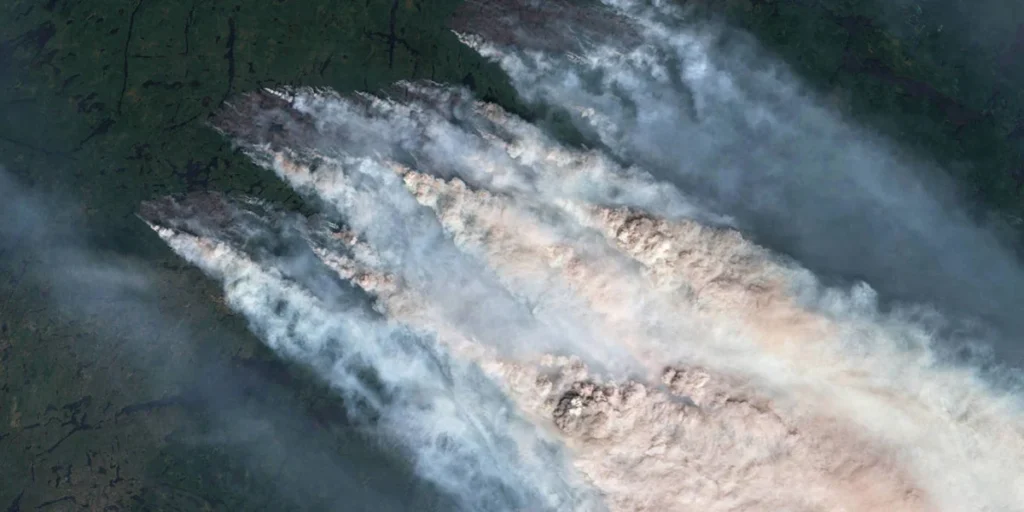
In a paradigm-shifting development that has sent shockwaves through international diplomatic circles, the United States has unilaterally moved to treat transboundary climate-driven environmental damage as a matter of national security and trade law. The recent imposition of tariffs by the United States on Canada—ostensibly in response to the choking wildfire smoke that descended upon the American Northeast—marks the first time in history that a major power has attempted to monetize the physical harms of climate change through punitive trade policy.
This move effectively ends the era in which climate-driven disasters were categorized solely as humanitarian crises, insurance liabilities, or abstract emissions-accounting problems. By framing the atmospheric fallout from Canadian forest fires as an "unnecessary invasion" of American sovereign territory, the U.S. administration has signaled that the global climate crisis is no longer a matter of collective stewardship, but a volatile theater of bilateral conflict between G7 economies.
A Chronology of Escalation: From Disaster to Dispute
The roots of this conflict lie in the increasing frequency of climate-driven catastrophes. While the world has long observed devastating events in the Global South—such as the catastrophic flooding in Mozambique in late 2025, which displaced over 200,000 people and claimed 300 lives—the international donor community historically responded with vague rhetoric about collective responsibility. Climate disasters in developing nations were met with sympathy but never with bills for damages.
The dynamic changed abruptly in 2026 when the skies over the American Northeast turned a haunting, apocalyptic orange. As smoke from hundreds of Canadian wildfires drifted south, disrupting daily life and threatening the viability of major international sporting events, the U.S. response shifted from mutual aid to economic retaliation.
- December 2025–February 2026: Severe, climate-intensified rainfall devastates Mozambique. World Weather Attribution confirms a 40% increase in intensity due to human-induced climate change. No international compensation mechanisms are triggered.
- Early 2026: A wave of record-breaking wildfires erupts across Canadian forests.
- Mid-2026: Smoke blankets the U.S. Eastern Seaboard. President Donald Trump declares the U.S. has been "unnecessarily invaded" by Canadian pollution.
- Late 2026: The U.S. administration formalizes a tariff regime targeting Canadian goods, citing "willful negligence" in forest management as the primary justification.
- Present: The precedent is set. Trade relations between two of the world’s closest allies are now hostage to the unpredictable nature of wildfire seasons.
The Irony of the "Tragedy of the Horizon"
Perhaps the most bitter irony of this dispute lies in the political position of Canadian Prime Minister Mark Carney. A decade ago, Carney was the world’s preeminent voice on climate-related financial risk. His seminal warnings regarding the "tragedy of the horizon"—the idea that climate change poses systemic risks to financial stability that markets are ill-equipped to price—provided the intellectual framework for global climate finance.
Today, as Prime Minister, Carney finds himself trapped in a geopolitical pincer movement. On one hand, he faces a domestic coalition demanding expanded oil and gas production to bolster the Canadian economy. On the other, he is confronted by an American administration that is using protectionist tariffs to demand even greater fossil fuel extraction and pipeline development—the very activities that exacerbate the wildfires currently poisoning the air. This friction highlights a grim reality: science is no longer the primary arbiter of climate costs. Instead, those costs are being weaponized by the actors who hold the most coercive economic power.
Supporting Data: The Economics of Fragmentation
The move toward "climate-securitization" and the rise of "smoke tariffs" carry profound economic risks. Financial experts and insurance underwriters warn that the fragmentation of global climate policy is inherently destructive.
- Lost Output: Economic modeling suggests that if major powers move toward a "fortress" model of climate policy—prioritizing protectionism over decarbonization—the global economy could forfeit approximately 14% of potential output by 2050.
- Capital Trapping: As countries retreat into regional risk pools, insurance capital is being trapped behind national borders. This leads to reduced diversification and a catastrophic decline in insurance availability for areas with high climate risk.
- The Precedent Effect: The U.S.-Canada dispute is not an isolated incident but a bellwether. With India, Pakistan, and China sharing contested Himalayan water sources, and Senegal dealing with the influx of Saharan dust, the legal and economic framework for "transboundary harm" is being tested in real-time.
Official Responses and the Search for Accountability
The international community is currently struggling to reconcile this new era of "climate nationalism" with existing international law. While small island states have taken their grievances to the International Court of Justice (ICJ), the U.S.-Canada conflict provides a stark, real-world example of how powerful nations may circumvent international norms to seek immediate financial redress.
Critics of the U.S. approach argue that if the U.S. can levy tariffs for wildfire smoke, the logic of "actionable interstate injury" must logically extend to the Global South. If climate harm is indeed quantifiable, then developing nations battered by disasters they did not cause should, by the same precedent, be entitled to levy their own "emissions tariffs" against the largest historical polluters.
Implications: A New Era of Climate-Security Conflict
The implications of the U.S.-Canada dispute are threefold and represent a major regression in global climate governance:
1. The Weaponization of Climate Costs
We have moved from an era of cooperative climate action to an era where climate impacts serve as leverage in trade negotiations. This creates a perverse incentive: countries may be less interested in actually solving the underlying climate problem if the "damage" caused by their neighbor provides a useful pretext for protectionist tariffs.
2. The Erosion of Multilateralism
The decision by the U.S. to bypass multilateral frameworks in favor of unilateral sanctions undermines the progress made by the United Nations and the V20 group of climate-vulnerable nations. It replaces science-based adjudication with raw, coercive power.
3. The Need for a New Global Machinery
If the world is to avoid a descent into a fragmented, "every-country-for-itself" climate landscape, three pillars must be established immediately:
- Shared Resilience: Climate resilience must be treated as a shared security obligation. Tariff revenues, if levied, should be directed toward joint investments in fire management, grid resilience, and watershed protection, rather than general treasury coffers.
- Scientific Adjudication: The world needs an objective, AI-supported mechanism to assess climate harms. By grounding claims in data—identifying who contributed to the emission, who failed to adapt, and who suffered the damage—we can transition from leverage-based bullying to transparent, science-based compensation.
- Global Compliance Markets: Instead of border-tariff wars, nations must lean into sophisticated carbon markets that link emissions, market access, and adaptation finance.
Conclusion: Beyond the Smoke
The smoke over the U.S. Northeast eventually cleared, allowing the international community to briefly turn its attention back to global events. However, the precedent remains. As physics guarantees that the frequency of wildfires, floods, and droughts will continue to escalate, the world must decide if it will continue down the path of "billing the neighbor," or if it will construct a more resilient, science-based framework for international cooperation.
The U.S.-Canada climate-security conflict serves as a sobering reminder: climate change is no longer just an environmental issue. It has become a fundamental pillar of national security. Whether this leads to a new, more efficient global order or a decade of destructive trade wars will depend on whether world leaders can find an answer better than the one currently being written at the border. The window for such a transition is closing, but as the world remains on the precipice of a more volatile climate, the opportunity for a more rational, cooperative framework remains within reach.