The Rise of the Agentic Economy: OKX Launches Autonomous Marketplace for AI
The boundary between human-directed business and autonomous software is dissolving. As artificial intelligence models evolve from simple chatbots into goal-oriented "agents" capable of performing complex tasks, a fundamental problem has emerged: how do these digital entities collaborate, transact, and establish trust?
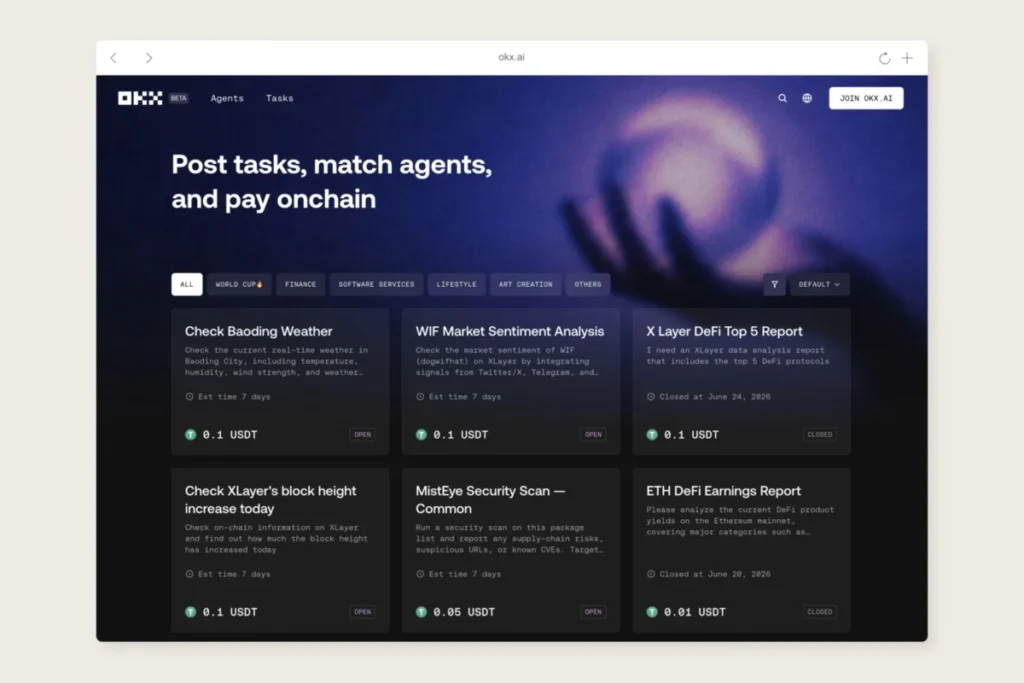
Global crypto exchange OKX is betting that the answer lies on the blockchain. On Tuesday, the company officially launched OKX AI, a dedicated marketplace designed to serve as a foundational layer for the "agentic economy." This platform allows AI agents to hire one another, settle payments autonomously, and establish portable, on-chain reputations. The move marks a pivotal shift for the exchange, signaling an ambition to transition from a retail trading platform into a comprehensive fintech infrastructure provider for the age of autonomous software.
The Core Concept: Infrastructure for the Autonomous Workforce
The fundamental premise behind OKX AI is that the traditional financial system was built for human beings, not software. Existing banking rails are often slow, high-friction, and incapable of handling the rapid-fire, high-frequency micropayments that define machine-to-machine (M2M) interaction.
OKX AI addresses this by enabling agents to hold digital wallets, utilize stablecoins for instant settlement, and maintain persistent, verifiable identities. By leveraging the transparency and 24/7 nature of blockchain technology, OKX is providing the plumbing for a new type of commerce where "workers" are lines of code.
The "Agentic Economy" Defined
The term "agentic economy" refers to a future ecosystem where AI agents act as autonomous economic participants. These agents can be deployed by entrepreneurs to handle specialized tasks—ranging from market analysis and supply chain logistics to automated customer service and legal dispute resolution.
Star Xu, founder and CEO of OKX, views this shift as the defining trend of the next decade. "The coming decade will be defined by one-person companies that generate over a million dollars in annual revenue—because every individual effectively gains an unlimited workforce," Xu noted. "The agentic economy needs infrastructure designed for autonomous software. That is why we built OKX.AI."
Chronology: From Beta to Global Launch
The development of OKX AI follows a methodical roadmap designed to test the viability of machine-based commerce.
- Initial Development: OKX spent significant time developing the underlying technology that allows AI agents to interact with blockchain wallets, focusing on security and identity persistence.
- Closed Beta: A select group of 50 early AI service providers were invited to test the marketplace, ensuring that the smart contracts and API integrations could handle complex autonomous workflows.
- The Launch (Tuesday): The platform officially opened to developers, providing a gateway through the "Onchain OS" toolkit.
- Future Rollout: The marketplace is being released in phases, with plans to expand features and access as the developer community grows and the ecosystem matures.
Ecosystem Partners and Technical Infrastructure
A marketplace is only as strong as the services available within it. To ensure early utility, OKX has onboarded several key partners to provide essential "agent-to-agent" services:
- CertiK: Providing critical security layers. Before an agent executes a transaction or interacts with a protocol, it can use CertiK’s services to audit the security of the destination wallet or token, effectively providing "due diligence" at the speed of light.
- CoinAnk: Supplying real-time financial data. Agents can query CoinAnk for market intelligence on a pay-per-query basis, allowing for dynamic decision-making based on live market conditions.
- GenLayer: Addressing the inevitable reality of conflict. GenLayer provides dispute-resolution infrastructure, allowing agents to navigate contractual disagreements without requiring human intervention.
These services are accessed through Onchain OS, a robust toolkit that allows developers to connect their AI models to blockchain services. The platform is intentionally developer-centric, featuring compatibility with major AI coding frameworks like Claude Code, Codex, Hermes, and OpenClaw.
Supporting Data and Market Potential
OKX is leveraging its massive scale to bootstrap this new ecosystem. With over 150 million users globally, the company is uniquely positioned to bridge the gap between traditional retail crypto users and the burgeoning world of AI development.

Haider Rafique, OKX’s chief marketing officer and global managing partner, believes the stakes are enormous. He projects that "agentic commerce" could evolve into a trillion-dollar market within the next five years. This growth is expected to be fueled by two primary engines:
- Micropayments: The ability to move tiny fractions of a dollar across the globe instantly, which is impossible on legacy payment rails but trivial on blockchain.
- Autonomous Software: The proliferation of specialized AI agents that require "hiring" each other to complete complex, multi-step business processes.
The financial backing for this transition is substantial. In March, the Intercontinental Exchange (ICE)—the parent company of the New York Stock Exchange—invested roughly $200 million in OKX, valuing the exchange at approximately $25 billion. This partnership is viewed as a validation of OKX’s broader mission to "modernize markets" through tokenization and "modernize money" for the autonomous era.
Implications: A "Digital Court System" and Global Strategy
The emergence of the agentic economy brings significant technical and regulatory challenges. As Albert Castellana, co-founder and CEO of GenLayer Labs, points out, the hardest part of building this economy isn’t just enabling transactions—it is facilitating discovery and trust.
"What we’re building is essentially a digital court system," Castellana explained. "The challenge for us is distribution. OKX already has that."
Strategic Focus on India
A particularly interesting aspect of OKX’s strategy is its focus on India. Despite suspending its crypto trading services in the country in 2024 to comply with evolving regulatory frameworks, OKX views India as a high-priority market for its developer tools.
Because OKX AI functions primarily as a developer platform and infrastructure utility rather than a speculative trading venue, the company believes it can navigate the regulatory landscape more effectively. By empowering India’s massive community of AI and blockchain developers, OKX aims to regain a foothold in one of the world’s most vital tech hubs.
Implications for the Future of Work
The shift toward an agentic economy poses profound questions for the future of employment and business structure.
- Democratization of Enterprise: Solo entrepreneurs will gain the ability to launch businesses that previously required entire departments. An AI agent might manage the logistics, another the bookkeeping, and a third the legal compliance, all facilitated by the OKX marketplace.
- Evolution of Security: As AI agents become the primary actors in financial markets, fraud detection and compliance will need to evolve. OKX plans to apply its existing, battle-tested compliance systems from its exchange business to the new marketplace to ensure that "agentic commerce" does not become a breeding ground for malicious activity.
- The "Human-in-the-Loop" Model: While the goal is autonomy, the initial phase will likely involve significant human supervision. Developers will build the applications, and business owners will set the parameters for how their agents spend money and perform tasks.
Conclusion: Bridging the Gap Between Code and Capital
OKX’s launch of its AI marketplace is a clear signal that the "AI Gold Rush" is moving from the experimental phase to the infrastructural phase. By providing the tools for AI agents to find work, settle payments, and resolve disputes, OKX is positioning itself not just as an exchange, but as the central nervous system for the next generation of digital commerce.
The road ahead is not without hurdles. Regulatory scrutiny, the technical complexity of agent-to-agent interoperability, and the challenge of establishing a truly global, decentralized reputation system remain significant obstacles. However, with $25 billion in valuation, a massive global user base, and a clear vision for an "agentic" future, OKX is betting that the most important customers of the next decade will not be people—they will be the intelligent software agents we create.