The Price of Patriotism: How Independence Day Became America’s Most Expensive Ritual
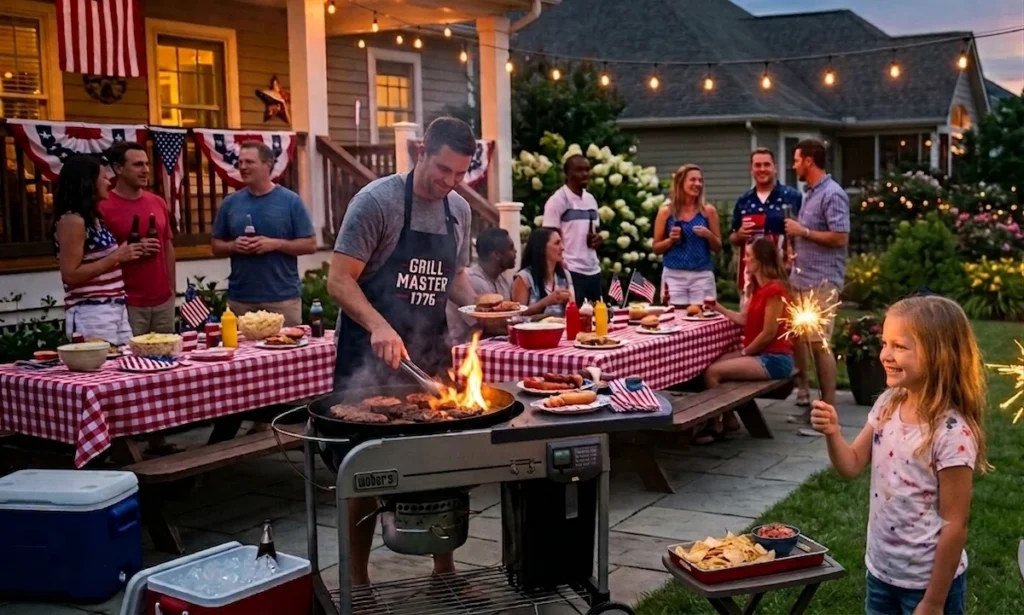
Every July, as the humidity climbs and the scent of charcoal begins to permeate the American suburbs, the nation gathers around the grill, gazes at the horizon, and asks a question that feels increasingly pertinent in an era of fluctuating inflation and economic uncertainty: Can liberty be itemized?
The answer, delivered annually with a side of potato salad, is a resounding yes. Independence Day has evolved from a simple commemoration of national birth into a massive, multi-billion-dollar economic engine. It is a unique holiday where patriotism, protein, and payment rails converge, often wearing flip-flops and clutching a cold drink. From the suburban backyard cookout to the record-breaking surge in holiday travel, the Fourth of July has become an "operating ritual" that tests both the patience of the average traveler and the resilience of the American household budget.
The Fiscal Footprint: Independence Day by the Numbers
In the modern American household, the Fourth of July occupies a distinct niche. While it lacks the gift-giving obligations of the winter holidays, it is, in every sense, a "spending holiday." Data from the National Retail Federation (NRF) underscores the scale of this commitment: 87% of American consumers plan to participate in Independence Day festivities this year.
The financial burden of these celebrations is hitting record highs. The average food spending per person is estimated at $94.41. For a standard family of four, that translates to approximately $378 spent on groceries—before a single bottle of bug spray, bag of charcoal, or box of sparklers is added to the cart. When one accounts for the "emergency" bag of ice that invariably costs $8 at the corner store, the total quickly swells.
According to data compiled by Numerator and reported by HomePage News, the broader shopping basket—which includes non-food items like decorations and party supplies—averages $117 per person, or $468 for a family of four. On a national scale, this represents a staggering $22 billion in potential holiday spending.
A Chronology of Consumption: Two Decades of Rising Costs
To understand the current economic climate of the Fourth of July, one must look back at how the cost of "liberty" has inflated over the last two decades.
2006: The Dawn of the Modern Getaway
Twenty years ago, the logistics of the Fourth were simpler, yet the financial stakes were high for those who chose to travel. In 2006, ABC News noted that a holiday weekend involving travel could easily exceed $1,000 for a family. At the time, a record 40.7 million Americans were expected to hit the roads, establishing the precedent that Independence Day was as much about movement as it was about fireworks.
2016: The Baseline Decade
By 2016, the NRF projected that the average household would spend $71.34 on food for their backyard gatherings, with total national food spending hovering around $6.8 billion. AAA reported 43 million travelers during that window, driven by relatively cheap gasoline and the enduring, if optimistic, belief that leaving for a road trip immediately after lunch would allow travelers to beat the traffic.
2021: The Post-Pandemic Rebound
The year 2021 was a turning point. Following the lockdowns of the previous year, the holiday saw a massive surge in demand. Food spending reached $80.54 per person, and AAA tracked 47.7 million travelers. The focus was on "revenge travel," with 91% of those travelers opting for the relative safety of the personal vehicle.
2025–2026: The New Normal
Last year, the NRF tracked food spending at $92.44 per person. Fast forward to 2026, and we are witnessing the highest nominal prices for a traditional cookout since the American Farm Bureau Federation began tracking the data in 2016. A meal for 10 now costs $73.82—or $7.38 per person—driven by price increases in beef, pork, and poultry.
Supporting Data: The Anatomy of the Holiday Budget
The "Red, White, and Blue" receipt, as detailed by recent reports from Fox/WalletHub, reveals exactly where the money goes. Americans are expected to spend $9.4 billion on food and over $4 billion on beer and wine alone.
The sheer volume of consumption is difficult to fathom:
- The Hot Dog Index: Roughly 150 million hot dogs are consumed during the holiday window.
- The Pyrotechnic Premium: Spending on fireworks reached $2.95 billion in 2025, a figure that continues to climb as municipalities and private citizens alike lean into the tradition of lighting up the night sky.
- Travel Volume: AAA projects 72.2 million Americans will travel at least 50 miles from home this year. Of those, 61.4 million will drive, 5.85 million will fly domestically, and nearly 5 million will opt for alternative transit like trains, buses, or cruises.
The Logistics of Travel: When the Sky Becomes Expensive
Travel is arguably where the holiday has seen its most dramatic financial expansion. For those choosing to fly, the cost of admission is steep. Domestic round-trip airfare is currently averaging $830. For a family of four, the total cost for airfare alone hits $3,320—a figure that excludes lodging, rental cars, and the unavoidable "emotional duress" purchases, such as airport snacks or last-minute travel accessories.
The shift toward cruises is particularly noteworthy. As travelers grow weary of the unpredictability of airport delays and the soaring costs of last-minute hotel bookings, the "all-inclusive" nature of a cruise has become an attractive financial hedge. It allows families to bundle their costs into a predictable package, mitigating the risk of mid-holiday price shocks.
Implications: The Economic and Social Shift
The economic reality of the modern Fourth of July has turned the holiday into a "choose-your-own-checkout adventure."
- The Backyard Anchor: For those who stay home, the cost is manageable but rising. It is a local experience defined by grocery store aisles and the persistent inflation of staples like beef and hamburger buns.
- The Travel Premium: For those who choose to venture out, the holiday is a high-stakes economic endeavor. The competition for limited resources—gas, parking, flight seats, and hotel rooms—creates a demand-driven pricing structure that punishes the unprepared.
- The Deflationary Exceptions: Interestingly, while most items are trending upward, some categories remain stable. Potato salad and chips have emerged as the "patriotic deflation heroes," providing a small measure of relief in an otherwise expensive shopping basket.
Conclusion: A Ritual of Consistency
Why do we continue to pay these premiums year after year? The answer lies in the nature of the holiday itself. The Fourth of July is less a vacation and more a national operating ritual. It is a moment of synchronization for a country that is, at its heart, profoundly consistent.
Whether it is the uncle who insists that fireworks were "better and more dangerous" in his youth, or the parents balancing a budget that seems to expand every July, the holiday persists because it is an essential expression of national identity. We grill, we gather, we overspend, and we look up at the sky. At 250 years old, the United States remains hungry, traffic-prone, and absolutely convinced that one more bag of ice—or one more box of sparklers—is not just an expense, but a constitutional necessity.
In the end, the price of the holiday is simply the cost of participating in the ongoing experiment. We may itemize the liberty, but we rarely cancel the order.