The Hidden Ledger: Why CFOs Are Rethinking the True Cost of Legacy Disbursements
In the modern corporate finance landscape, the term "disbursement" has long been relegated to the back-office doldrums of accounts payable. For years, finance leaders have tracked these payouts through the narrow lens of transaction fees—the postage, the check-printing costs, and the nominal wire transfer charges. However, a seismic shift is underway. Forward-thinking CFOs and operations leaders are beginning to recognize that their legacy disbursement infrastructure—reliant on paper checks and antiquated clearing systems—is not merely a routine expense; it is a profound drain on liquidity, operational efficiency, and customer loyalty.
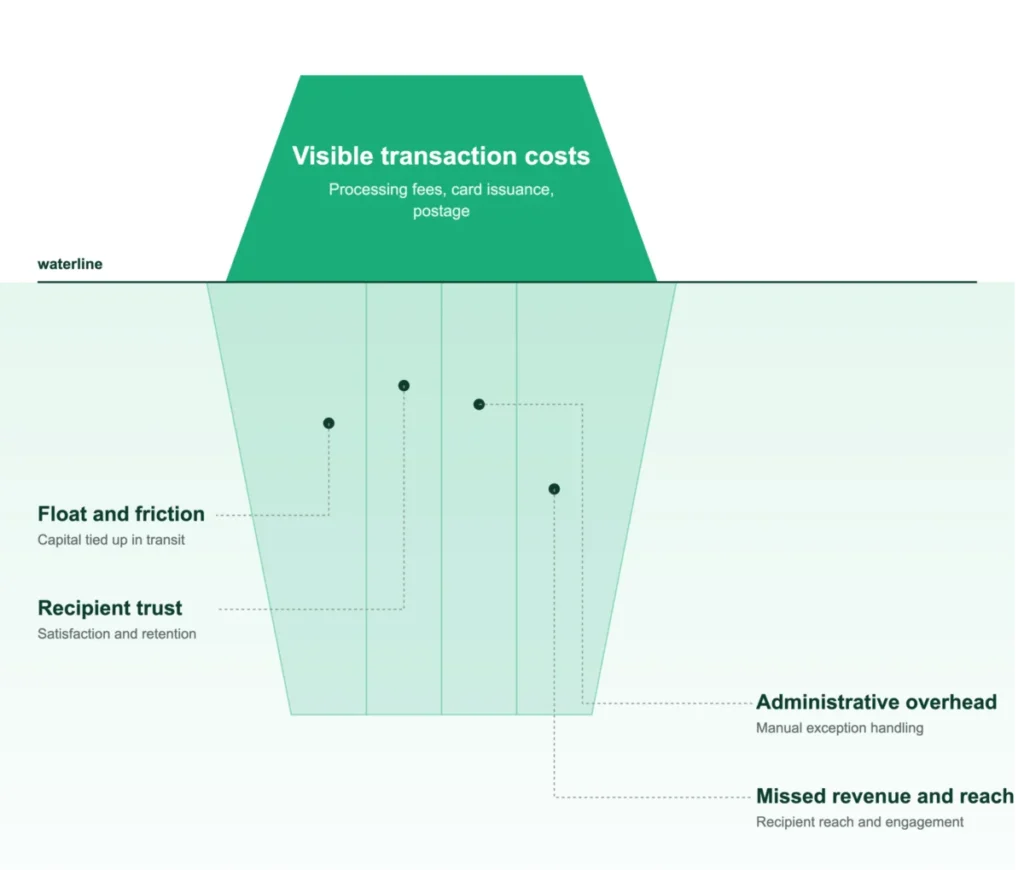
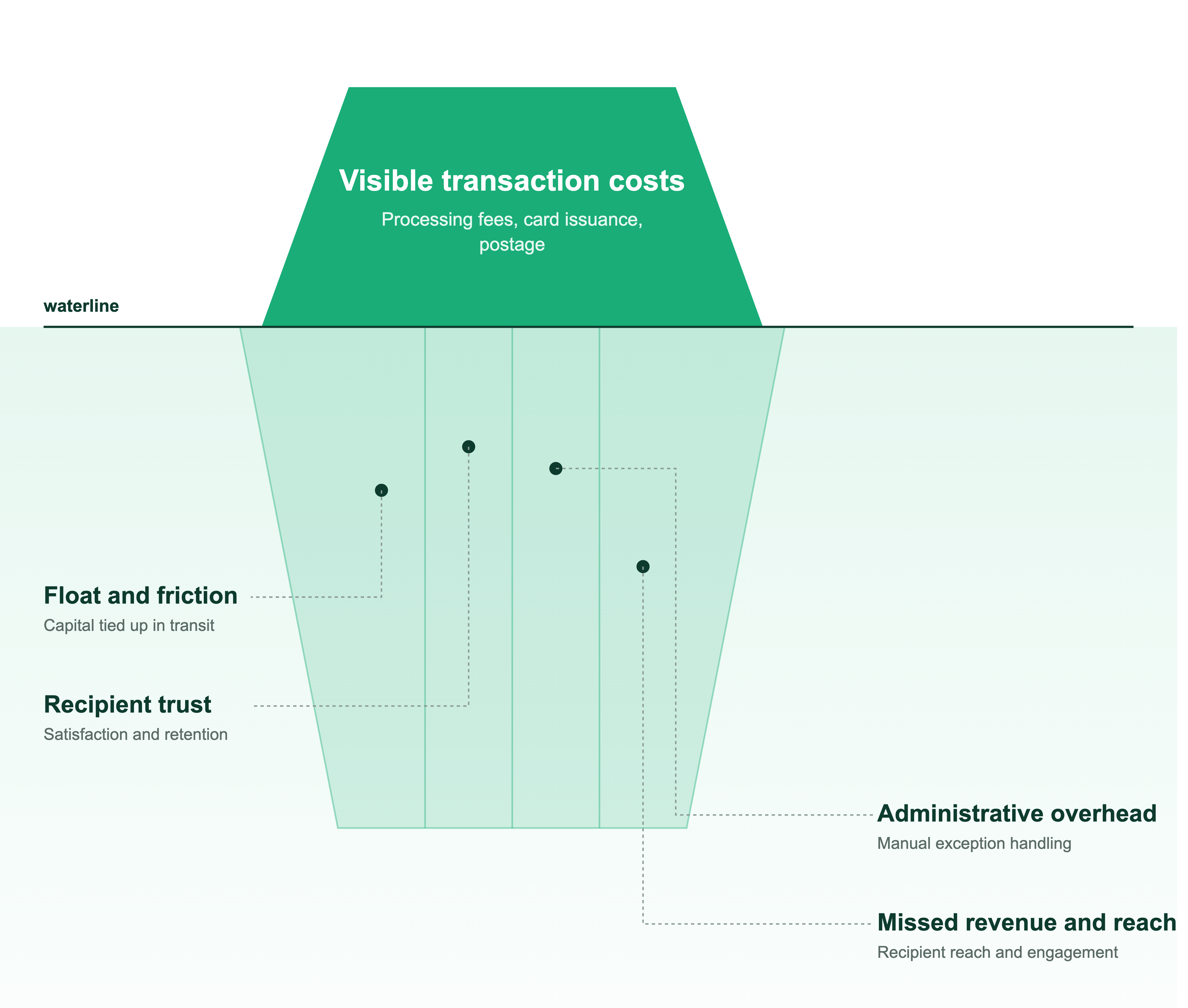
The reality, as revealed in the latest industry tracking, is that the visible costs of disbursements are merely the tip of the iceberg. Beneath the waterline lies a vast, often unmeasured reservoir of "hidden" costs: capital trapped in transit, exorbitant manual labor hours, and the silent, cumulative attrition of customers who increasingly demand instant, digital-first experiences.
The Evolution of Payouts: From Paper to Digital
The history of corporate disbursements is a story of incremental, yet sluggish, technological adoption. For decades, the paper check was the gold standard—a tangible, albeit slow, instrument of trust. However, the 21st-century digital economy has rendered this "trust" obsolete.
The Chronology of Disruption
- The Era of Paper (Pre-2010s): Disbursements were defined by manual processing, batch files, and the inherent multi-day delays of the postal system and bank clearing houses.
- The Rise of Electronic Transfers (2010–2020): While ACH and standard wire transfers improved speed slightly, they remained tethered to legacy banking hours and batch-processing limitations.
- The Real-Time Imperative (2020–Present): The COVID-19 pandemic acted as a massive accelerant for digital payments. Consumers and B2B vendors alike began to expect the same immediacy in payouts that they experienced in retail e-commerce. According to recent research from Federal Reserve Financial Services, 78% of U.S. consumers now explicitly prefer faster payment options, and the market has responded with the proliferation of push-to-card and digital wallet solutions.
The Hidden Costs: Analyzing the "Invisible" Tax
To understand why CFOs are shifting strategies, one must look at the specific areas where value leaks out of the organization.
1. The Trap of Capital Float
When a payment is issued via check, it enters a state of "financial limbo." Funds are debited from the account or encumbered, yet they remain in transit, serving neither the sender nor the recipient. For an organization disbursing $10 million monthly, a five-day delay compared to real-time card funding means that roughly $1.6 million is consistently trapped in the pipeline. This idle capital represents a significant opportunity cost; it cannot be deployed for growth, debt reduction, or yield-generating investments.
2. The Labor of Exception Handling
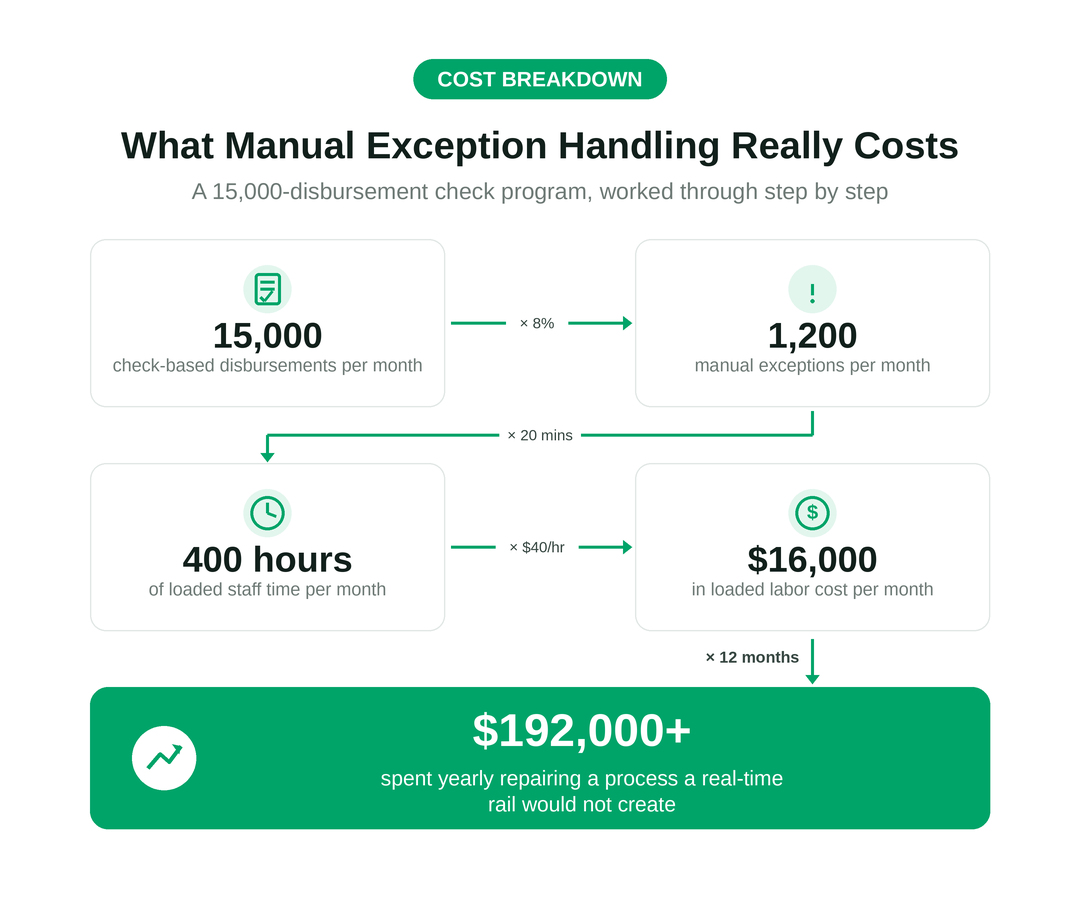
Legacy systems are notoriously prone to errors. Lost mail, stale addresses, and rejected deposits trigger a chain reaction of administrative overhead. If 8% of a company’s 15,000 monthly disbursements require manual intervention—such as reissuing a check or updating a customer’s address—the company is burning hundreds of staff hours. At an average of 20 minutes per exception, this equates to roughly 400 hours of labor per month. At $40 per hour, that is $16,000 in monthly overhead—a cost that vanishes entirely when moving to a modern, API-driven, real-time platform.
3. The Trust Deficit
Perhaps the most damaging, yet hardest-to-quantify cost, is the erosion of recipient trust. In industries like insurance, gig-economy platforms, and lending, the disbursement is often the "moment of truth." An insurance claimant waiting for funds after a traumatic event or a gig worker expecting their earnings is not merely receiving a transaction; they are receiving a signal of the company’s reliability. A slow, archaic payout process is increasingly viewed as a competitive vulnerability.
Supporting Data: The Case for Modernization
The financial data underscores the urgency of this transition. Organizations that fail to modernize are facing two primary pressures: increased fraud risk and decreased customer engagement.
- Fraud Vulnerability: The 2026 AFP Payments Fraud and Control Survey highlights a sobering reality: 76% of U.S. organizations experienced attempted or actual payment fraud in the past year. Checks, due to their physical nature and reliance on outdated clearing rails, were the primary target, accounting for 58% of all fraud incidents.
- Customer Satisfaction: Federal Reserve research indicates that 61% of consumers consider it a vital differentiator whether their financial institution offers instant payment options. This is no longer a "value-add" feature; it is a core expectation for retention.
Official Perspectives: The Path to Integration
Industry experts and treasury consultants argue that the move to modern infrastructure is not merely a technology upgrade—it is a strategic overhaul of the "liquidity system."
Modern disbursement platforms provide:
- API-First Integration: By connecting payout systems directly to ERPs and claims software, companies can eliminate the "manual handoff" that slows down the payout process from days to minutes.
- Configurable Governance: Organizations often fear that speed equals a loss of control. However, modern platforms offer granular, rule-based controls that ensure compliance—such as anti-money laundering (AML) checks and regulatory reporting—are performed automatically at the moment of authorization.
- Unified Management: By centralizing insurance claims, vendor payments, and loan proceeds onto a single platform, firms can retire redundant legacy software, reduce vendor complexity, and gain full visibility into the entire payout lifecycle.
Implications for the Future: Why the CFO Must Lead
The shift toward real-time, card-based disbursement is, at its core, a change in how a business interacts with its ecosystem.
Building the Business Case
For a CFO, the business case for modernization must be built on "hard" dollars. By calculating the cost of float, the labor hours spent on exception handling, and the quantifiable impact of reduced customer churn, the ROI of a new platform becomes undeniable. Rather than selling a "tech upgrade," leaders should frame the proposal as a "liquidity recovery project."
Navigating the Transition
Modernization is not without its hurdles. Organizations must address:
- Regulatory Compliance: Any new system must be mapped to specific state and federal requirements, particularly in highly regulated fields like workers’ compensation.
- Recipient Adoption: Companies must provide clear communication and, where possible, choice. Moving too aggressively without explaining the benefits to the recipient can lead to friction.
- Security Posture: While moving away from checks reduces fraud, the new system must be built with "security-by-design" principles, ensuring that identity verification and fraud detection are embedded in the digital flow.
The Bottom Line: Moving from "Routine" to "Strategic"
The true cost of slow disbursements is the accumulation of systemic friction. It manifests in capital that sits idle, in staff hours wasted on low-value administrative tasks, and in a diminished ability to reach and retain a digital-native customer base.
Modernizing disbursement infrastructure is not simply about moving money faster; it is about providing the organization with a clearer, safer, and more profitable way to fulfill its obligations. For the modern CFO, the mandate is clear: the current disbursement model is an invisible, recurring tax on the business. By making these costs visible and measurable, organizations can unlock the capital, efficiency, and trust necessary to compete in an increasingly real-time global economy.
The transition to instant, card-based, and API-integrated disbursements represents the next great efficiency frontier. Those who act to measure and modernize now will secure a distinct competitive advantage over those still waiting for their checks to clear.