The Nuanced Revolt: Rethinking Populism in Central and Eastern Europe
By Harold James
June 26, 2026
Introduction: Challenging the Conventional Narrative
The prevailing orthodoxy in contemporary political science suggests that the defining feature of the 21st century is a monolithic, autocratic, and ethnonationalist backlash against the dual pillars of global capitalism and liberal democracy. From the halls of Washington to the corridors of Brussels, the assumption persists that the rise of "populism" is a singular, uniform phenomenon—an aggressive, exclusionary surge that seeks to dismantle international institutions.
However, recent political mobilizations in Hungary, Albania, and across Central and Eastern Europe (CEE) suggest a much more complex reality. While these movements are frequently branded as nationalist or populist, they bear little resemblance to the virulent ethnonationalism often associated with the MAGA movement in the United States. Instead, we are witnessing a divergence in the nature of political revolt. As rapid technological and economic shifts continue to destabilize traditional social structures, populations are naturally turning to the past for guidance. Yet, this nostalgia is not inherently destructive; it is proving to be a dual-edged sword, capable of both fueling autocratic tendencies and providing a foundational narrative for those seeking to defend democratic resilience.
Main Facts: A Disjointed Wave of Populism
The primary miscalculation in current political analysis is the attempt to fit all modern political movements into a single "populist" box. In Central and Eastern Europe, the motivations behind recent mobilizations are rooted in specific historical traumas and anxieties that differ significantly from the American experience.
- Sovereignty vs. Isolationism: While American movements often prioritize economic protectionism and isolationism, the CEE "revolt" is frequently a demand for agency within international structures. It is not necessarily a rejection of the European Union, but a push for a "Europe of nations" that maintains cultural autonomy.
- Historical Memory: In Hungary and Albania, the reliance on historical symbols is a reaction to the vacuum left by the post-1989 transition. For many citizens, the promises of the "End of History" failed to materialize in the form of stable, prosperous middle-class lives, leading to a nostalgic pivot that seeks to reclaim national identity without necessarily embracing the aggressive, race-based exclusion seen elsewhere.
- Technological Displacement: Economic anxiety in the region is driven by the rapid automation of manufacturing and the brain drain of the younger, educated demographic. This displacement creates a fertile ground for leaders who promise to "restore" a lost sense of stability, even if the policy prescriptions are often contradictory.
Chronology: The Evolution of the Eastern European Political Landscape
- 2010–2015: The Consolidation of Illiberalism: The early decade saw the rise of consolidated governance models, particularly in Hungary, where electoral victories were framed as a defense of Christian values against perceived liberal intrusion.
- 2018–2022: The Crisis of the Periphery: Economic stagnation and the COVID-19 pandemic exacerbated the divide between urban centers and rural hinterlands. Movements in Albania and Serbia began to blend anti-corruption rhetoric with strong-man governance styles.
- 2023–2025: The Great Realignment: As global inflation and supply chain volatility peaked, the political rhetoric in the region began to shift. The focus moved away from simple "anti-Western" tropes toward a more sophisticated critique of global financial dependency.
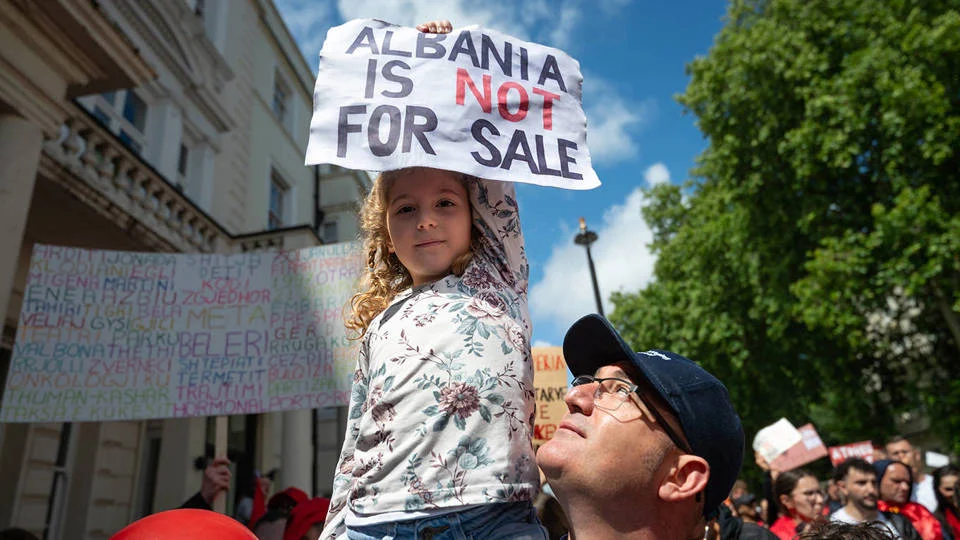
- Mid-2026: The Emergence of the "New Model": Recent mass demonstrations in Tirana and Budapest are no longer simply "pro" or "anti" government. They reflect a growing public demand for a third way—one that values sovereign decision-making while resisting the descent into full-scale autocracy.
Supporting Data: Indicators of a Changing Climate
Data from the European Social Survey and recent regional polling indicate that the public appetite for "strong-man" politics is beginning to plateau, even as support for "nationalist" rhetoric remains high.
- Democratic Satisfaction: Despite the rhetoric of leaders, polling shows that over 65% of citizens in the Visegrád Group still prefer democratic processes over authoritarian ones, provided those processes address the cost-of-living crisis.
- Economic Anxiety Index: When cross-referenced with local GDP growth, regions with the highest levels of digital automation show the highest propensity for "nostalgic" political mobilization. It is not necessarily an aversion to progress, but a reaction to the speed of change.
- Institutional Trust: Trust in local institutions has risen slightly in Albania, while trust in supranational bodies (like the European Commission) has declined, suggesting that the "revolt" is essentially a localist corrective rather than an existential threat to the concept of democracy itself.
Official Responses: The Divergence of Policy
The reaction from established powers has been largely reactive. Brussels has traditionally responded with financial conditionality—threatening to withhold funds in response to democratic backsliding.
However, this "stick" approach has increasingly backfired, providing local leaders with the ammunition to paint themselves as defenders of national pride against foreign intervention. The more nuanced approach, currently being piloted by some moderate factions within the European Parliament, involves engaging with the legitimate grievances of these movements (economic precarity and cultural preservation) while drawing firm lines against the erosion of judicial independence.
In Albania, the government has responded to recent protests by framing their development projects as "modernizing nationalism," attempting to capture the populist energy while keeping the country tethered to European integration pathways. It is a precarious balancing act that suggests that the era of simple "populist vs. liberal" labels is nearing its expiration date.
Implications: Is This a Model for the Future?
If we strip away the alarmist rhetoric that characterizes both the Western media and the populist leaders themselves, we are left with a critical question: Could this "nuanced revolt" actually serve as a template for a new form of politics?
The Case for a "New Model"
If these movements can successfully navigate the transition from aggressive, exclusionary populism toward a "sovereign democracy"—where national identity is preserved without suppressing minority rights—they could provide a blueprint for other nations struggling with the pressures of globalization. The key lies in the distinction between defensive nostalgia (using the past to create community) and aggressive ethnonationalism (using the past to define an enemy).
The Risks of Misinterpretation
The danger lies in our inability to distinguish between these two. If the West continues to treat all nationalist-leaning movements as existential threats to the liberal order, it risks pushing these nations into the arms of autocratic powers like Russia or China, who are more than willing to provide the "stability" that the West currently seems unable to offer.
A Call for Intellectual Rigor
We must move beyond the binary of "liberal globalism" vs. "populist autocracy." The 21st-century political landscape is being reshaped by the search for identity in an age of digital fragmentation. The challenge for policymakers is not to suppress this search, but to guide it toward a constructive, civic-minded framework.
Conclusion
As we look toward the remainder of the decade, the developments in Central and Eastern Europe serve as a mirror for the rest of the world. The "populist" revolt is not a sudden eruption of irrationality, but a calculated, albeit messy, response to the failure of the post-Cold War consensus to provide security and meaning in a hyper-connected world. Whether these movements evolve into a sustainable model of sovereignty or collapse into the autocracy that many fear depends entirely on the ability of local leaders to distinguish between the politics of resentment and the politics of renewal. The future of the European project—and perhaps liberal democracy itself—depends on our capacity to understand this nuance before the divide becomes permanent.