The Cash Flow Standard: How VFLO Crossed the $7.5 Billion Milestone

By June 22, 2026, the VictoryShares Free Cash Flow ETF (VFLO) had officially reached a landmark in the world of asset management: $7.5 billion in assets under management (AUM). Launched three years prior, on June 21, 2023, the fund has transcended the typical "start-up" phase of the ETF lifecycle to become a fixture in institutional due diligence frameworks. For many wealth managers and institutional gatekeepers, the three-year mark is the "coming of age" threshold—a period required to verify that a fund’s performance is not a product of luck, but a consistent application of its stated methodology.
In an era where market volatility and economic uncertainty have prompted a flight to quality, VFLO’s growth suggests that investors are increasingly prioritizing "hard" fundamentals over speculative growth. By focusing on the cash a company generates after all expenses—the lifeblood of any business—VFLO has positioned itself as a robust alternative to traditional market-cap-weighted strategies.
The Genesis of a Strategy: Why Free Cash Flow Matters
The premise behind the Victory U.S. Large Cap Free Cash Flow Index, which VFLO tracks, is grounded in the belief that cash is the only metric that cannot be "faked." Traditional accounting-based value metrics, such as Price-to-Earnings (P/E) ratios, are frequently vulnerable to the nuances of GAAP accounting, where accruals, non-cash charges, and management estimates can obscure the actual economic health of a firm.
Free Cash Flow (FCF) provides a clearer, more durable signal of quality. It represents the actual cash a company retains after covering its operating expenses and capital expenditures. This capital is the "optionality" that allows a business to thrive: it can be redeployed into research and development, used to pay dividends to shareholders, or utilized to deleverage the balance sheet. VFLO’s success over the past three years highlights a shift in investor sentiment, moving away from accounting-based value metrics toward a "cash-is-king" approach to large-cap allocation.
A Chronology of Growth and Verification
The journey of VFLO from a new entrant to a multi-billion-dollar powerhouse reflects a disciplined adherence to a rules-based index.
- June 21, 2023: The VictoryShares Free Cash Flow ETF (VFLO) officially launches, bringing a focus on forward-looking FCF to the broad market.
- The First 18 Months (2024): As macroeconomic conditions shifted, the market began to punish firms with high debt loads and weak cash generation. VFLO’s methodology—which uses Enterprise Value (EV) rather than market cap as a denominator—naturally steered the portfolio toward companies with healthier balance sheets.
- The Three-Year Milestone (June 2026): Reaching $7.5 billion in AUM, the fund solidified its place in the market. The three-year live-market record allowed the fund to pass the rigorous screening requirements of institutional investors, effectively validating the strategy in a wide array of economic environments.
Dissecting the Methodology: The "Quality" Filter
What distinguishes VFLO from generic value funds is its sophisticated, two-step screening process. The Index does not simply chase high yields; it filters for sustainability and future viability.
1. Forward-Looking Valuation
Most value strategies fall into the "value trap" by relying solely on trailing 12-month data. VFLO, conversely, uses "Expected FCF," which averages a company’s trailing 12-month performance with its forward 12-month projections. This creates a balanced view that accounts for both historical success and future potential. Furthermore, by using Enterprise Value (Market Cap + Debt – Cash) as the denominator, the strategy inherently favors companies with low net debt, automatically screening out firms that are over-leveraged and vulnerable to rising interest rates.

2. The Growth Mandate
A high FCF yield is meaningless if the business is in a state of terminal decline. To address this, the index applies a stringent growth filter. This mechanism removes companies whose low valuations are merely a symptom of deteriorating fundamentals. By combining high-yield screening with a growth filter, the index produces a concentrated, 50-stock portfolio of high-quality, cash-generating leaders.
This approach finds academic validation in the work of Penman and Reggiani (2018). In their seminal research published in the Financial Analysts Journal, they analyzed nearly 177,000 U.S. non-financial companies over five decades. They concluded that high-yield stocks paired with weak profitability carry a significantly higher risk of failure. VFLO’s inclusion of a forward-growth filter is a direct application of this research, ensuring that investors are not buying "cheap" companies that are destined to fail.
Performance Data: A Three-Year Review (June 2023 – June 2026)
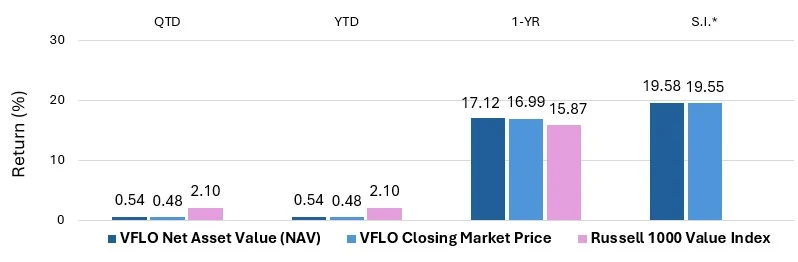
The performance data since inception paints a compelling picture. When compared to the S&P 500 and the Russell 1000 Value Index, VFLO has demonstrated superior cumulative returns with a unique risk profile.
| Metric | VFLO | Russell 1000 Value | S&P 500 |
|---|---|---|---|
| Cumulative Return | 89.41% | 67.58% | 77.58% |
| Annualized Return | 23.70% | 18.76% | 21.07% |
| Standard Deviation | 16.10% | 13.13% | 15.03% |
| Max Drawdown | -17.78% | -15.59% | -18.75% |
| Forward P/E | 11.53 | 18.41 | 22.55 |
Source: FactSet/Bloomberg. Past performance is not indicative of future results.
The data shows that VFLO’s portfolio is significantly "cheaper" than the broader market, as evidenced by a Forward P/E of 11.53 compared to 22.55 for the S&P 500. Furthermore, the fund has maintained an Expected FCF yield of 9.01%, a stark contrast to the 2.78% seen in the S&P 500. Most notably, the fund has achieved these results while holding 0% of the "Magnificent 7," proving that market-beating returns are possible outside of the mega-cap tech concentration that has dominated the S&P 500 in recent years.
Sector Positioning: Where the Cash Flows
As of June 19, 2026, the sector breakdown reveals a portfolio heavy on industries that require significant capital but produce massive amounts of it. The index intentionally excludes Financials and Real Estate, where traditional FCF metrics are distorted by banking balance sheets and REIT-specific accounting (FFO/AFFO).
The portfolio is currently anchored by:
- Information Technology: 23.00%
- Energy: 22.80%
- Health Care: 20.56%
These sectors are characterized by their ability to fund their own operations and return value to shareholders through buybacks and dividends—key pillars of the VFLO thesis.
Implications for the Investor
For wealth managers, the arrival of VFLO as a multi-billion-dollar vehicle offers a specialized tool for core large-cap value allocation. It bridges the gap between passive indexing and active stock selection by providing an ETF wrapper for a rules-based, high-conviction mandate.
As VFLO enters its fourth year, the investment thesis remains unchanged: in an era of macroeconomic complexity, the ability to generate and deploy cash is the ultimate arbiter of corporate survival. While past performance is never a guarantee of future results, the consistency of the VFLO methodology suggests that the focus on "quality cash" is not merely a passing trend, but a fundamental shift in how large-cap value is defined.
Important Disclosure Information
All investing involves risk, including the potential loss of principal. ETFs may trade at a premium or discount to their net asset value. Investing in companies with high free cash flows could lead to underperformance when such investments are unpopular or during periods of industry disruptions. The fund’s sector concentration in energy and healthcare carries specific regulatory and market risks. Before investing, carefully consider the fund’s investment objectives, risks, charges, and expenses by visiting www.vcm.com/prospectus to obtain a prospectus. Read it carefully before investing.
VictoryShares ETFs are distributed by Victory Capital Services, Inc. (VCS), which is not affiliated with VettaFi. VettaFi acts as the index provider for VFLO and receives a licensing fee, but does not sponsor or endorse the fund itself.