The Mid-Life Investing Crisis: How to Handle Six-Figure Market Swings When Compounding Finally Kicks In
Main Facts
The modern financial media landscape offers plenty of guidance for two distinct demographic groups: young adults learning the basics of budgeting, saving, and the power of early compound interest, and retirees navigating the intricate maze of tax planning, safe withdrawal rates, and wealth preservation. Yet, an entire generation of investors sits silently in a vast, overlooked financial desert.
Middle-aged investors—the Generation X of the personal finance world—are currently grappling with an unprecedented psychological milestone. Having survived formative economic trauma like the Dot-com bust and the 2008 Great Financial Crisis, these investors built a relentless, automated discipline centered on dollar-cost averaging (DCA).
Today, at age 44 or in their late 40s, these steadfast savers face a brand-new psychological hurdle. Thanks to decades of continuous contributions and a historically resilient bull market, compounding is finally doing the heavy lifting. However, this success brings a jarring side effect: absolute dollar volatility. When a portfolio swells into the hundreds of thousands or millions, a standard 10% stock market correction no longer represents a minor blip. Instead, it translates to a dollar-denominated loss that dwarfs an annual salary. Seeing a house-sized amount of wealth vanish from a brokerage screen in a matter of days forces a critical, high-stakes question: Does a shifting life stage demand an alteration of portfolio strategy, or merely an evolution of mindset?
Chronology: The Evolution of the Long-Term Investor
To understand the modern mid-life investing crisis, it is helpful to trace the chronological timeline of a typical wealth-building lifecycle. Each phase brings distinct challenges, behaviors, and financial realities:
Phase 1: The Accumulation Launchpad (Ages 22–35)
- The Financial Reality: Portfolios are small, often starting from zero or negative net worth due to student loans. Income is relatively modest, but personal savings rate is the primary driver of wealth.
- Market Psychology: A 50% market crash is mathematically insignificant in absolute terms. If an investor in their 20s loses $15,000 during a severe bear market, that deficit can typically be erased within a single year through dedicated contributions to a Roth IRA or 401(k).
- The Mindset: Resilience is easy to maintain because there is very little capital at risk. Mistakes are cheap, and time is the ultimate asset.
Phase 2: The "Sandwich Generation" Squeeze & Mid-Life Realities (Ages 36–52)
- The Financial Reality: Career earnings peak, but financial responsibilities multiply exponentially. This is the "sandwich generation" era, characterized by funding children’s college accounts, maintaining mortgages, and occasionally supporting aging parents.
- Market Psychology: Portfolios have matured significantly. Two decades of consistent DCA mean that the baseline assets are large. Consequently, standard market corrections produce absolute losses that match or exceed a year’s gross income.
- The Mindset: Stoicism is tested. Investors experience an emotional tipping point where the visual shock of large portfolio drops outweighs the intellectual understanding of long-term math.
Phase 3: The Glidepath to Retirement (Ages 53–65+)
- The Financial Reality: Peak asset accumulation. The focus shifts gradually from aggressive growth to capital preservation, tax efficiency, and income generation.
- Market Psychology: Sequence-of-returns risk becomes the dominant threat. A major market downturn right before or during early retirement can permanently alter lifestyle choices.
- The Mindset: Strategic risk reduction takes center stage, often manifested through target-date funds, fixed-income allocations, or systematic de-risking strategies.
Supporting Data: The Mechanics of Savings vs. Investing
The core tension of middle-age investing lies in the changing mechanics of how wealth is generated. Financial calculators and historical models reveal a profound shift over a multi-decade timeline.
The Saving vs. Investing Curve
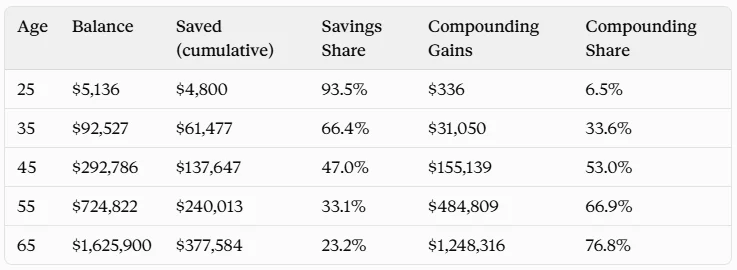
At the outset of a career, saving trumps investing. When an investor begins saving 12% of a salary at age 25, receiving modest annual raises and a 7% nominal return, the absolute volume of money generated is driven almost entirely by the sweat equity of regular contributions.
- The Early Years: Investment returns are minor compared to the sheer force of fresh capital entering the account each month.
- The Late Years: As time progresses, the snowball effect takes over. Compounding becomes back-loaded. Analytical breakdowns of long-term portfolios show that an overwhelming majority of total portfolio gains materialize in the final decade before retirement.
The Staggering Reality of Absolute Dollar Swings
Consider an investor with a $1,000,000 portfolio—a common milestone for disciplined middle-aged savers.
- A mild, entirely normal 5% pullback erases $50,000.
- A standard 10% correction wipes out $100,000, an amount higher than the median household income in the United States.
- A severe 20% bear market reduces net worth by $200,000 in weeks.
Even if an investor intellectually understands that markets historically recover and that stocks are "on sale" during a downturn, the visceral, emotional impact of watching six figures evaporate on a digital dashboard creates a profound physiological stress response.
Official Insights & Wealth Management Perspectives
Seasoned financial planners and wealth managers note that portfolio realignments are rarely triggered by market events alone. Instead, human behavior is almost always dictated by life milestones.
What Drives Portfolio Changes?
Industry data indicates that structural changes in client accounts happen far more frequently due to life events than market crashes.
- Milestone Events: Marriage, the birth of children, unexpected inheritances, career pivots, health crises, and approaching retirement drive adjustments.
- Market-Induced Changes: While severe drawdowns occasionally force defensive positioning, reactive panic selling tends to destroy long-term performance.
Strategic Options for the Mid-Life Investor
When faced with an investing mid-life crisis, experts generally point to two primary paths:
- Option A: The Structural Glidepath (Changing Strategy)
Many investors initiate a systematic de-risking phase. For example, taking a 100% equity portfolio and trimming risk assets by 3% to 5% annually until reaching a steady state—such as an 80/20 or 75/25 stock-to-bond allocation. Utilizing fixed-income assets, cash equivalents, or alternative income-generating vehicles lowers expected long-term returns slightly, but it dramatically reduces emotional volatility and guards against sleepless nights. - Option B: Reframing the Denominator (Changing Mindset)
Instead of viewing a portfolio through the lens of absolute dollar amounts, investors can maintain a robotic DCA mindset by focusing entirely on share accumulation or long-term compounding percentages. By treating market drops as clearance sales for future dividend-paying shares, the psychological sting of a falling ticker price is reframed as an operational advantage.
Implications: Finding Your Personal Risk Equilibrium
Ultimately, navigating the middle-aged investing phase requires deep self-awareness rather than adherence to a rigid formula. There is no universal right or wrong answer when absolute wealth reaches a level where market volatility produces life-changing dollar figures.
Investors must weigh two competing desires:
- The desire for peace of mind: Protecting accumulated capital, reducing short-term volatility, and trading away a portion of potential upside to ensure psychological comfort.
- The desire to maximize growth: Continuing to ride the wave with an aggressive "risk-on" posture—such as maintaining a barbell strategy of equities paired with cash or integrating trend-following momentum strategies to manage downside exposure without sacrificing growth engines.
Successfully bridging the gap between early accumulation and late-stage compounding means acknowledging that the game has changed. As absolute stakes rise, the true test of a seasoned investor is no longer just how much money they can save, but how well they can manage their own psychology when the market demands a front-row seat to massive, high-stakes wealth fluctuations.