The Geopolitical Shift: How the Russia-Ukraine War Reshapes the Sino-Indian Balance of Power
NEW YORK — More than four years after the full-scale invasion of Ukraine, the reverberations of the conflict continue to alter the architecture of Eurasian geopolitics. While Western capitals focus primarily on the immediate battlefield dynamics and the resilience of Ukrainian resistance, a profound structural transformation is quietly taking place in the East.
Russia, once a formidable global superpower operating on its own terms, has been steadily relegated to the status of a junior economic and strategic partner to Beijing. For China, this asymmetrical realignment serves immediate and long-term national interests, offering discounted energy, secure overland trade routes, and a reliable diplomatic shield against Western hegemony.
However, for India—Moscow’s historic, time-tested partner—this shift is nothing short of a geopolitical nightmare. New Delhi has long relied on its "special and privileged strategic partnership" with Russia to act as a vital counterweight against a rising and increasingly assertive China. As the Kremlin grows ever more dependent on Beijing, the foundations of India’s foreign policy calculus are being violently shaken.
1. Main Facts
At the heart of this evolving crisis is a paradox in Asian diplomacy. On the surface, New Delhi and Beijing appear to share an identical playbook regarding the war in Ukraine. Both nations have resisted joining Western-led sanctions regimes, both have significantly increased their purchases of discounted Russian crude oil, and both consistently advocate for a diplomatic resolution while refusing to condemn the Kremlin’s aggression at the United Nations.
Yet, a closer examination reveals a fundamental divergence in their strategic objectives:
- The Chinese Calculus: Beijing benefits directly from a protracted conflict. As Russia becomes diplomatically isolated from the West, Moscow has no alternative but to lean into China’s embrace. This dynamic allows Beijing to secure energy supplies on highly favorable terms, integrate Russia deeper into its yuan-dominated economic sphere, and tie down Western resources in Europe—all without firing a single shot.
- The Indian Dilemma: New Delhi wants the war to end as quickly as possible. Every month the war drags on, Russia sinks deeper into China’s economic and technological orbit. India recognizes that a completely Beijing-dependent Moscow loses its capacity—and likely its willingness—to act as an independent balancer in Asia, leaving New Delhi dangerously exposed along its contested Himalayan border.
Furthermore, the war has severely disrupted India’s defense supply chains. Historically, India has sourced over 60 percent of its military hardware from Russia. With Russian defense factories operating on a permanent wartime footing and prioritizing domestic consumption, delivery timelines for crucial spare parts, fighter jets, and missile systems to India have faced unprecedented delays.
2. Chronology of the Strategic Realignment
To understand how the current imbalance came to pass, it is necessary to trace the erosion of Russia’s strategic autonomy from the onset of the conflict to the present day:
- February–March 2022: Following the invasion of Ukraine and the swift implementation of sweeping Western sanctions, Russia’s economic ties with Europe—its primary energy market—collapse overnight. Moscow immediately pivots its economic strategy eastward, looking to Beijing and New Delhi as its primary economic lifelines.
- Late 2022–2023: China and India emerge as the principal buyers of Russian seaborne crude. However, structural differences quickly emerge. While India navigates Western secondary sanctions through complex currency arrangements and maritime loopholes to secure cheap energy, China formalizes a "no-limits" partnership with Moscow, signing massive long-term gas pipeline deals (such as Power of Siberiaing frameworks) that institutionalize Russian economic subordination.
- 2024: Western intelligence reports confirm that Beijing is supplying Moscow with crucial dual-use technologies—including microelectronics, machine tools, and navigation equipment—which sustain the Russian defense industrial base. Concurrently, reports surface of North Korean artillery shells and ballistic missiles being funneled to Russia, further cementing an axis that bypasses traditional diplomatic norms and leaves little room for Indian influence.
- 2025: As defense bottlenecks persist, India quietly accelerates its push toward "Atmanirbhar Bharat" (self-reliant India) and diversifies its defense acquisitions toward France, the United States, and domestic manufacturers. Meanwhile, high-level diplomatic exchanges reveal a growing tension in Moscow-New Delhi relations, with Indian diplomats expressing unease over deepening Sino-Russian military interoperability, including joint naval patrols in the Sea of Japan and the Western Pacific.
- September 2026: The structural reality is fully realized. Russia’s reliance on China is institutionalized. Moscow’s votes in international forums increasingly mirror Beijing’s positions, and India finds itself forced to manage a northern neighbor emboldened by its secure northern flank.
3. Supporting Data and Economic Realities
The asymmetry defining the contemporary Sino-Russian-Indian triangle is starkly illustrated by economic and trade data:
- Bilateral Trade Volume: Sino-Russian trade skyrocketed past $240 billion, shattering previous records. China now accounts for over 30 percent of Russia’s total foreign trade, while Russia represents a much smaller, albeit vital, fraction of China’s global commerce.
- The Energy Lifeline: China remains the largest importer of Russian pipeline gas and crude oil. India, too, ramped up its oil imports from virtually zero to nearly 40 percent of its total crude intake by 2023–2024, saving billions in foreign exchange. However, unlike China—which pays heavily in renminbi and dictates terms—India has frequently struggled with payment mechanisms due to Western pressure on Indian banking channels and a surplus of trapped rupees held by Moscow.
- Defense Dependencies: According to data from the Stockholm International Peace Research Institute (SIPRI), India’s reliance on Russian arms imports dropped from roughly 70 percent over the 2011–2015 period to around 36 percent by 2021–2025. This decline is not merely a deliberate policy of strategic diversification by New Delhi, but a direct consequence of Moscow’s inability to guarantee timely deliveries and technological upgrades amid its war in Ukraine.
4. Official Responses and Diplomatic Posture
New Delhi’s Balancing Act
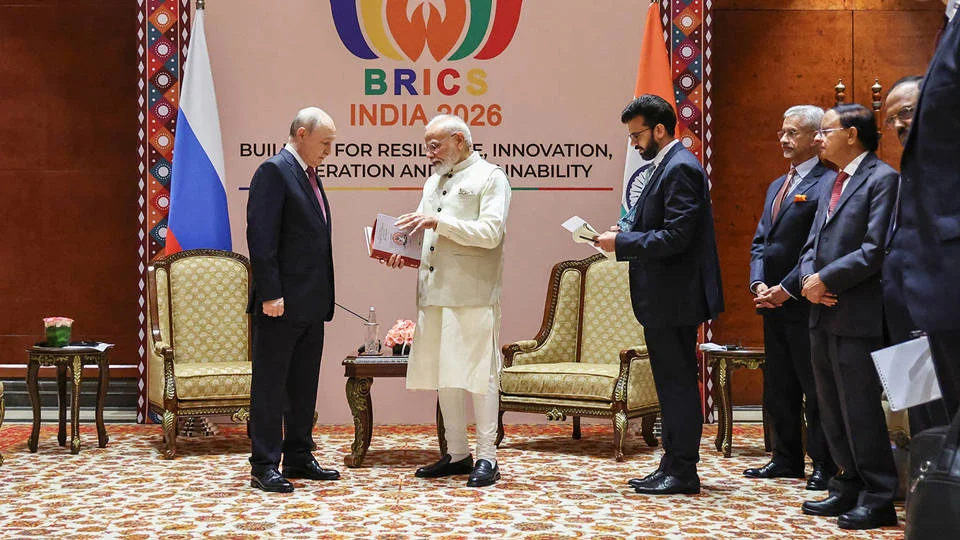
Indian Ministry of External Affairs (MEA) officials continue to publicly defend their diplomatic independence, framing their continued engagement with Moscow as a matter of "strategic autonomy" and national economic necessity. Prime Minister Narendra Modi’s administration has consistently emphasized that India’s ties with Russia are decades-old and independent of third-party relations.
However, behind closed doors, Indian defense and security planners express deep anxiety. Speaking on condition of anonymity, senior Indian foreign policy analysts note that New Delhi’s primary objective is to prevent Moscow from becoming a complete client state of Beijing. By maintaining diplomatic channels open with the Kremlin, India hopes to preserve whatever residual leverage it has to ensure Russian policymakers do not entirely discount Indian security concerns—particularly regarding sensitive defense technologies and intelligence-sharing in Central Asia.
Beijing’s Strategic Silence
In Beijing, official statements from the Ministry of Foreign Affairs routinely praise the "rock-solid" and "unbreakable" nature of the China-Russia comprehensive strategic partnership of coordination. Chinese state media frames the relationship as a model for a "multipolar world order" designed to resist Western hegemony.
Privately, Chinese strategic thinkers view Russia’s current vulnerability as a historic windfall. For decades, Beijing worried about a potential U.S.-Russia-India alignment against China. By binding Moscow tightly to its economic engine and neutralizing Russian strategic independence, Beijing has effectively eliminated the threat of a two-front geopolitical containment strategy in Asia.
Moscow’s Perspective
The Kremlin maintains that its relations with both Beijing and New Delhi remain robust. Russian official rhetoric emphasizes that its partnership with China does not target any third country. Yet, Russian diplomats privately concede that Moscow has little room for maneuver. With European markets permanently closed and Western sanctions crippling its high-tech sectors, Moscow views Beijing as its primary political protector on the UN Security Council and its chief economic savior. Consequently, when conflicts of interest arise between Beijing and New Delhi, Moscow increasingly tilts toward its northern neighbor.
5. Implications for Global Order and Regional Stability
The transformation of Russia into Beijing’s junior partner carries profound implications that extend far beyond the borders of South Asia and Eastern Europe:
The Erosion of Indian Multialignment
India has long prided itself on practicing strategic autonomy—engaging simultaneously with the West (through the Quad and deep intelligence-sharing with the U.S.) and traditional partners like Russia. However, the widening chasm between Moscow and the West, coupled with Russia’s subordination to China, makes this balancing act increasingly untenable. As Washington demands greater alignment against both Beijing and Moscow, and as Moscow grows increasingly hostile to Western interests, New Delhi’s diplomatic bandwidth is being severely tested.
Increased Vulnerability on the Line of Actual Control (LAC)
For India, the most immediate danger lies along its disputed Himalayan frontier with China. Following the deadly Galwan Valley clashes in 2020, security planners in New Delhi understood that a hostile China required a secure western and northern flank. With Russia now heavily dependent on China for economic survival, India can no longer rely on Moscow to remain strictly neutral or to pressure Beijing during a border crisis. Worse yet, joint Sino-Russian military exercises and intelligence cooperation could indirectly benefit Beijing’s operational capabilities along the Himalayan border.
The Accelerating Fragmentation of the Global Economy
The war in Ukraine has catalyzed the fragmentation of the global trading system. The dominance of the U.S. dollar is being actively challenged by bilateral currency swaps between Beijing and Moscow, a trend that nations like India are forced to navigate cautiously. As financial systems decouple and secondary sanctions complicate trade, middle powers find themselves caught between competing spheres of influence, reducing global economic efficiency and increasing the risk of systemic financial shocks.
Conclusion
The protracted war in Ukraine has fundamentally rewritten the geopolitical script of the 21st century. What began as a regional territorial conflict in Eastern Europe has triggered a massive tectonic shift in Eurasia. For China, the crisis has provided a historic opportunity to lock a nuclear-armed superpower into its economic and strategic orbit. For India, it represents a profound strategic crisis—striking at the core of a foreign policy doctrine built on independent balancing and diversified partnerships.
As the geopolitical landscape hardens into competing blocs, India’s ability to safeguard its national security, modernize its military, and maintain strategic autonomy will depend heavily on its capacity to adapt to a world where its oldest friend has become its northern rival’s most valuable asset.