The Evolution of Wall Street: How Market Structure, Costs, and Information Have Transformed Investing
October 23, 2026
By Ben Carlson
Introduction: A Glimpse into the Financial Past
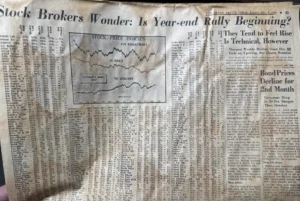
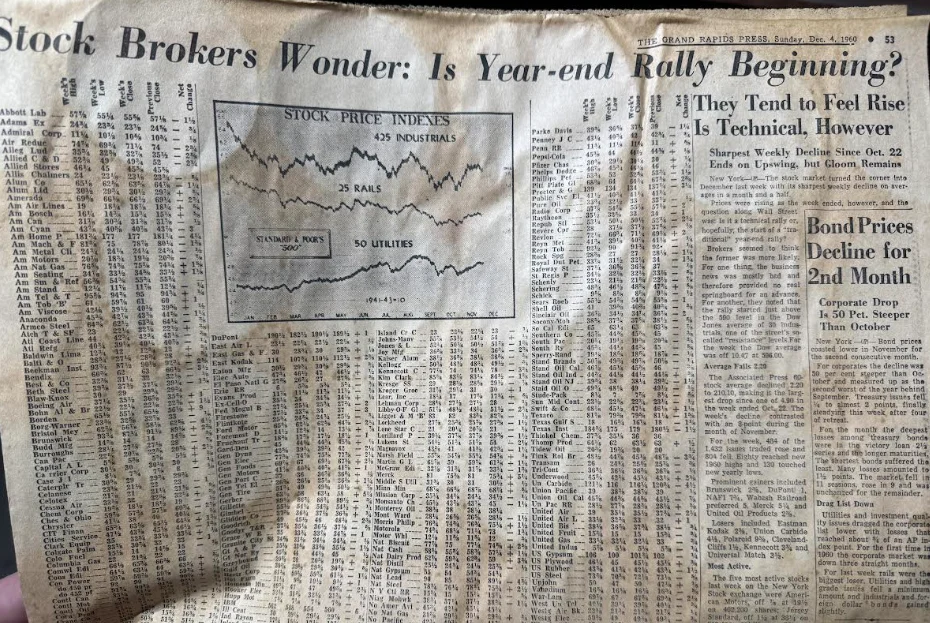
While clearing out an old rental property, a close friend recently stumbled upon a remarkable piece of financial history: the business section of a newspaper dating back to 1960. Amidst the yellowed pages and faded ink was a stark reminder of how unrecognizable the financial markets of yesteryear appear to the modern investor.
The primary artifact of interest was a chart detailing the sector makeup of the S&P 500. Comparing that snapshot from 1960 to the modern index reveals an evolution that goes far beyond simple market capitalization shifts. While today’s stock market is notoriously concentrated in a handful of mega-cap technology names, the broader index boasts a vastly different structural composition and a level of diversification that mid-20th-century investors could only imagine.
This historical juxtaposition highlights a fundamental truth of financial analysis: comparing historical market valuations to today’s landscape is an apples-to-oranges endeavor. The underlying architecture of the market—comprising trading costs, regulatory frameworks, information access, and investor behavior—has undergone a complete metamorphosis.
Main Facts: The Structural Shift in Modern Markets
To understand how far the financial ecosystem has advanced, one must examine the friction that once defined investing. Decades ago, Wall Street was an exclusive, high-cost, and information-asymmetric playground. Today, it is a low-cost, democratized engine powered by ubiquitous data and automated systems.
The core differences defining the modern market versus the mid-to-late 20th-century market include:
- Transaction Costs: Brokerage fees for retail investors routinely exceeded 2% per trade, while institutional costs regularly topped 1%. Today, zero-commission trading is the industry standard.
- Fund Expenses: Mutual funds historically demanded up-front sales loads of 5% to 8%, paired with annual management fees ranging from 0.5% to 2%. Modern index funds and ETFs operate at fractions of a percent.
- Information Flow: Information monopolies were legal and commonplace until the turn of the century. Corporations routinely fed material data to favored institutional analysts long before the public received it.
- Market Microstructure: Fractional pricing increments (such as trading in 1/8ths of a dollar) created automatic "bid-ask bounces" that artificially inflated returns, a phenomenon entirely absent in today’s penny-increment digital markets.
Chronology: Milestones in Market Evolution
The transformation of global financial markets did not happen overnight. It was driven by decades of regulatory reform, technological innovation, and structural breakthroughs by financial pioneers.
1. The Pre-Digital Era and High Frictions (1960s–1970s)
In the 1960s, the stock market was physically constrained and heavily guarded by gatekeepers. Buying a diversified portfolio required steep commissions, and access to corporate research was tightly restricted.
It was during this opaque era that financial pioneers like Michael Milken uncovered inefficiencies that others overlooked. As detailed in Robin Wigglesworth’s book A Fabulous Debt, Milken poured over an exhaustive, dense 1900–1943 study by Walter Braddock Hickman on corporate bonds. While 1,999 out of 2,000 readers ignored the data, Milken recognized a profound anomaly: taking on credit risk in corporate bonds historically yielded returns that more than compensated for default rates. This deep historical insight laid the groundwork for the high-yield (junk bond) market explosion of the 1980s—proving that back then, proprietary research and deep reading of obscure data could yield monumental market advantages.
2. The Indexing Revolution and Fee Compression (1970s–1990s)
The introduction of the first index funds marked the beginning of the democratization of finance. However, early products were far from the ultra-low-cost vehicles known today; even Vanguard’s pioneering index fund initially carried an 8.5% sales load. Over subsequent decades, competitive pressures and technology steadily drove these costs toward zero.
3. The Death of Information Asymmetry (2000)
Perhaps the most consequential market structure reform of the 21st century occurred quietly in 2000, when the Securities and Exchange Commission (SEC) enacted Regulation FD (Fair Disclosure).
Prior to Reg FD, publicly traded companies could legally disclose material non-public information to select institutional investors, Wall Street analysts, and corporate insiders before making it available to the general public. This legalized insider advantage was the primary engine behind active management outperformance. Once regulators forced companies to disseminate significant corporate news to all market participants simultaneously, the playing field was permanently leveled.
The immediate casualty of Regulation FD was the traditional active hedge fund model. The era of the legendary stock-picker effortlessly beating the market through exclusive access came to an abrupt close.
Supporting Data: The Math of Past vs. Present
Financial researcher Andrew Ang recently conducted an analysis estimating the true historical drag on yesterday’s stock market returns. While nominal annualized long-term stock returns historically hovered around 10% or higher, federal taxes alone routinely chopped those returns down to roughly 7%.
When factoring in state and local income taxes, historical mutual fund loads, and steep brokerage commissions, the net realized return for an everyday investor in the mid-20th century was significantly lower than the gross headline numbers suggest.
By contrast, modern investors enjoy:
- Institutional-grade diversification available via fractional shares and low-cost Exchange-Traded Funds (ETFs).
- Automated investing platforms that eliminate behavioral pitfalls through scheduled, recurring contributions.
- Spread elimination, where trades execute in penny increments, ensuring that transaction slippage is kept to an absolute minimum.
As financial commentator Ben Carlson notes, while gross nominal returns in the future may or may not match the historical averages of the past, on a net, after-cost basis, investors have never had it better than they do today.
Official Responses and Industry Perspectives
Market regulators and financial historians agree that the democratization of data has fundamentally altered the paradigm of wealth generation.
Financial journalist Jason Zweig, writing for The Wall Street Journal, emphasized how dramatically the plumbing of Wall Street has changed, noting that historical comparisons fail to account for the sheer friction that drained investor capital in earlier generations.
Similarly, financial authors and researchers point out that the "low-hanging fruit" of obvious market inefficiencies has long since been harvested. In a world where data, analytics, and market knowledge are ubiquitous, generating alpha requires navigating an intensely competitive landscape populated by algorithmic traders and globally connected institutions.
Implications for Modern Investors
The transformation of market structure from a high-cost, exclusive club to a hyper-efficient, low-fee digital marketplace carries profound implications for today’s wealth builders.
1. The Fallacy of Extrapolating the Past
Knowing more about financial history and possessing terabytes of real-time market data does not make predicting the future any easier. The abundance of information can easily breed a false sense of overconfidence. Investors often fall into the trap of believing that sophisticated analytics can eliminate market risk.
2. Human Nature Remains the Constant
While trading algorithms, fee structures, and corporate disclosures have evolved drastically, human psychology remains entirely unchanged. Fear, greed, overreaction, and overconfidence continue to drive market cycles.
3. Focus on What You Can Control
In an era where transaction costs are practically zero and information is instantly accessible, trying to outsmart the market through proprietary knowledge is a losing game for retail participants. Instead, the ultimate edge lies in:
- Minimizing behavioral mistakes.
- Leveraging automated investing to maintain discipline.
- Keeping portfolio costs as low as possible.
The golden age of investing is not hidden in the high-cost, opaque markets of 1960. It is happening right now, for any investor disciplined enough to harness the power of low fees, broad diversification, and long-term consistency.