The Evolution of Personal Wealth Management: A Comprehensive Analysis of the Market’s Leading Net Worth Tracking Applications
Main Facts: The Shift from Static Calculators to Real-Time Financial Engines
In an increasingly complex macroeconomic environment, tracking personal net worth has evolved from an annual manual exercise into a dynamic, real-time necessity. Net worth—calculated simply as total assets minus total liabilities—serves as the definitive metric of an individual’s financial health. Historically, individuals calculated this figure using basic pen-and-paper ledgers or static offline spreadsheets. Today, the personal financial management (PFM) sector has transitioned toward automated, cloud-based applications that aggregate disparate data streams into a single, cohesive dashboard.
The modern suite of net worth tracking tools does far more than execute basic arithmetic. Utilizing secure open-banking APIs, these platforms establish continuous connections with financial institutions, including retail banks, credit card issuers, brokerage firms, mortgage lenders, and retirement account custodians. Advanced integrations also pull real-time valuations for non-traditional assets, such as real estate (via Zillow APIs), motor vehicles (via Vehicle Identification Number [VIN] databases), digital assets (via cryptocurrency exchange APIs), and even alternative investments like domain names or private equity.
As a result, consumers no longer view their financial standing through a retrospective lens. Instead, they have access to predictive cash flow modeling, automated asset allocation analysis, investment fee diagnostics, and AI-driven budgeting assistance.
Chronology: The Decades-Long Evolution of Personal Finance Software
The technological trajectory of personal wealth tracking can be categorized into four distinct eras:
[1980s-1990s: Desktop Era] ──> [2007-2023: Open Banking & Mint Era] ──> [2024: The Great Mint Migration] ──> [Present: AI-Driven Ecosystems]1. The Desktop Era (1980s–1990s)
The foundation of digital personal finance was laid by early desktop software programs such as Quicken and Microsoft Money. While revolutionary for their time, these applications required manual data entry or the tedious importing of downloaded bank files (.QFX or .CSV). Data remained siloed on individual hard drives, lacking real-time synchronization.
2. The Open Banking and Mint Era (2007–2023)
The launch of Mint.com in 2007 marked a paradigm shift. Mint pioneered web-based automated aggregation by utilizing screen-scraping technologies and, eventually, secure application programming interfaces (APIs) provided by aggregators like Plaid, Yodlee, and Finicity. Around the same time, Personal Capital (founded in 2009) emerged, catering specifically to high-net-worth investors by focusing on investment portfolios rather than just monthly cash budgeting.
3. The Great Mint Migration (Late 2023–2024)
In late 2023, Intuit announced it would shut down Mint.com, directing its massive user base toward the less feature-rich TurboTax/Credit Karma ecosystem. This decision, finalized in early 2024, triggered a historic migration. Millions of consumers sought alternative platforms, catalyzing rapid growth and feature development among independent, paid competitors such as Monarch Money, Simplifi by Quicken, and Rocket Money.
4. The Present Era of AI-Driven and Multi-Asset Ecosystems (2025 and Beyond)
Today, the industry is defined by consolidation and technological sophistication. Platforms are no longer judged solely on their ability to sync bank accounts; they are evaluated on their implementation of proprietary AI engines, optical character recognition (OCR) for receipt scanning, and holistic tracking of alternative assets.
Supporting Data: Comparative Evaluation of Leading Platforms
To assist consumers and wealth managers in navigating the crowded fintech marketplace, we have analyzed the six leading net worth tracking applications. Each tool is categorized by its primary strength, cost structure, platform availability, and target audience.
| Platform | Primary Strength | Annual Cost (Approx.) | Target Audience | App Store Rating |
|---|---|---|---|---|
| Empower | Investment Performance & Asset Allocation | Free | Active Investors & Retirement Planners | 4.8 / 5 |
| Monarch Money | Collaborative Budgeting & AI Capabilities | ~$99.99/yr (or $14.99/mo) | Families & Former Mint Power Users | 4.9 / 5 |
| Kubera | Global & Alternative Asset Tracking | $249/yr | High-Net-Worth Individuals & Crypto Investors | Web-Optimized |
| Rocket Money | Subscription Cancellation & Cash Flow | $48–$144/yr (Sliding Scale) | Budget-Conscious Consumers | 4.7 / 5 |
| Simplifi by Quicken | Mobile-First Budgeting & Investment Basics | ~$41.88/yr (First Year Promo) | Modern Mobile Users | 4.5 / 5 |
| Tiller | Spreadsheet Customization & Data Privacy | $79/yr | Spreadsheet Enthusiasts & Developers | N/A (Sheets/Excel) |
Detailed Platform Deep Dives
1. Empower (Editor’s Choice for Investment Management)
- Pricing: Free
- Platforms: iOS, Android, Web
- Key Features: Real-time investment portfolio tracking, retirement planner, fee analyzer, asset allocation inspector, Zillow integration.
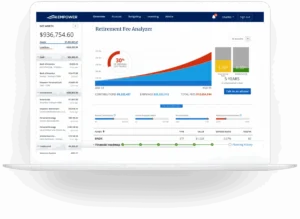
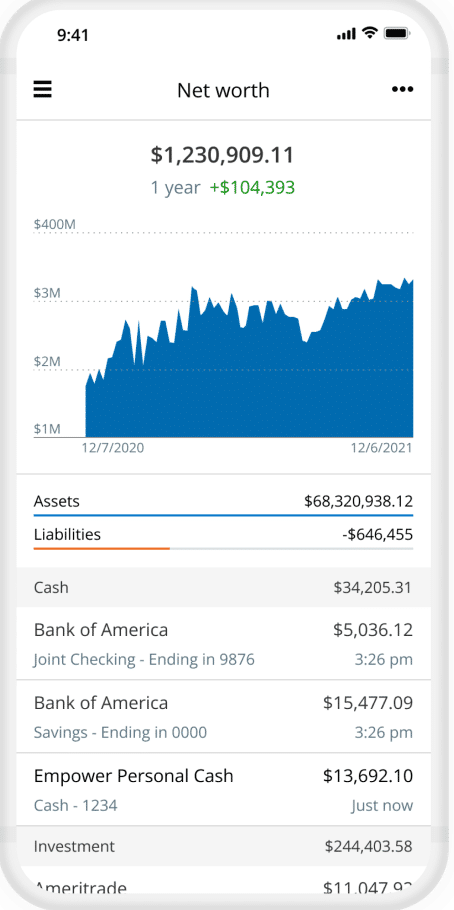
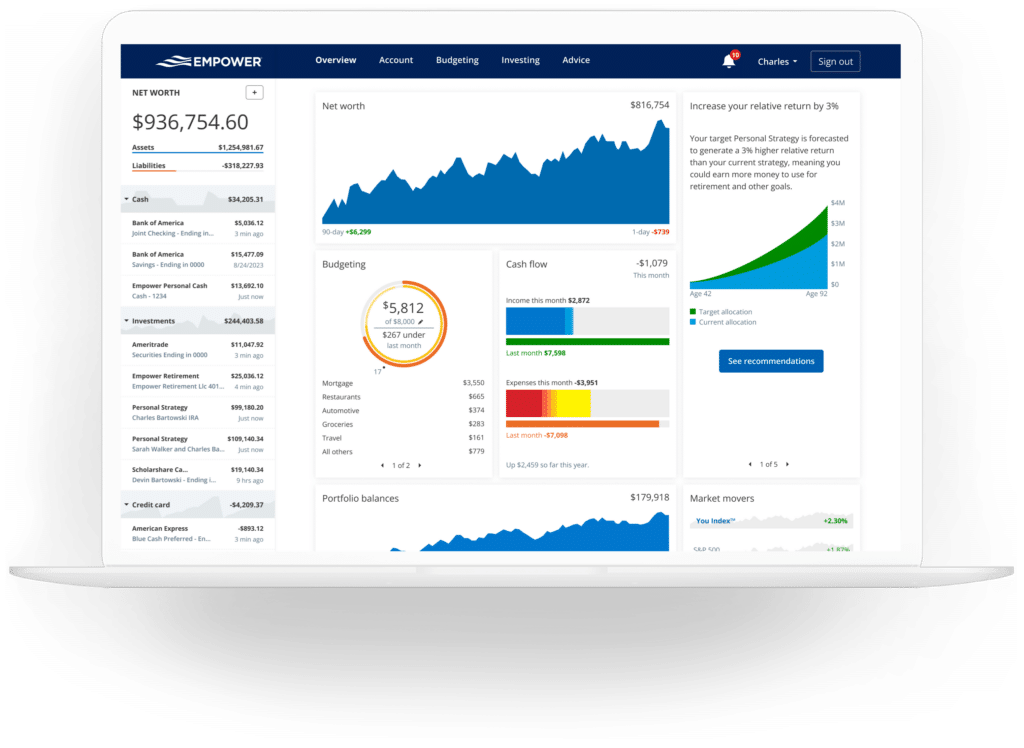
Formerly known as Personal Capital, Empower remains the industry gold standard for tracking net worth, particularly for individuals with significant investment portfolios. Unlike many of its competitors, Empower offers its comprehensive tracking suite completely free of charge. The company monetizes its platform by offering optional, human-advised wealth management services to users with asset balances exceeding $100,000.
Empower’s dashboard provides an institutional-grade analysis of investment portfolios. Its Investment Fee Analyzer scans mutual funds and 401(k) plans to uncover hidden management fees (expense ratios) that erode long-term returns. The Retirement Planner runs Monte Carlo simulations to calculate the statistical probability of a user’s assets lasting through retirement based on current spending and market volatility.
2. Monarch Money (Best Overall for Budgeting & AI Innovation)
- Pricing: Free trial, then $99.99/year (or $14.99/month)
- Platforms: iOS, Android, Web
- Key Features: AI financial assistant, OCR receipt scanner, collaborative household accounts, Apple Card integration, Coinbase sync.
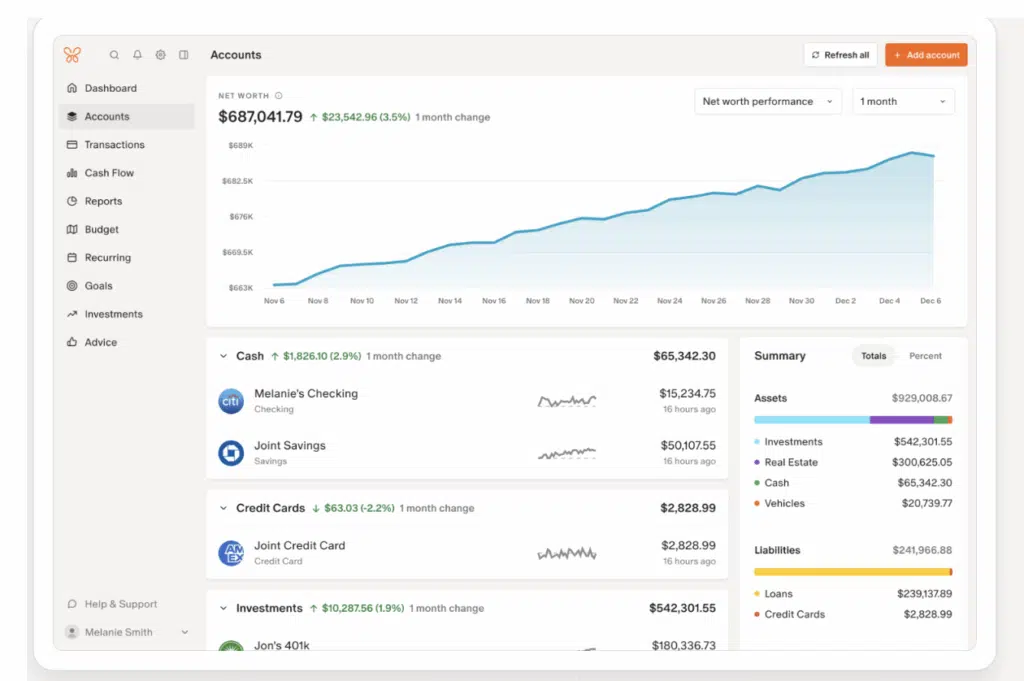
Created by one of Mint’s original product designers, Monarch Money has quickly risen to prominence as the premier premium budgeting and net worth app. Monarch distinguishes itself through its clean user interface, lack of advertisements, and rapid feature deployment.
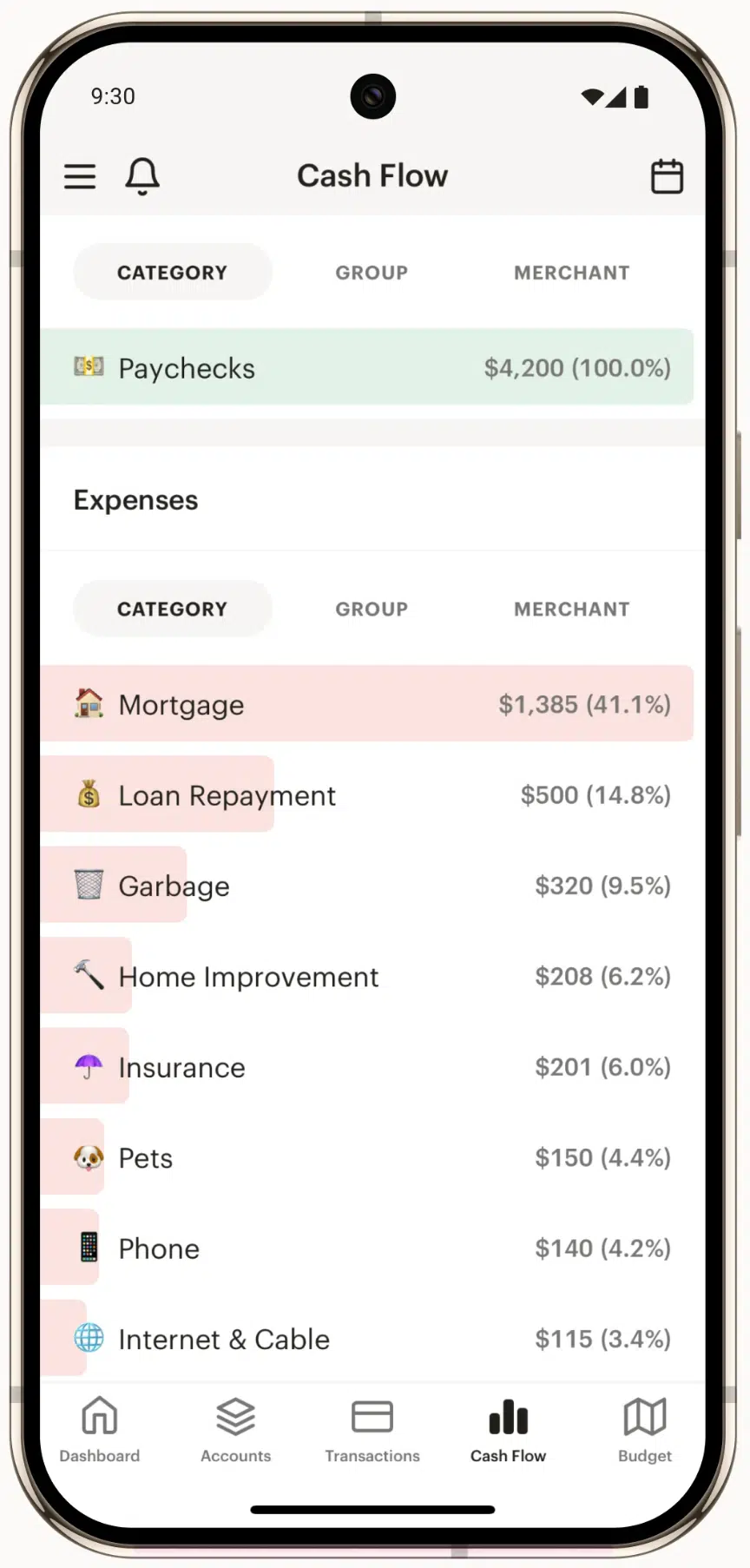
Monarch allows partners to link their individual accounts under a single household login, facilitating collaborative financial planning. The platform supports multiple data aggregation engines (Plaid, Finicity, and MX), allowing users to switch aggregators if a specific bank connection fails.
Monarch’s latest updates include an AI Financial Assistant that allows users to query their financial data using natural language (e.g., "How much did I spend on dining out compared to last month?" or "What is my current debt-to-equity ratio?"). Additionally, its new OCR Receipt Scanner automatically matches uploaded receipts to specific transactions, extracting line items for precise expense categorization.
3. Kubera (Best for Global Wealth & Alternative Assets)
- Pricing: 14-day free trial; $249/year
- Platforms: Web, iOS, Android (optimized for web)
- Key Features: Global currency conversion, domain name valuation, VIN-based vehicle tracking, document vault, beneficiary "Dead Man’s Switch."
For high-net-worth individuals, entrepreneurs, and investors with global portfolios, standard banking apps often fall short. Kubera was built specifically to address these gaps. It does not offer budgeting or transaction categorization; instead, it functions strictly as an advanced balance sheet.
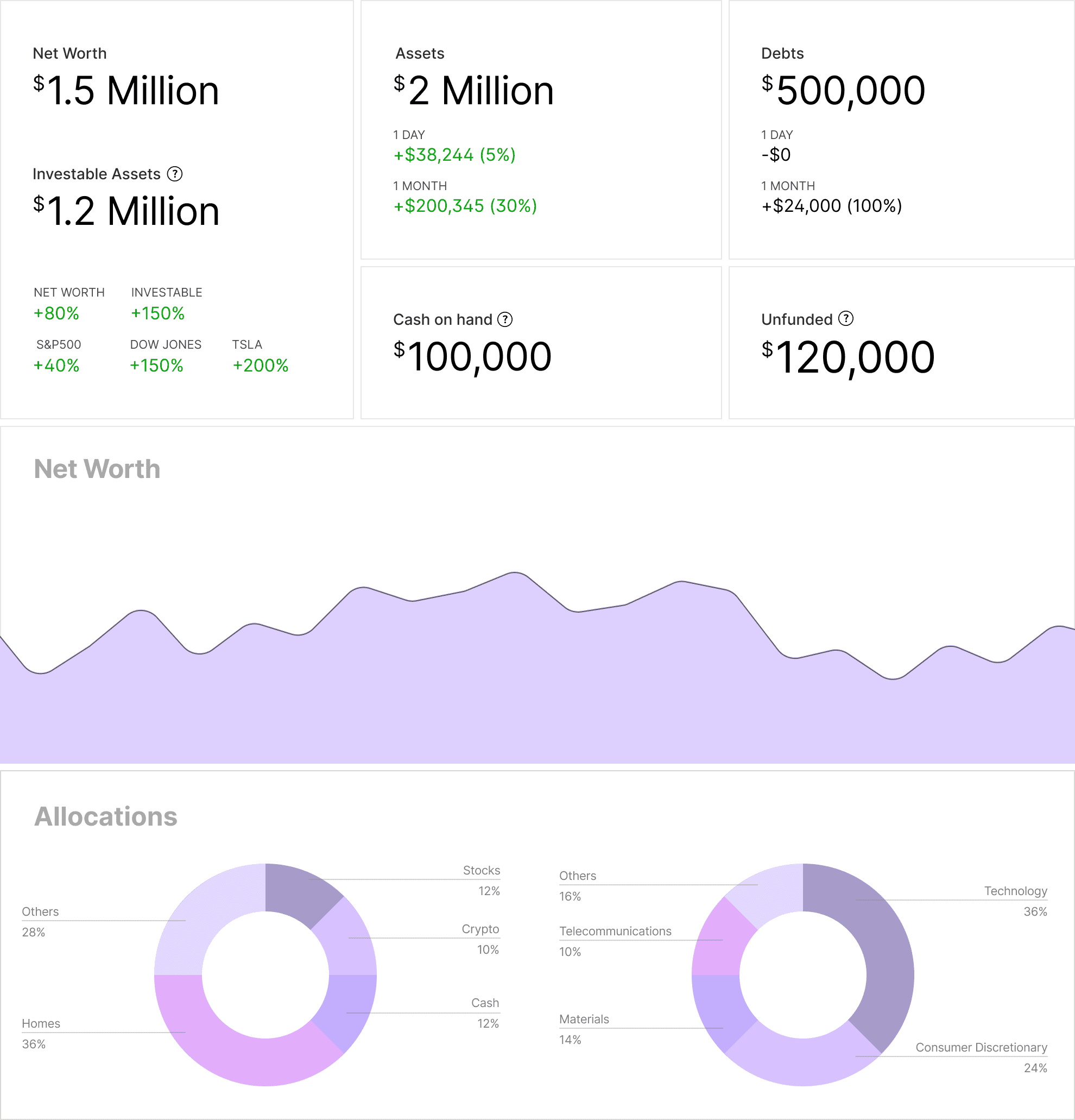
Kubera supports multi-currency tracking, automatically converting foreign bank accounts and international assets into a single base currency using real-time exchange rates. It connects to global stock brokerages, crypto wallets, and physical asset databases. Users can input vehicle VINs to pull real-time market valuations and link domain portfolios to track their digital real estate value.
Crucially, Kubera includes a secure document vault for storing insurance policies, wills, and trust documents. It also features a "Life Portfolio Share" mechanism (often referred to as a dead man’s switch) that automatically sends financial credentials and asset portfolios to designated beneficiaries if the user is inactive for a pre-set period.
4. Rocket Money (Best for Subscription Management & Bill Negotiation)
- Pricing: Free tier; Premium tier costs $6 to $12/month (pay-what-you-want scale) or $4/month billed annually
- Platforms: iOS, Android, Web
- Key Features: Subscription auto-detection, bill negotiation services, credit score monitoring, basic net worth tracking.
Originally launched as Truebill, Rocket Money focuses heavily on identifying recurring expenses and optimizing monthly cash flow. For users whose primary financial leak is "subscription creep," Rocket Money is highly effective.
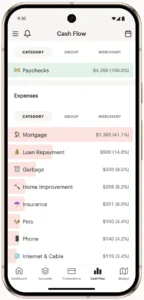
The app automatically categorizes transactions and flags recurring subscriptions, offering a one-tap cancellation service. Rocket Money also provides a bill negotiation feature, where its agents contact service providers (such as telecom and internet utilities) on the user’s behalf to negotiate lower rates, taking a percentage of the annual savings as a fee. While its investment tracking features are less robust than Empower’s, its cash-flow optimization tools make it highly accessible to the general consumer.
5. Simplifi by Quicken (Best Mobile-First Budgeting Experience)
- Pricing: $3.49/month (billed annually) for the first year, then $6.99/month
- Platforms: iOS, Android, Web
- Key Features: Highly customizable watchlist, savings goals tracker, investment performance metrics, ad-free interface.
Leveraging Quicken’s decades of financial software experience, Simplifi is a modern, mobile-first application designed to compete directly with independent fintech startups. It features a highly customizable dashboard that focuses on "spendable income" rather than rigid, traditional budgets.
Simplifi’s Watchlist feature allows users to monitor specific spending categories or merchants (e.g., limiting target spending at Amazon or Starbucks) without having to build an entire monthly budget. With its recent integration of robust investment tracking features, Simplifi has evolved from a simple budgeting tool into a comprehensive net worth tracker.
6. Tiller (Best for Spreadsheet Purists)
- Pricing: 30-day free trial; $79/year
- Platforms: Google Sheets, Microsoft Excel
- Key Features: Automated bank feeds to spreadsheets, customizable templates, developer-level data control, no third-party advertisements.
For users who distrust closed-source applications or prefer the unlimited flexibility of formulas and pivot tables, Tiller is the premier choice. Tiller bridges the gap between manual entry and automated aggregation by securely downloading bank transactions and account balances directly into Google Sheets or Microsoft Excel.
Tiller provides a variety of pre-built templates, including a highly detailed Net Worth Tracker sheet. Because the data resides entirely within the user’s personal spreadsheet, they retain complete ownership and control over their financial history. This setup enables advanced users to build custom forecasting models, write proprietary scripts, and design bespoke visualizations that no standard mobile app can replicate.
Official Responses and Security Protocols: How Fintech Protects User Data
As financial aggregation software becomes more deeply integrated into consumers’ daily lives, security remains a paramount concern. Industry executives and security officers emphasize that modern PFM tools are designed with strict institutional safeguards.
According to technical documentation from major aggregators:
- Read-Only Access: PFM applications do not have write access to financial accounts. They can aggregate and display transaction histories and balances, but they cannot initiate transfers, pay bills, or move funds.
- Bank-Level Encryption: Data transmission is secured using Advanced Encryption Standard (AES) 256-bit encryption, matching the protocols used by major global financial institutions and military networks.
- Credential Tokenization (OAuth): The industry has largely transitioned away from storing raw login credentials. Through partnerships with API aggregators like Plaid and Finicity, platforms use OAuth (Open Authorization) tokens. This protocol redirects users to their bank’s official portal to authorize access, ensuring the third-party app never sees or stores their password.
- SOC 2 Compliance: Premium platforms like Monarch Money and Kubera undergo annual SOC 2 Type II audits, verifying that their security systems, operational procedures, and data privacy controls meet strict criteria set by the American Institute of Certified Public Accountants (AICPA).
Implications: The Behavioral and Macroeconomic Impact of Automated Wealth Tracking
The democratization of sophisticated wealth-tracking technology has profound implications for consumer behavior and the broader financial services industry.
Behavioral Economics and Wealth Accumulation
In behavioral finance, the "measurement effect" dictates that the simple act of tracking a metric directly influences its outcome. By providing daily, highly visual representations of net worth, these applications keep financial goals top-of-mind.
The integration of liabilities into net worth graphs also helps mitigate the cognitive bias of "debt denial," prompting users to pay down high-interest liabilities more aggressively when they see their negative impact on their overall net worth in real time.
Visualized Tracking (Daily Net Worth Graph)
       │
       ▼
Mitigates "Debt Denial" (High-interest liabilities are explicitly shown)
       │
       ▼
Incentivizes Debt Reduction & Asset Accumulation
The Unbundling of Traditional Wealth Management
Historically, comprehensive financial planning and asset allocation analysis were services reserved for high-net-worth individuals who could afford professional wealth advisors. Free or low-cost tools like Empower and Monarch Money have effectively democratized these services. Retail investors can now self-audit their portfolios, rebalance their assets, and analyze fund fees without paying the traditional 1% assets-under-management (AUM) advisory fee.
Future Outlook: The Role of Generative AI in Wealth Management
The next frontier for net worth tracking lies in predictive AI. As large language models (LLMs) become more integrated into these tools, platforms will shift from historical reporting to predictive guidance.
Future iterations will likely analyze historical spending, market trends, and tax codes to offer automated advice, such as: "Based on your tax bracket and current net worth trajectory, you should harvest $5,000 in capital losses this month and redirect those funds to your Roth IRA to optimize your long-term wealth."
Ultimately, while the mathematical formula for net worth remains unchanged, the tools used to measure it have transformed. By automating data aggregation and offering sophisticated analytical features, modern tracking applications empower individuals to manage their financial futures with unprecedented clarity and precision.