The European Competitiveness Imperative: A Continent at a Crossroads
By Lars Sandahl Sørensen
June 17, 2026
The global economic landscape is undergoing a tectonic shift. As the United States leans into aggressive industrial policy and East Asia consolidates its dominance in the digital and green transition sectors, Europe finds itself at a precarious juncture. The promise of the European Single Market—once the engine of the continent’s prosperity—is being stifled by an accumulation of regulatory inertia, energy costs, and fractured infrastructure.
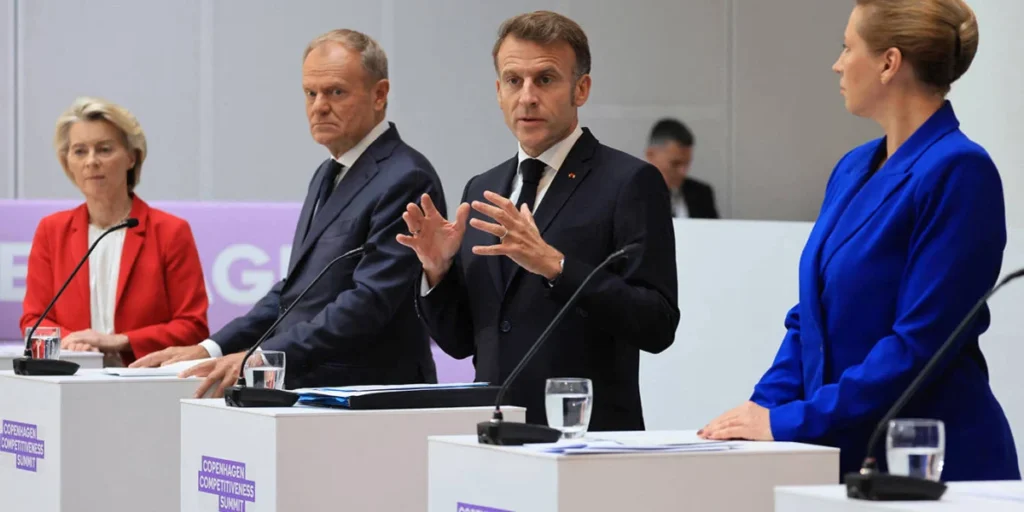
Last October, the Copenhagen Competitiveness Summit served as a high-stakes acknowledgement of this reality. When French President Emmanuel Macron stood alongside European Commission President Ursula von der Leyen, Polish Prime Minister Donald Tusk, and Danish Prime Minister Mette Frederiksen, the optics were clear: Europe’s leadership is cognizant of the decline. Joined by executives from 28 of the continent’s largest corporations, the summit was intended to be more than a photo opportunity; it was a rallying cry for structural reform.
The Core Challenge: Why Europe is Losing Ground
The diagnosis provided by industry leaders and policymakers alike is consistent: European businesses are currently operating with one hand tied behind their backs. The competitiveness gap is not a result of a lack of innovation or talent, but rather a systemic failure to foster an environment where scale and speed are rewarded.
The Regulatory Bottleneck
European enterprises are currently suffocating under a labyrinthine regulatory framework. While the intention behind initiatives like the Green Deal and the Digital Services Act is noble, the implementation has resulted in a "compliance-first" culture. Small and medium-sized enterprises (SMEs) are particularly vulnerable, often lacking the legal departments required to navigate the thicket of directives that change with dizzying frequency.
Energy Costs and Infrastructure
The energy crisis of 2022 was a brutal wake-up call, but the structural response has been sluggish. Industrial energy prices in Europe remain significantly higher than in North America or China. Without a unified, high-capacity energy grid and a massive acceleration in the permitting process for renewable energy projects, European manufacturers will continue to lose their comparative advantage.
Chronology of a Crisis: From Copenhagen to Brussels
The Copenhagen Competitiveness Summit was the culmination of months of mounting pressure from both the private sector and member states.
- Q1 2025: Initial discussions began among Northern and Western European trade blocs regarding the "Productivity Gap." Concerns were raised regarding the outflow of venture capital to U.S.-based markets.
- Q2 2025: The European Commission released a mid-term report on the Single Market, highlighting that internal trade barriers remained at levels comparable to 2015, despite pledges to harmonize digital and service sectors.
- October 2025 (The Summit): The Copenhagen gathering focused on "The Five Pillars": simplified rules, accelerated permitting, affordable energy, robust infrastructure, and the completion of the Single Market.
- Q1 2026: Following the summit, the Commission introduced the "Competitiveness Act," a legislative package aimed at streamlining cross-border business operations.
- June 2026: Current status shows that while the intent is clear, implementation remains stalled in the European Parliament due to disagreements over fiscal sovereignty and environmental trade-offs.
Supporting Data: The Productivity Gap
The empirical evidence for Europe’s struggle is stark. According to recent data from the European Central Bank (ECB) and independent economic think tanks, the productivity growth gap between the Eurozone and the United States has widened to its largest point since the 1990s.
Investment Trends
In 2025, venture capital investment in Europe fell by 14% compared to the previous year, while investment in AI and deep-tech sectors saw a 22% increase in North America. This "capital flight" is not merely about currency fluctuations; it is a vote of no confidence in the regulatory agility of the European market.
Permitting Lead Times
The average time to secure environmental and construction permits for critical infrastructure—such as high-voltage transmission lines or green hydrogen facilities—in the EU is currently 6.5 years. In comparison, similar projects in Japan and parts of the United States are seeing approval cycles reduced to under three years through "fast-track" permitting mandates.
Energy Price Differentials
European industrial electricity prices are currently 2.8 times higher than the ten-year historical average for U.S. manufacturing hubs. While European leaders argue that this is the "cost of transition," industry leaders argue that the transition is unsustainable if it forces the de-industrialization of the continent.
Official Responses and Policy Shifts
The response from Brussels has been a delicate balancing act. President Ursula von der Leyen has frequently cited the need for a "European Industrial Strategy," yet this is often met with resistance from member states that fear a dilution of their national economic autonomy.
The Commission’s Stance
"We are at a point where we must choose between a fragmented, declining market and a unified, competitive powerhouse," von der Leyen stated in a recent address to the European Parliament. The Commission’s current strategy focuses on "Regulatory Sandboxes," where industries can pilot new technologies without the immediate burden of full-scale compliance, provided they meet strict safety standards.
The Executive Perspective
Industry leaders, such as those present at the Copenhagen Summit, have been more direct. They argue that "simplification" is not just a buzzword; it is an existential necessity. Their primary demand is the adoption of a "One-In, Two-Out" policy for new regulations, ensuring that for every new compliance requirement introduced, two outdated or redundant regulations must be repealed.
Implications: A Continent at the Crossroads
The implications of failing to act are profound. If Europe does not address these structural hurdles, we face three primary long-term risks:
- De-industrialization: Energy-intensive industries—chemicals, steel, and automotive manufacturing—will continue to relocate to regions with lower overheads, permanently hollowing out the European middle class.
- Strategic Dependency: By failing to lead in the digital and clean-tech sectors, Europe risks becoming a consumer of foreign technologies rather than a producer, leaving it vulnerable to geopolitical leverage from powers in the East and West.
- Social Erosion: A stagnant economy makes it increasingly difficult to fund the European social model. High taxation is necessary for social cohesion, but it cannot be sustained if the tax base itself is shrinking.
The Path Forward
The solution requires political courage. It requires the completion of the Capital Markets Union, which would allow European savings to be invested within the continent rather than flowing to U.S. markets. It requires a radical overhaul of the European energy infrastructure, turning the continent into a single, interconnected grid. And, perhaps most importantly, it requires a mindset shift from a "precautionary" regulatory stance to a "pro-innovation" one.
As we look toward the remainder of 2026, the question is no longer whether Europe knows what to do. The blueprints, the summits, and the data are all in place. The question is whether the political machinery of the European Union can transcend national interests to ensure that the continent remains a global economic player.
The Copenhagen Competitiveness Summit was a starting point, but the clock is ticking. The global economy does not wait for consensus; it moves forward, and Europe must decide whether it will move with it or be left to manage its own decline. The policies are clear: simpler rules, faster permitting, affordable energy, and a fully functioning market. Now, it is time for delivery. If policymakers fail to act, the competitiveness challenge will not just be a headline—it will be the defining failure of the decade.