The Efficiency Trade-off: Analyzing Google’s New Gemini 3.1 Flash Lite

Google’s ongoing expansion of its generative AI ecosystem reached a new milestone last week with the launch of Gemini 3.1 Flash Lite (codenamed "Nano Banana 2 Lite"). Positioned as the foundational entry point in Google’s image generation stack, this new model is designed to sit comfortably beneath the mid-tier Gemini 3.1 Flash (Nano Banana 2) and the high-performance Gemini Pro (Nano Banana Pro).
For enterprises and individual developers, the arrival of this model is less about pushing the boundaries of "photorealistic perfection" and more about optimizing the balance between computational speed, fiscal responsibility, and functional utility. By offering a direct replacement for the legacy Gemini 2.5 Flash, Google is explicitly pitching a "same ecosystem, less money, less waiting" value proposition.
Main Facts: The New Entry Point
The core appeal of Gemini 3.1 Flash Lite is its raw performance profile. It delivers text-to-image outputs in approximately four seconds—a 2.7x speed increase compared to the standard Gemini 3.1 Flash.
The model’s integration is comprehensive from day one. It is available via Google AI Studio, the Gemini API, and the Enterprise Agent Platform. Furthermore, it is already baked into Google’s suite of consumer applications, including Search, the Gemini app, NotebookLM, and Google Photos. It also introduces compatibility with the new "Interactions API," which allows users to stack up to three sequential image edits within a single session, streamlining workflows that previously required multiple round-trips to the model.

Chronology of Development
The release of 3.1 Flash Lite marks a strategic refinement of Google’s three-tier model architecture:
- Gemini 3.1 Flash Lite: Optimized for high-frequency, low-latency, and cost-sensitive tasks.
- Gemini 3.1 Flash: Designed for the sweet spot between high-fidelity output and rapid processing speeds.
- Gemini 3.1 Pro: Reserved for high-complexity professional creative work requiring the highest degree of nuance and adherence to complex spatial constraints.
This structured rollout follows the successful launch of the Gemini 3.1 Flash model earlier this year, which established a high bar for accessible AI image generation. By introducing the "Lite" variant, Google is attempting to capture the market segment currently occupied by competitors like Seedream 5.0 Lite, while maintaining the massive infrastructural advantage of its native app integration.
Supporting Data: A Deep Dive into Performance
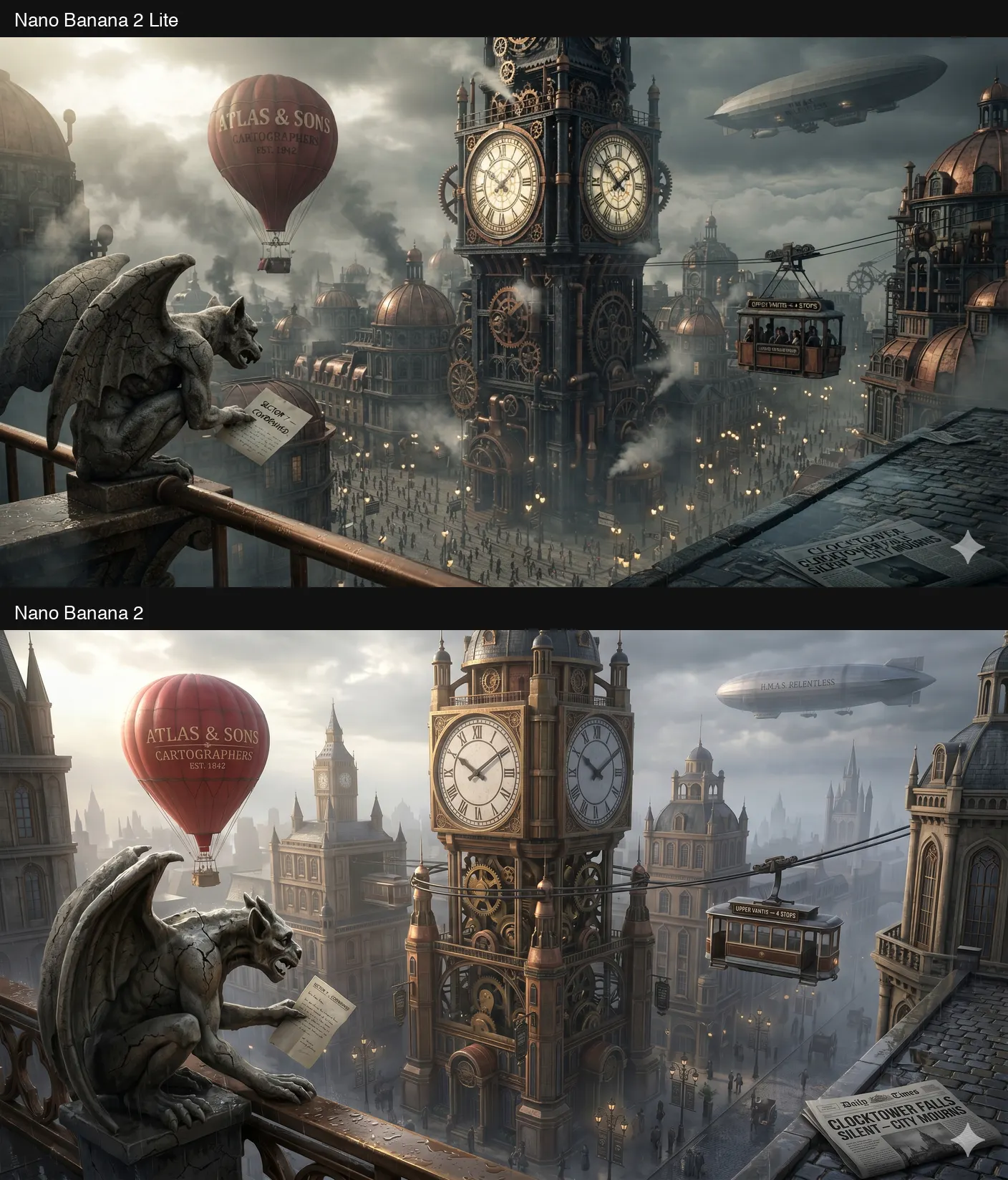
To determine if the quality drop-off is perceptible to the average user, we subjected both the Lite and the standard Flash models to a rigorous battery of tests across five distinct categories.
1. Realism and Photographic Fidelity
In tests involving cinematic portraiture—specifically a 32-year-old female architect on a rooftop—the gap between the models was most pronounced. While the Lite model correctly identified the environmental constraints (the trench coat, the glasses, the blueprints), it struggled with the subtle anatomical and atmospheric nuances. The Lite version produced images that felt like high-quality stock photography, lacking the depth-of-field precision and naturalistic skin textures present in the standard Flash model.

2. Prompt Adherence and Complex Constraints
When faced with a "steampunk cityscape" prompt requiring ten simultaneous, specific labels (e.g., a balloon with a specific historical date and a newspaper with a unique headline), both models demonstrated surprising competence. However, the Lite model frequently faltered on specific text-based details, occasionally transposing dates or garbling signage. The standard Flash model, by contrast, maintained higher accuracy, largely due to its superior handling of complex, multi-layered visual directives.
3. Spatial Awareness
Spatial reasoning—the ability to render objects in three-dimensional space with correct occlusion—remained a strong suit for both models. The Lite model performed admirably, successfully layering foreground, mid-ground, and background elements. While the standard Flash model provided a richer atmospheric gradient, the Lite model is arguably a "good enough" solution for most storyboarding and game asset conceptualization tasks.
4. Text Generation (The Counterintuitive Win)
In a surprising twist, the Lite model outperformed the standard model in text-heavy scenarios, such as a nighttime hardware store scene filled with multiple signs, posters, and stickers. Because the Lite model defaults to a brighter, more neutral lighting profile, it naturally maximizes the legibility of text. The standard model, with its sophisticated, moody, and darker aesthetic, often allowed text elements to fall into shadow, rendering them illegible. For infographic and signage-heavy tasks, the Lite model is, paradoxically, the superior choice.
Official Responses and Pricing Strategy
Google has positioned the pricing of 3.1 Flash Lite to disrupt the market. At approximately $0.034 per image at 1K resolution, it is roughly half the cost of the standard Gemini 3.1 Flash ($0.067).

This places it in direct competition with the $0.031–$0.035 price point of Seedream 5.0 Lite. While other niche providers like Reve 2.0 offer lower prices ($0.0067/image), they lack the deep, native integration into the Google ecosystem. For enterprise teams, the "platform-switching cost" of using a cheaper, isolated API often outweighs the savings, making the Google ecosystem’s breadth a compelling argument for the $0.034 price point.
Implications: Where Does the Lite Model Fit?
The arrival of Gemini 3.1 Flash Lite forces a re-evaluation of how creators and businesses choose their AI tools.
For the Content Creator
If your output is destined for social media or rapid visual ideation, the Lite model is a highly efficient, cost-effective workhorse. Its speed allows for rapid iteration that can save significant time in a production pipeline. However, if the image is a final, client-facing deliverable—such as a hero image for a campaign or a high-end portfolio piece—the Lite model’s limitations regarding texture and cinematic lighting will likely necessitate manual correction.
For the Developer
The "Interactions API" and the model’s low latency make it an ideal candidate for applications requiring real-time user feedback. If your app involves user-generated content, signage mockups, or internal documentation where text clarity is the priority, the Lite model provides a robust, readable, and lightning-fast experience.
The Verdict on the "Downgrade"
It is inaccurate to call the Lite model a "straight downgrade." Rather, it is a specialized tool. It is a scalpel for specific use cases—legibility, speed, and cost—rather than a hammer for all creative needs.
The most significant takeaway from this release is that Google is finally segmenting its AI model capabilities to match the reality of modern workflows. Not every task requires the maximum possible aesthetic fidelity; many require speed, consistency, and the ability to accurately render text. By focusing on these utility-driven metrics, Google has created a model that, while lacking the "wow factor" of its more powerful siblings, earns its place in the toolkit by being exactly what is needed for the mundane, high-volume tasks that define the modern digital economy.
As AI models continue to proliferate, the differentiator will no longer be which model can create the most beautiful picture, but which model can integrate into a specific pipeline with the least friction and the best ROI. With the launch of 3.1 Flash Lite, Google has signaled that it is no longer just chasing the frontier of intelligence; it is settling into the infrastructure of efficiency.