Beyond Pixels: Black Forest Labs’ FLUX 3 Marks a Paradigm Shift in Multimodal AI
In a landmark development for the generative artificial intelligence sector, Black Forest Labs (BFL) unveiled its latest flagship model, FLUX 3, on Thursday. Representing a significant departure from the company’s previous iterations, FLUX 3 is the lab’s first model engineered from the ground up to generate video, audio, and imagery within a unified, natively multimodal architecture.
For the researchers at Black Forest Labs—a company with deep roots in the evolution of diffusion models—this release is not merely an incremental update. It is a strategic pivot toward "world modeling," where the AI does not just predict the next pixel, but attempts to simulate the physics of the environment it represents.
The Core Innovation: A Unified Multimodal Architecture
The prevailing industry standard for generative AI has long been a "bolt-on" approach: combining separate models—one for image, one for audio, and one for video—and attempting to sync them through complex middleware. Black Forest Labs has eschewed this methodology in favor of true multimodality.
FLUX 3 was trained on a massive, concurrent dataset of images, video, and audio. By learning these modalities simultaneously, the model develops an intrinsic understanding of the relationship between visual motion and sound. When FLUX 3 generates a 20-second video clip, the accompanying audio—be it dialogue, ambient noise, or sound effects—is generated in lockstep, resulting in a level of synchronization that has historically been difficult to achieve through post-hoc editing.
A Chronology of Disruption: From Stable Diffusion to FLUX 3
To understand the significance of FLUX 3, one must look at the meteoric rise of Black Forest Labs. Founded in August 2024 by a cadre of veteran researchers—many of whom were instrumental in the creation of the original Stable Diffusion models at Stability AI—the lab quickly established itself as a disruptive force.
- August 2024: Black Forest Labs is founded. The goal is clear: to reclaim the innovation cycle that had seemingly stalled at Stability AI.
- Late 2024: The launch of the original FLUX models sent shockwaves through the community. By offering superior quality and better prompt adherence than both MidJourney and Stability’s own Stable Diffusion 3, BFL quickly became the industry darling.
- October 2024: The release of FLUX 1.1 Pro saw BFL dominate the Artificial Analysis image arena, cementing its status as the gold standard for high-end generative art.
- November 2025: BFL released FLUX.2. While technologically advanced, it failed to capture the same cultural momentum as its predecessor.
- Late 2025: The competitive landscape intensified as Alibaba’s Z-Image Turbo dethroned the original FLUX, offering comparable quality with lower hardware requirements, leading to a period of uncertainty for the German startup.
- July 2026: With the debut of FLUX 3, Black Forest Labs makes its definitive comeback, signaling a move away from pure image generation toward industrial and physical-world applications.
Performance Metrics: Head-to-Head Comparisons
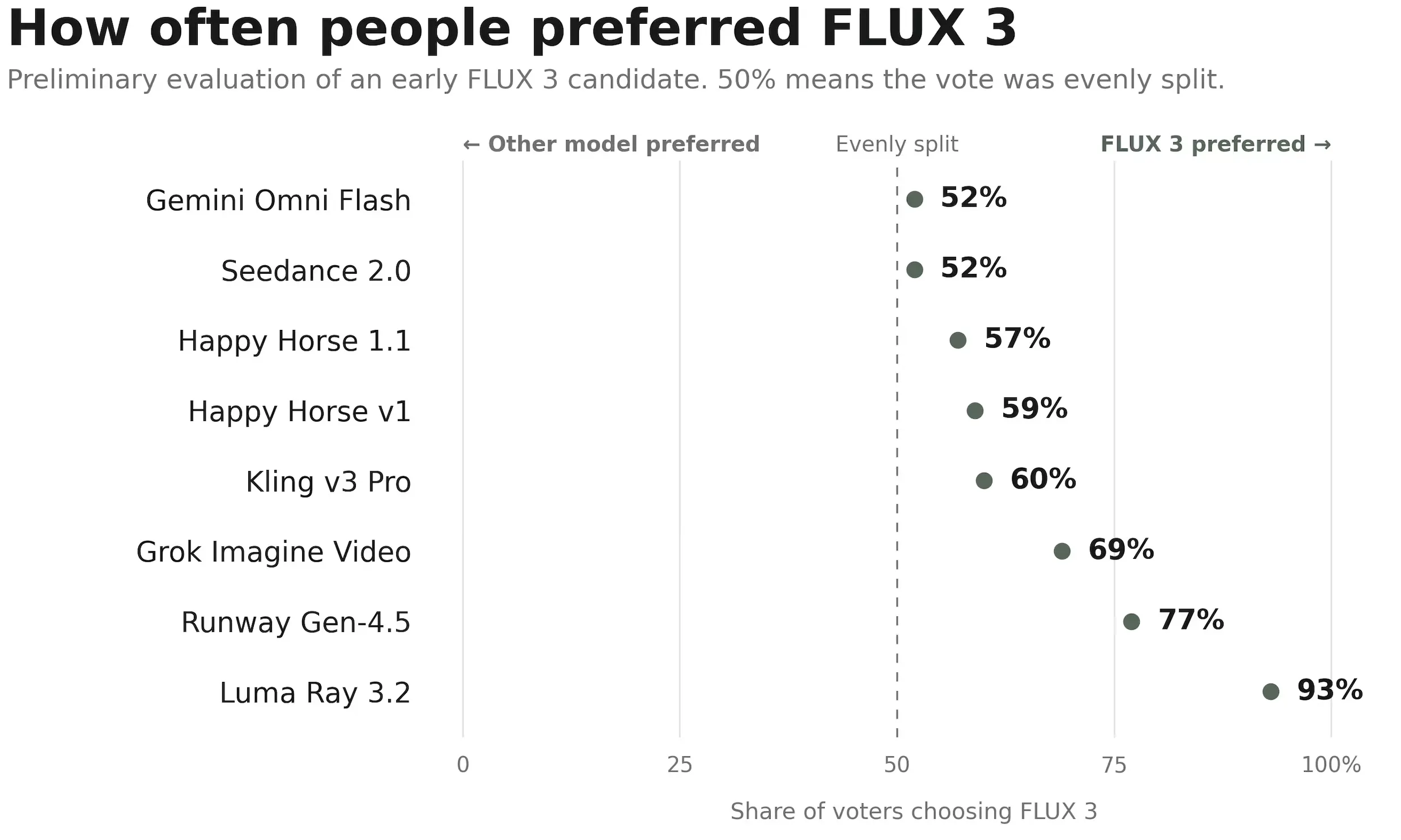
BFL has released early evaluation data based on subjective human preference tests—the industry’s primary benchmark for generative quality. In blind head-to-head comparisons, reviewers were asked to select the more convincing clip.
The results position FLUX 3 as a formidable contender in the video generation space:
- Vs. Runway Gen-4.5: FLUX 3 was preferred in 77% of evaluations.
- Vs. Luma Ray 3.2: FLUX 3 dominated with a 93% preference rate.
- Vs. Gemini Omni and Seedance: The competition is tighter, with FLUX 3 edging out these models in 52% of head-to-head comparisons.
While these tests represent subjective preference rather than a fixed rubric of "correctness," the high win rates suggest that BFL has successfully captured the nuance of temporal coherence—a common pitfall in generative video.
Bridging the Gap: FLUX-mimic and the Physical World
Perhaps the most ambitious aspect of the FLUX 3 release is its application in robotics. BFL’s co-founder and CEO, Robin Rombach, has long argued that a model restricted to images will only ever be a digital tool. By training the model to predict video, the AI is effectively learning the "physics of the world"—weight, inertia, contact, and temporal progression.
This philosophy has materialized in FLUX-mimic, a collaborative project with the Zurich-based firm mimic robotics. By attaching a lightweight "decoder" to the FLUX 3 engine, the model can translate its internal understanding of movement into real-time motor commands for robotic hardware.
The potential for this is already being stress-tested in the automotive sector. Audi is currently utilizing the system to manage "soft-body manipulation"—a task that involves handling flexible materials like door seals, which are notoriously difficult for rigid, pre-programmed industrial robots.
"Audi represents the kind of manufacturing partner we built FLUX-mimic for," stated mimic co-founder Stephan-Daniel Gravert. According to Christoph Schneider of Audi, the system has enabled robots to solve complex manipulation challenges that previous automation could not handle. Impressively, the system reports a latency of approximately 101 milliseconds, putting it within the threshold of human visual reflexes.
The Strategy Behind the Release
Despite the excitement surrounding FLUX 3, the rollout has been methodical. Unlike the original, highly accessible FLUX models, FLUX 3 is currently restricted to early access via APIs and select enterprise partners.
The strategy appears to be twofold:
- Industrial Integration: By focusing on partners like Audi, BFL is securing its financial future by proving its utility in high-value, real-world manufacturing environments rather than relying solely on the "AI art" enthusiast market.
- Controlled Deployment: BFL has indicated that a broader, open-weight "Dev" version—intended for local use—will not be released until later in 2026. This allows the company to refine the model’s safety and performance parameters in a controlled environment before it reaches the open-source community.
Implications for the AI Landscape
The emergence of FLUX 3 represents a turning point where generative AI shifts from a creative curiosity to a functional component of the physical economy.
For the average user, the promise is a generation of video that is not only visually stunning but also narratively and auditorily coherent. For the industry, however, the implications are more profound. If a model can learn the physics of the world simply by watching video, the barrier to entry for robotics and automation could collapse.
As Black Forest Labs navigates the remainder of 2026, the tech world will be watching to see if they can maintain their momentum. The "open-source crown" may have been lost to rivals in late 2025, but with FLUX 3, the company has staked a claim on a much larger territory: the physical, tangible world of automation. Whether this "world model" approach will redefine the future of human-AI collaboration remains the most significant question in the field today.
As the industry looks toward the eventual release of the open-weight version, one thing is certain: Black Forest Labs has effectively moved the goalposts, transforming the generative AI race from a competition of pixels into a race for reality itself.