The Efficiency Pivot: SpaceX-xAI Launches Grok 4.5 in a High-Stakes Race for Developer Dominance
In the rapidly evolving landscape of Large Language Models (LLMs), the strategy of "bigger is better" is beginning to face a formidable challenger: "cheaper and faster is smarter." On Wednesday, Elon Musk’s xAI—now operating under the unified banner of the SpaceX-xAI merger—officially unveiled Grok 4.5. This release marks a significant milestone for the firm, representing its first major public model since the February merger and arriving against the backdrop of SpaceX’s massive, pending $60 billion acquisition of the AI-powered code editor, Cursor.
Rather than positioning Grok 4.5 as a world-beating, omniscient intelligence, xAI is pitching it as a specialized workhorse. The model is explicitly tailored for the "knowledge worker" ecosystem—a broad spectrum ranging from software engineers debugging complex kernels to legal teams scrutinizing thousands of pages of contracts and financial analysts constructing intricate Excel models.
Chronology: A New Era of Vertical Integration
The path to Grok 4.5 has been characterized by aggressive consolidation and massive infrastructure deployment. Following the February closure of the SpaceX-xAI merger, the company signaled its intent to vertically integrate its AI capabilities directly into the tools used by developers.
- February 2025: The merger between SpaceX and xAI is finalized, consolidating Musk’s AI ambitions with his aerospace engineering powerhouse.
- Spring 2025: Work begins on the integration of Cursor’s development environment into the xAI training pipeline.
- June 2025: SpaceX announces its intention to acquire Cursor in a $60 billion deal, aiming to dominate the developer workflow stack.
- July 2025 (Wednesday): Grok 4.5 is released to the public, launching concurrently with OpenAI’s GPT 5.6 Sol, sparking an immediate industry comparison.
- Mid-July 2025: Planned rollout for European users, who remain currently restricted from accessing the new model.
The Economic Argument: Challenging the "Frontier Tax"
The most striking feature of Grok 4.5 is its pricing structure. In an era where flagship models from competitors often come with prohibitive price tags, xAI is undercutting the market significantly.
Grok 4.5 is priced at $2 per million input tokens and $6 per million output tokens. To put this in perspective, Anthropic’s flagship Claude Opus 4.8 commands $5 for input and $25 for output. Meanwhile, OpenAI’s newly launched GPT 5.6 Sol mirrors the high-end market at $5 and $30 respectively.
Musk himself took to X to contextualize the performance, describing the model as "roughly comparable to Opus 4.7, but much faster." By choosing to emphasize speed and cost-efficiency over raw, state-of-the-art capability, Musk is signaling a shift in xAI’s philosophy: the company is no longer solely chasing the "AGI crown," but rather aiming to become the utility provider for the enterprise engineering sector.
Benchmarks and the Hardware Disparity
SpaceX-xAI’s decision to publish internal benchmarks at launch has provided a transparent, if complex, look at how the model stacks up against the current giants of the industry.
The Performance Landscape
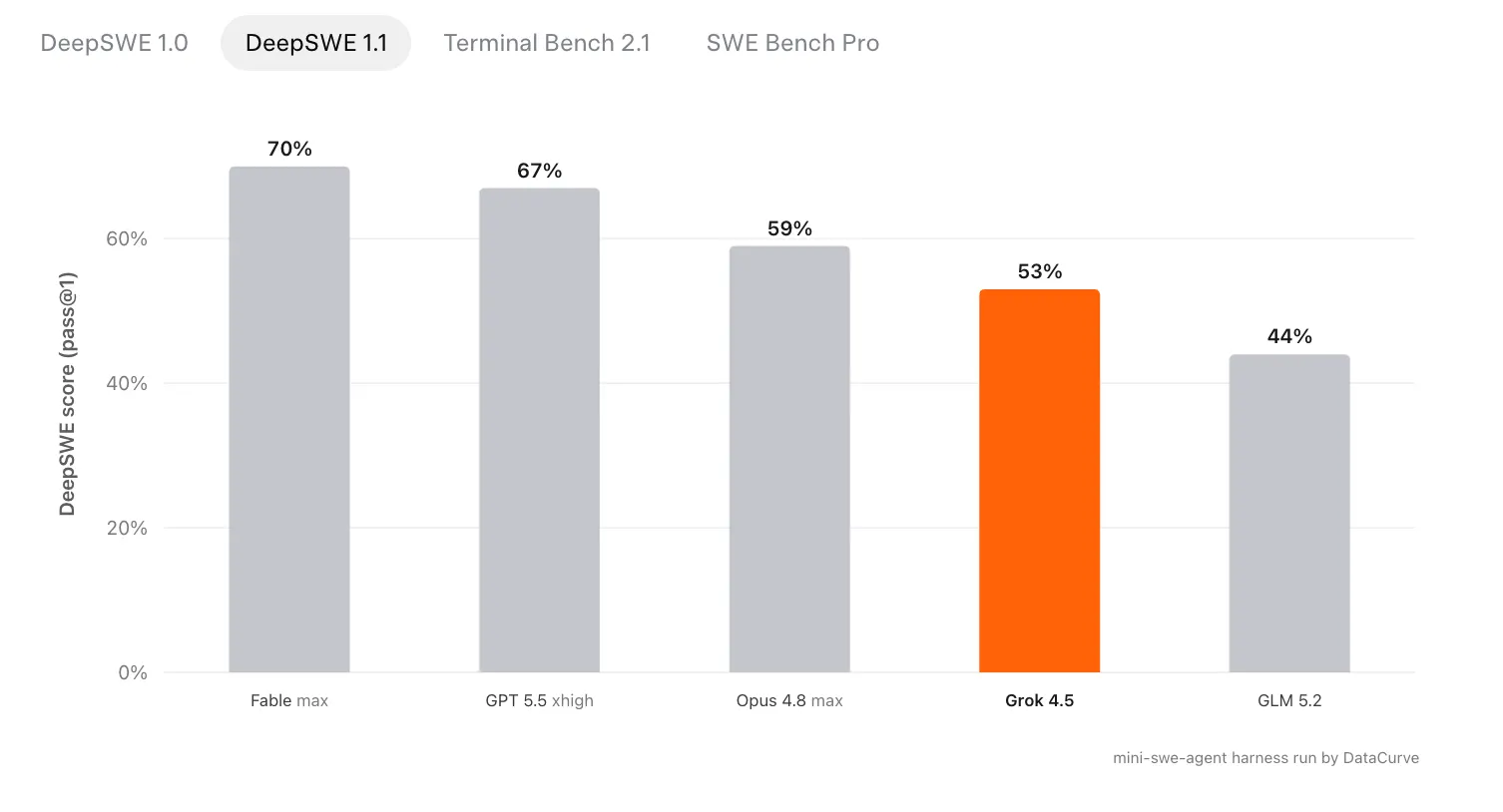
Using standardized testing, xAI evaluated Grok 4.5 against the industry standard DeepSWE 1.1, which measures the ability of an AI to close real-world software bugs. Grok 4.5 posted a score of 53%. While respectable, it trails behind Claude Opus 4.8 (59%), GPT 5.5 (67%), and the current leader, Anthropic’s Claude Fable 5, which sits at 70%.
However, the narrative shifts when looking at the SWE Bench Pro, which analyzes a broader collection of engineering tasks. Here, Grok 4.5 achieved a 64.7% resolution rate, successfully outpacing GPT 5.5’s 58.6%. While Claude Fable 5 remains the undisputed leader at 80.4%, Grok 4.5 proves itself to be a highly competitive middle-weight contender.
The Power of "Colossus"
A critical factor in this release is the hardware behind it. Grok 4.5 was trained using tens of thousands of Nvidia GB300 GPUs housed in "Colossus," the Memphis-based supercomputer that represents one of the largest concentrations of compute power in the world.
Industry analysts have pointed out the irony: while labs with significantly fewer resources are currently producing models that outperform Grok 4.5 on several benchmarks, xAI is banking on the sheer scale of its infrastructure to iterate faster than anyone else. The model’s training data was enriched by session data from Cursor, including debugging traces and granular code edits—a "training signal" that differentiates it from models trained primarily on static, publicly available code repositories.
Implications: Efficiency as a Competitive Advantage
The real-world case for Grok 4.5 is rooted in "efficiency math." In many AI workflows, the cost of the model is only one variable; the number of tokens consumed to reach a solution is another.
According to data provided by xAI, on SWE Bench Pro tasks, Grok 4.5 utilized an average of 15,954 output tokens to reach a successful resolution. In contrast, Claude Opus 4.8 required 67,020 tokens for the same task. This represents a 4.2x efficiency gap. For organizations running AI at massive scale, this difference is transformative. It allows for more iterations, faster feedback loops, and a lower total cost of ownership (TCO) that could potentially offset the slightly lower performance scores when compared to frontier models like Fable 5.
Regulatory and Ethical Scrutiny
The integration of Cursor’s proprietary developer data into the training pipeline has not gone unnoticed. Elon Musk has previously faced legal scrutiny regarding xAI’s training practices, specifically concerning the use of OpenAI models to "train" earlier versions of Grok. As SpaceX prepares to finalize its acquisition of Cursor, the company is effectively closing the loop on its data supply chain. This move secures a proprietary flow of high-quality, real-world coding data, but it also invites continued regulatory oversight regarding data provenance and intellectual property rights in AI training.
The Verdict: A Tool for the Trenches
For the average user, initial impressions have been mixed. Early testing via the Hermes interface suggests that while Grok 4.5 excels in specific, structured coding tasks, it may lag in creative writing or more nuanced linguistic tasks compared to the latest GPT or Claude models.
However, the model’s target audience is not the creative writer; it is the engineer working on tight deadlines. With a context window of 500,000 tokens—roughly equivalent to 400,000 words—Grok 4.5 can digest entire codebases, documentation sets, and legal filings in one go.
As the AI arms race continues, the industry is splitting into two distinct paths. One path, occupied by the likes of Anthropic and OpenAI, continues to push for the highest possible "intelligence" at any cost. The other, currently being carved out by SpaceX-xAI, is focusing on the practical application of AI within the existing developer workflow.
By prioritizing speed, cost-per-token, and deep integration with tools like Cursor, Musk is betting that engineers care less about achieving 99th-percentile benchmark scores and more about getting the code to run—without breaking the budget. Whether this "efficiency-first" approach is enough to capture the market from more capable models remains to be seen, but the release of Grok 4.5 proves that in the AI industry, the era of the "all-purpose" model may be giving way to the era of the "purpose-built" tool.