The Crumbling Pillar: How Germany’s Christian Democrats Lost Their Way in Mecklenburg-Vorpommern
By Jan-Werner Mueller
Published: October 15, 2026
Main Facts
BERLIN—Recent state elections across Germany have justifiably dominated international headlines, largely due to the unprecedented electoral surges of the far-right, which secured first-place finishes in two major regional contests and stands on the precipice of executive power in at least one state legislature. However, while political analysts and pundits fixate on the rise of anti-establishment radicalism, future historians may well identify a quieter, far more seismic earthquake in the foundations of the post-war German political order.
For the first time since the founding of the Federal Republic of Germany, the Christian Democratic Union (CDU)—historically one of the two grand pillars of German democracy—failed to clear the five percent electoral threshold required to enter a state parliament.
Even more humiliatingly, this historic collapse occurred not in an urban stronghold of the political left, but in the largely rural, economically fragile northern state of Mecklenburg-Vorpommern. This is the very region where former Chancellor Angela Merkel, the titan of European conservative politics for sixteen years, chaired the CDU state branch for nearly seven years.
Traditionally, Christian Democracy was built on a foundational premise: that by acting as a broad Volkspartei (people’s party) capable of reconciling competing socio-economic interests across class and regional divides, conservative governance could forge a harmonious social balance. This strategy of inclusive catch-all politics was designed specifically to inoculate the republic against the populist polarization and self-destructive infighting that destroyed the Weimar Republic.
Yet, the structural conditions that enabled this post-war strategy have fundamentally dissolved. Nowhere is this truer than in eastern Germany, where the CDU now faces an existential identity crisis. To survive, the party can no longer rely on the comforting myths of the Merkel era; instead, it must urgently reconnect with a deeper, often overlooked chapter of its ideological history.
Chronology of a Crisis: The Long Decline of Eastern Conservatism
To understand how the CDU fell beneath the five percent threshold in Mecklenburg-Vorpommern, one must trace a multi-decade arc of post-reunification political transformation, demographic shifts, and strategic miscalculations.
1. The Post-Reunification Honeymoon (1990–2000)
Immediately following German reunification in 1990, the CDU—under the leadership of Chancellor Helmut Kohl—enjoyed substantial initial success in the former East Germany (the GDR). Promising "blushing landscapes" and rapid economic convergence, the party swept early regional elections. However, the rapid de-industrialization of the east, mass privatization under the Treuhandanstalt, and soaring structural unemployment quickly eroded this goodwill.
2. The Merkel Era and Institutional Rooting (2002–2021)
As Angela Merkel consolidated her control over the federal CDU and later became Chancellor in 2005, the party in Mecklenburg-Vorpommern occupied a complex dual identity. On one hand, Merkel’s personal popularity and her status as a local Landesvorsitzende (state chairwoman) from 2002 to 2009 provided the state branch with a protective umbrella. On the other hand, Merkel’s pragmatic, technocratic, and center-leaning repositioning of the federal CDU systematically hollowed out the party’s distinct ideological profile in rural eastern territories. The CDU survived in the state primarily as a junior coalition partner in technocratic alliances rather than as an inspiring ideological home.
3. The Great Fragmentation (2015–2024)
The migration crisis of 2015–2016 marked a watershed moment. Merkel’s "Willkommenskultur" deeply alienated large segments of rural eastern voters, who felt disconnected from urban cosmopolitan centers. As the Alternative for Germany (AfD) established itself as the primary vehicle for protest and nationalist sentiment, the CDU found itself squeezed. It lost conservative hardliners to the far-right while failing to attract younger, progressive, or urban professionals who gravitated toward the Greens or the Left Party (Die Linke).
4. The 2026 Collapse
In the run-up to the recent state elections, the Mecklenburg-Vorpommern CDU attempted a conventional campaign focusing on administrative competence and incremental economic tweaking. The strategy backfired entirely. Plagued by internal factionalism, a lack of charismatic local leadership, and an inability to articulate a compelling vision for rural revitalization, the party cratered at the ballot box, failing to secure even the minimum five percent of the vote required for parliamentary representation.
Supporting Data and Demographic Shifts
An examination of demographic and electoral data from the Mecklenburg-Vorpommern election reveals the structural drivers behind the CDU’s unprecedented defeat:
- The Youth Drain: Over the past three decades, Mecklenburg-Vorpommern has experienced a persistent demographic drain, with hundreds of thousands of young, educated citizens—particularly women—migrating to western urban centers. The remaining population skews significantly older, a demographic that increasingly views mainstream centrist parties as out of touch with the realities of rural aging.
- The Rural-Urban Divide: While the CDU retained pockets of modest support in regional administrative hubs like Schwerin and Rostock, its vote share in deeply rural districts collapsed by nearly 50% compared to the previous election cycle.
- Voter Volatility: Exit polls indicated that over 40% of former CDU voters in the state switched directly to the AfD, citing dissatisfaction with national economic policies, inflation, and federal energy transitions that disproportionately impact rural infrastructure.
- Turnout Dynamics: Overall voter turnout in rural precincts surged, driven largely by anti-establishment mobilization. However, this surge bypassed the traditional center-right entirely, flowing instead to radical alternatives on both the left and the right.
Official Responses and Political Repercussions
The disaster in Mecklenburg-Vorpommern has sent immediate shockwaves through the national headquarters of the CDU in Berlin, triggering emergency leadership consultations and sharp internal divisions.
Federal Leadership Under Pressure
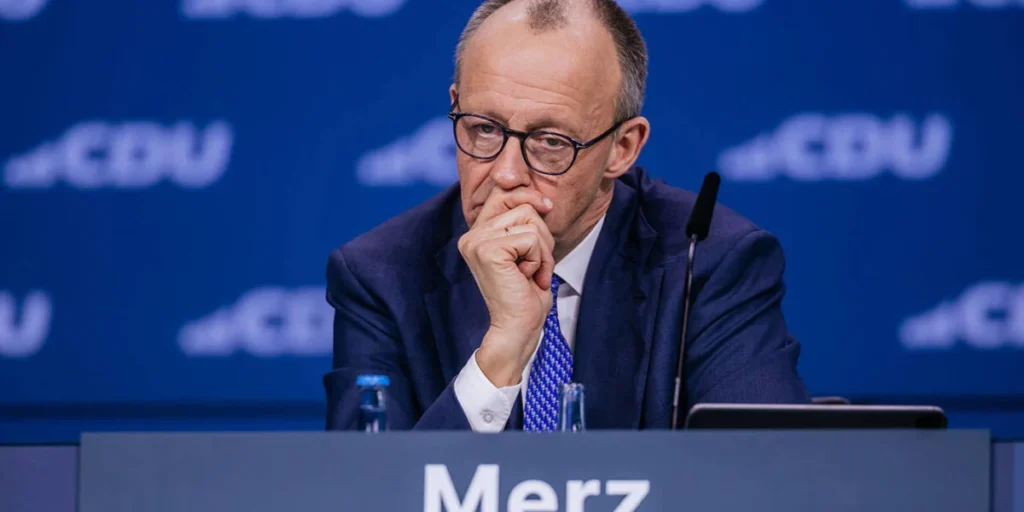
Federal CDU Chairman Friedrich Merz, who has staked his political capital on steering the party back toward a more assertive, traditional conservative course, addressed the press in an emergency briefing following the election certification.
"The result in Mecklenburg-Vorpommern is a bitter, sobering wake-up call," Merz stated. "We cannot simply attribute this to regional idiosyncrasies. When a foundational party of the Federal Republic fails to clear the five percent hurdle in a state where our former Chancellor held her political home, it signifies a profound rupture in the bond between our movement and the citizens we are sworn to represent."
Merz emphasized that the party must accelerate its efforts to win back voters who feel abandoned by federal technocracy. However, internal critics immediately seized on the defeat to challenge Merz’s strategy, arguing that his sharp rhetoric has failed to stem the bleeding on the party’s right flank while alienating moderate voters.
Regional Fallout and Resignations
In Schwerin, the entire executive board of the Mecklenburg-Vorpommern CDU announced their immediate resignation, accepting full responsibility for the historic debacle.
"We failed to offer a credible narrative of hope and security," outgoing state secretary Paula Brandt said during an emotional press conference. "For years, we acted as administrative managers of decline rather than architects of a regional revival. The voters rightly demanded an alternative, and we were simply no longer perceived as one."
Reactions from Coalition Partners and Rivals
- The Social Democratic Party (SPD): Longtime regional partners in various coalition configurations, the SPD expressed alarm at the total evaporation of the center-right. SPD general secretary Matthias Miersch noted that a stable democracy requires a functioning conservative anchor, warning that the total collapse of the CDU threatens to polarize regional parliaments into unmanageable ideological blocs.
- The Alternative for Germany (AfD): Celebrating their dominant performance, AfD regional leaders framed the CDU’s elimination from the state parliament as the natural death of "Merkelism," asserting that the traditional conservative consensus is dead and buried in eastern Germany.
Implications: Rebuilding Christian Democracy from the Roots
The unprecedented erasure of the CDU in Mecklenburg-Vorpommern is not merely a regional statistical anomaly; it serves as a clinical diagnosis of the broader crisis facing center-right politics across the Western world.
1. The Limits of the Catch-All Strategy
For decades, political scientists celebrated the Volkspartei model as the pinnacle of democratic stability. By smoothing over ideological contradictions in pursuit of median voters, parties like the CDU and the German SPD successfully governed for generations. However, in an era defined by profound systemic disruptions—including globalization, climate transformation, demographic aging, and digital disruption—the middle has hollowed out. Voters no longer reward triangulation; they demand ideological clarity, emotional resonance, and structural protection.
2. The Eastern Exception vs. The National Rule
While the complete wipeout occurred in the east, the underlying pathologies—alienation from federal elites, anxieties over cultural and economic preservation, and the erosion of local civic institutions—are increasingly visible in rural pockets of western Germany as well. If the CDU treats Mecklenburg-Vorpommern as an eastern outlier rather than an early warning indicator, it does so at its own peril.
3. Returning to Historical Roots
As columnist Jan-Werner Mueller and other political historians have argued, the CDU’s contemporary crisis demands a critical re-engagement with its pre-Merkel history. In its formative post-war decades, Christian Democracy was not merely a managerial coalition of convenience; it was deeply rooted in Christian social ethics, strong regional civil society networks, robust local economies, and a genuine commitment to social solidarity that transcended pure market liberalism.
To reconnect with these roots, the modern CDU must transition away from top-down, Berlin-centric technocracy and invest heavily in grassroots community-building. It must prove to citizens in rural and economically neglected regions that conservative politics offers tangible, community-based solutions to housing, healthcare, and economic opportunity.
Conclusion
The fall of the CDU below the five percent threshold in Mecklenburg-Vorpommern will be studied by political scientists for generations to come. It marks the definitive close of an era defined by consensus-driven catch-all politics. Whether the Christian Democrats can rise from the ashes of this historic defeat will depend entirely on their willingness to abandon comfortable political orthodoxies, listen to the legitimate grievances of neglected communities, and rediscover the foundational social principles that birthed modern German democracy.