The Crisis of Multilateralism: Why the United Nations Must Reform or Face Obsolescence
By Maíra Martini
Published: September 17, 2026
BERLIN — Effective global governance has long relied on the architecture built in the wake of the Second World War. At its center stands the United Nations, an organization conceived to prevent the scourge of war, foster international cooperation, and uphold human rights. Yet, as the world navigates escalating geopolitical tensions, fragmented global alliances, and the existential threat of climate change, the foundational premise of effective multilateralism is fracturing.
True international cooperation depends on institutions that are transparent, accountable, and endowed with the structural authority to enforce their own rules. Today, the United Nations falls woefully short of these standards. If the international community is to weather the overlapping crises of the twenty-first century, the UN must lead by example—fundamentally transforming everything from how it selects its next secretary-general to how it intends to ensure that sovereign governments actually follow through on their binding climate commitments.
Main Facts
The debate over the future of global governance was thrown into sharp relief earlier this year. In January 2026, United States President Donald Trump floated a radical alternative to the established international order, suggesting that his newly minted "Board of Peace" might eventually replace the United Nations entirely.
While seasoned diplomats and political analysts were quick to dismiss the proposal as classic Trumpian bluster and rhetorical grandstanding, the mere articulation of such an idea underscores a deeper, more alarming reality: the United Nations has suffered a catastrophic loss of institutional credibility.
The core paradox facing the international system is stark. On one hand, public trust in the UN’s bureaucratic machinery, Security Council efficacy, and enforcement mechanisms has plummeted to historic lows. On the other hand, the global community desperately needs a centralized, legitimate institution capable of bringing sovereign nations together to tackle transnational challenges that respect no borders—most notably, anthropogenic climate change, global health security, and systemic economic instability.
Without sweeping internal reforms, the UN risks becoming a toothless talk shop, vulnerable to usurpation by ad-hoc, unilateral coalitions of power.
Chronology of a Crisis: How the UN Reached the Breaking Point
To understand the current existential threat facing the United Nations, one must trace the erosion of its authority through a series of key historical and recent milestones:
- June 1945: The United Nations Charter is signed in San Francisco, establishing an organization designed to maintain international peace and security. From its inception, however, the structural flaw of the permanent five (P5) veto power in the Security Council is baked into its foundation.
- December 2015: The landmark Paris Agreement is adopted at COP21, hailed as a triumph of multilateral diplomacy. However, the agreement relies on a "pledge-and-review" model—Nationally Determined Contributions (NDCs)—with virtually no enforcement mechanisms to punish nations that fail to meet their emission reduction targets.
- November 2021 – November 2023: Successive climate summits (COP26 in Glasgow and COP28 in Dubai) highlight the growing disconnect between scientific warnings and state-level policy implementation. Developing nations grow increasingly resentful as wealthy industrialized nations fail to deliver promised climate adaptation financing.
- January 20, 2026: Following diplomatic friction over regional conflicts, US President Donald Trump publicly suggests that his newly established "Board of Peace"—initially formulated to address post-conflict administration in Gaza—could scale up to supersede the United Nations. The announcement sends shockwaves through diplomatic corridors in Geneva, Brussels, and New York.
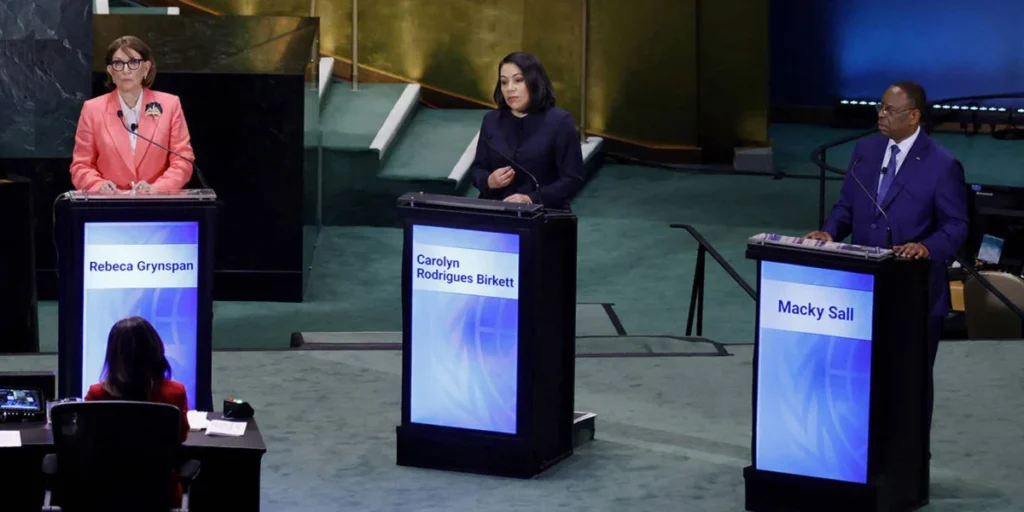
- September 2026: As the UN General Assembly convenes in New York, member states grapple with a looming leadership transition. The process for selecting the next UN secretary-general faces intense scrutiny from civil society groups demanding unprecedented transparency, moving away from closed-door bargaining by the P5.
Supporting Data and Systemic Vulnerabilities
The erosion of the UN’s standing is not merely a matter of perception; it is backed by structural data and institutional metrics that reveal deep vulnerabilities:
- The Climate Action Gap: According to reports from the UN Environment Programme (UNEP), current global commitments under the Paris Agreement put the planet on a trajectory toward a catastrophic temperature rise of 2.7°C to 2.9°C by the end of the century. Despite annual COPs, global greenhouse gas emissions continue to hover near record highs.
- Security Council Paralysis: In the past decade, the use—and threatened use—of the veto by permanent members of the UN Security Council (the US, Russia, China, the UK, and France) has paralyzed the body’s response to major humanitarian crises and conflicts in Ukraine, the Middle East, and parts of sub-Saharan Africa.
- Funding and Donor Dependency: The UN’s core budget and specialized agencies (such as the UNHCR and WFP) face chronic funding shortfalls. Increasingly, the organization relies on earmarked voluntary contributions from wealthy member states and private philanthropic entities, raising legitimate concerns regarding donor-driven agendas and compromised neutrality.
- Public Trust Deficits: Polling data across major G20 economies indicates a steady decline in public confidence in international organizations over the past fifteen years. Citizens increasingly view the UN as bureaucratic, bloated, and incapable of swift intervention during global emergencies.
Official Responses and Diplomatic Reactions
The proposition that a unilateral or alternative body could replace the world’s premier multilateral forum has elicited a spectrum of sharp reactions from global leaders and institutional defenders.
- The United Nations Secretariat: Speaking on condition of anonymity, senior UN officials have repeatedly pushed back against external attempts to delegitimize the organization. Representatives maintain that while the UN is imperfect, it remains the only universal platform where sovereign equals can engage in dialogue. The Secretariat has emphasized ongoing internal modernization efforts, though critics argue these initiatives are purely cosmetic.
- European Union Leadership: Brussels has emerged as a staunch defender of traditional multilateralism. European Commission and Council officials have reiterated that dismantling the UN architecture would plunge international relations back into a nineteenth-century paradigm of "might makes right." The EU continues to advocate for comprehensive UN reform—specifically calling for the expansion of the Security Council to include permanent representation from Africa, Latin America, and Asia—rather than its replacement.
- Global South Perspectives: Governments across the Global South have expressed a complex mix of frustration and defense regarding the UN. While many share deep grievances over the West’s historic dominance within Bretton Woods institutions and the UN Security Council, leaders from regions like Latin America and Southeast Asia warn that abandoning the UN entirely would strip smaller nations of their diplomatic leverage, leaving them entirely at the mercy of competing superpowers.
- Washington and Alternative Formations: Proponents of Trump’s "Board of Peace" argue that legacy institutions like the UN are too bureaucratic, slow, and bogged down by procedural gridlock to handle rapid-onset geopolitical and humanitarian crises. They contend that flexible, results-oriented coalitions represent the future of effective international statecraft.
Implications: Reform or Irrelevance
The existential crisis facing the United Nations forces a fundamental reckoning for the international community. The stakes could not be higher.
If the UN continues on its current trajectory—plagued by institutional paralysis, opaque leadership selections, and an inability to hold major polluters and human rights violators accountable—it will slowly slide into irrelevance. Alternative frameworks, ranging from economic blocs like BRICS to ad-hoc security boards crafted by individual superpowers, will inevitably fill the vacuum. Such a splintered global order would likely increase the frequency of trade wars, unconstrained regional conflicts, and accelerated ecological collapse.
Conversely, this moment of acute vulnerability presents a generational opportunity for renewal. To survive, the United Nations must embrace radical institutional surgery.
First, the selection process for the next secretary-general must be entirely democratized and transparent, breaking the historical monopoly held by the P5 veto powers. The office must be empowered to act as an independent moral and diplomatic arbiter, rather than a managerial secretary beholden to the whims of the world’s most powerful capitals.
Second, the international community must rethink how global treaties—particularly climate accords—are enforced. A "pledge-and-review" model that lacks teeth is no longer viable on a warming planet. Mechanisms involving economic adjustments, conditional financing, and transparent accountability metrics must be integrated into international law to ensure that governments cannot quietly renege on commitments that affect the survival of future generations.
The world does not need a new institution built on the whims of transient political leaders; it needs an old institution revitalized by courage, transparency, and collective will. The United Nations was built to save humanity from itself. If it is to fulfill that mandate in the decades ahead, it must prove that it can reform itself before the world decides to move on without it.