The Agency Shift: How Agentic AI is Rewriting the Rules of Financial Planning and Analysis
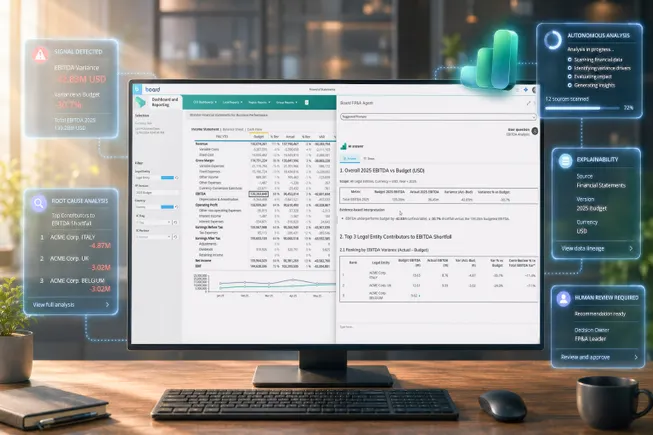
The landscape of corporate finance is undergoing a seismic transformation. For decades, Financial Planning and Analysis (FP&A) teams have operated in a reactive cycle: manually aggregating data, building spreadsheets, and waiting for scheduled reporting periods to surface insights. However, the emergence of "Agentic AI" has introduced a paradigm shift that promises to move finance from a back-office reporting function to a real-time, predictive powerhouse.
A recent report by Board, a leading provider of intelligent planning solutions, identifies this transition as the "Agency Shift." This term defines a fundamental change in the relationship between humans and software: the transfer of task initiation from the analyst to the system itself. While the AI now possesses the autonomy to monitor, analyze, and propose solutions, the ultimate mantle of accountability and strategic judgment remains firmly in human hands.
The Core Facts: Moving Beyond Simple Automation
To understand the Agency Shift, one must distinguish between the "AI-assisted" tools of the past and the "Agentic" systems of today. Previous iterations of AI in finance were essentially sophisticated task-doers; they waited for a human analyst to provide a command, a dataset, and a parameter before executing a routine process.
Agentic AI, by contrast, operates on a continuous feedback loop. It does not wait for a human to prompt it. Instead, it actively monitors market conditions, margin erosion, demand swings, and potential cash flow gaps in real-time. The moment an anomaly or a significant business signal is detected, the AI initiates the analysis, synthesizes the data, and surfaces a recommendation to the finance team.
"It’s now not only about automation," says Simone Ferrari, Product Manager for FP&A Solutions at Board. "The real power is in shortening the gap from facts to decision by compressing the distance between an event and a finance leader’s response."
Chronology of the Transformation
The evolution of financial technology can be viewed through three distinct phases, leading to the current state of agency:
- The Manual Era (Pre-2010s): Finance teams spent the vast majority of their time on manual data entry, reconciliation, and basic spreadsheet manipulation. The "human in the loop" was essentially a manual processor of information.
- The Automation Era (2010s–2023): The arrival of Robotic Process Automation (RPA) and early-stage AI allowed finance departments to automate repetitive tasks. While this freed up time, it was still a human-led process—the machine only worked when told to do so.
- The Agency Era (2024–Present): With the integration of Large Language Models (LLMs) and advanced agentic frameworks, the system has gained the ability to "see" and "act." It continuously scans the environment, triggers workflows, and presents insights, fundamentally changing the role of the analyst from a data gatherer to a strategic reviewer.
Supporting Data: The Case for Change
The urgency of this shift is underscored by the current state of corporate finance. Data from Board’s research reveals that modern finance teams are paradoxically overworked yet under-utilized.
- The Capacity Gap: Less than one-third of the average FP&A team’s time is spent on high-value, strategic work such as storytelling, business partnering, and decision support.
- The Data Tax: Nearly 50% of departmental capacity is consumed by manual data wrangling—the process of cleaning, consolidating, and formatting data from disparate legacy systems.
- The Latency Problem: Only 4% of organizations currently possess the capability to refresh a forecast within a single business day.
This creates a "latency lag." In an era where market conditions can shift in minutes, a reporting cycle that takes days or weeks to produce creates a dangerous void between a business signal and a management response. Agentic AI is designed specifically to close this gap, transforming finance into a proactive, rather than reactive, department.
Governance and "Architected Accountability"
With the introduction of autonomous agents, the risks associated with error, bias, or "hallucinations" increase. If an AI can suggest a budget reallocation, it can, in theory, make a bad decision if not properly constrained. This is why the conversation surrounding AI in finance has shifted from "can it be done" to "how do we govern it?"
Board emphasizes a concept they call "architected accountability." This requires finance leaders to move beyond the traditional view of governance—which is often siloed within IT or legal departments—and place it at the center of the financial strategy.
The Breakdown of Governance
When AI becomes an active participant in decision-making, it often exposes existing "governance debt." Ferrari notes that the first cracks usually appear in three areas:
- Semantic Inconsistency: Where different systems or departments define key metrics (like "gross margin" or "churn") differently, leading to conflicting AI outputs.
- Ambiguous Workflows: When approval thresholds are not clearly defined, leaving an AI agent with too much discretion.
- Auditability Gaps: When a system provides an answer, but the "paper trail" of how it reached that conclusion is obscured, making it impossible to defend before a board or regulator.
"The AI did it; I don’t know why is not a good enough answer," says Ferrari. Leaders require full transparency: the specific data sources used, the versioning of the scenario, the drivers behind the forecast, and the thresholds applied.
Implications for Finance Leadership
The Agency Shift implies a fundamental change in the skills required of a CFO and their staff. As the machine takes over the analytical legwork, the finance professional becomes an "Architect of Logic."
1. From Analyst to Auditor
Finance teams must now audit the logic of the system. Instead of checking cells in a spreadsheet, they are evaluating the rules, constraints, and parameters that the AI operates within. This is the essence of architected accountability.
2. Explainability as a Competitive Advantage
Systems that offer "black-box" outputs will be rejected by finance departments that are subject to strict regulatory oversight. The next generation of successful FP&A platforms, such as the one offered by Board, is designed with explainability as a core engineering principle. By providing full transparency for every prompt—including data provenance and currency—leaders can confidently defend AI-assisted decisions.
3. A Phased Adoption Strategy
Organizations should not attempt to automate their entire FP&A lifecycle overnight. The recommended path is a phased, high-value adoption:
- Identify the High-Impact/Low-Risk Areas: Start with use cases where the value is clear—such as variance analysis or monthly rolling forecasts.
- Measure and Calibrate: Use the initial outcomes to measure value and tune the AI’s thresholds.
- Expand Strategically: Use the confidence gained in the first phase to expand into more complex, sensitive areas of financial planning.
Conclusion: The Human in the Loop
The rise of agentic AI does not signal the end of the finance professional; rather, it marks the end of the finance professional as a "human calculator." By offloading the continuous monitoring of market signals to autonomous agents, teams can reclaim the time once lost to manual data wrangling.
However, the technology is merely a tool. As Simone Ferrari aptly puts it, "AI should be used to support human judgment, not replace it. Humans should be behind the steering wheel."
The Agency Shift is an invitation for finance leaders to stop looking backward at the previous month’s numbers and start looking forward at the real-time signals that will define the future of their enterprise. Through robust governance, architected accountability, and a clear vision for human-machine collaboration, companies can turn the inherent risks of autonomous AI into a powerful engine for strategic foresight.