The 3-Trillion-Parameter Breakthrough: How Moonshot AI’s K3 Challenged the Global AI Hierarchy

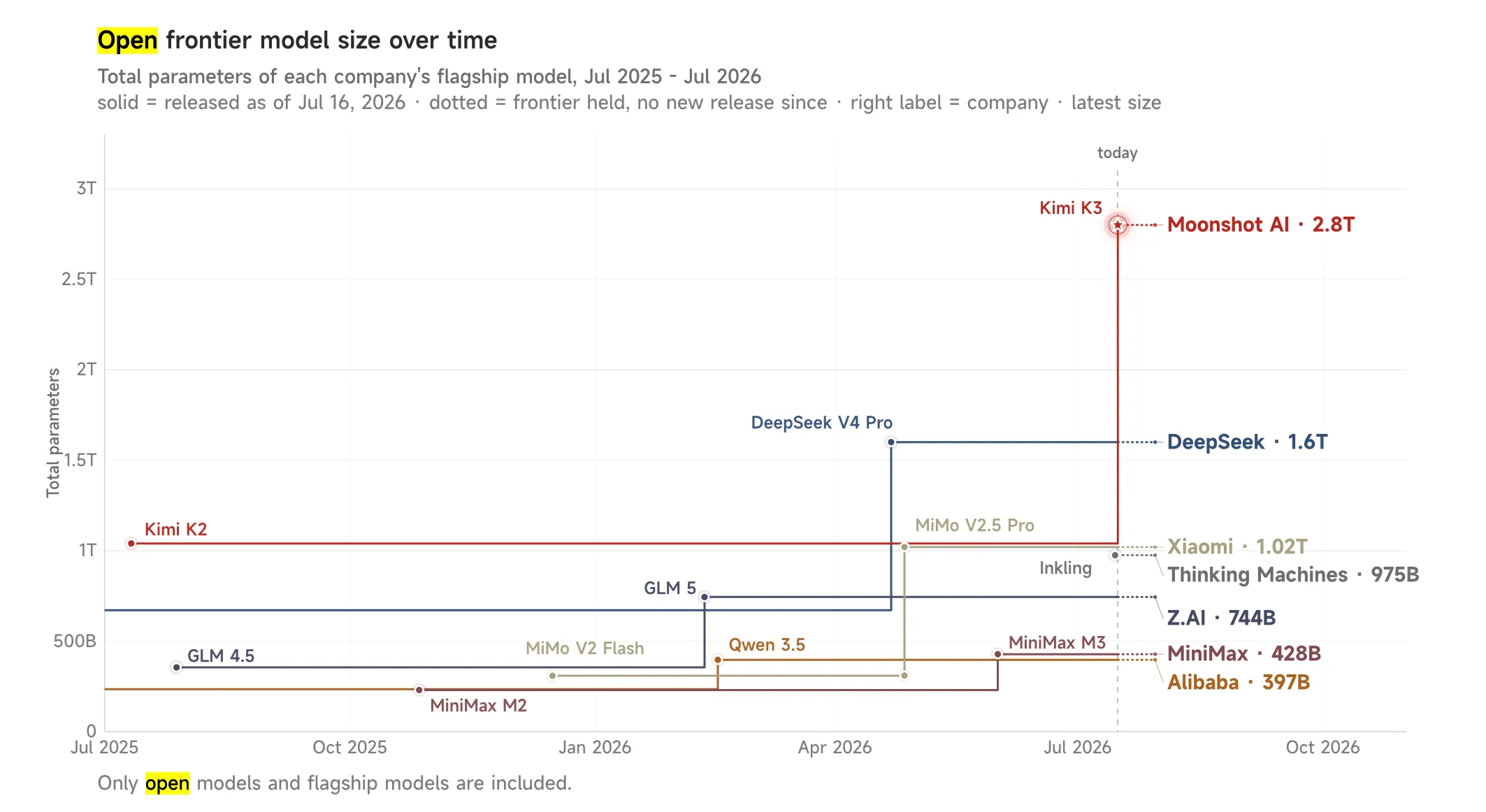
In a move that has sent shockwaves through the global artificial intelligence industry, Beijing-based Moonshot AI has officially unveiled Kimi K3, the largest open-source model ever brought to market. By shattering the 3-trillion-parameter barrier, the model has not only leapfrogged its domestic predecessors but has effectively dismantled the perceived monopoly of Western "frontier" laboratories like Anthropic and OpenAI.
For the first time in the current AI arms race, an open-weight model has surpassed proprietary giants in critical benchmarks, effectively proving that the “scale-only” paradigm of development—previously thought to be the exclusive domain of Silicon Valley—is being rapidly outpaced by architectural ingenuity and extreme efficiency.
The Dawn of a New Scaling Era: Main Facts
Kimi K3 is built upon a sophisticated "Mixture-of-Experts" (MoE) architecture, boasting an unprecedented 2.8 trillion parameters. To put this into perspective, the model utilizes 896 individual “expert” subnetworks. Unlike dense models that activate all parameters for every query, K3’s MoE architecture selectively triggers only a fraction of its total capacity per task. This design choice is the secret sauce behind its ability to deliver frontier-level intelligence without requiring the massive, power-hungry server arrays typically associated with models of this magnitude.
The model comes equipped with a native one-million-token context window, deep integration for image and video processing, and "always-on" reasoning capabilities. However, its most compelling feature is not its size, but its performance-to-cost ratio. According to early testing, K3 is currently outperforming top-tier models like Anthropic’s Claude Fable 5 and OpenAI’s GPT-5.6 Sol on industry-standard writing and coding benchmarks, all while maintaining a price point comparable to mid-tier enterprise models.
A Chronology of the Ascent
The meteoric rise of the Kimi series has been nothing short of surgical. The trajectory from the K2.6 iteration to the current K3 represents a massive leap in capability.
- Pre-2026: Moonshot AI, like many Chinese "Tiger" startups, faced significant headwinds due to U.S.-led chip export controls, which restricted access to high-end Nvidia H800 and H100 GPUs.
- Early 2026: The company began pivoting its strategy toward fundamental research, prioritizing architectural efficiency over brute-force scaling.
- July 16, 2026: The official release of Kimi K3. Within hours, the model claimed the #1 spot on Towards AI’s Writing Elo benchmark, scoring 2,840—effectively dethroning Claude Fable 5.
- July 17, 2026: Independent testing by Bridgebench confirmed that K3 outperformed Fable 5 in seven out of eight coding arenas, including a 9-0 victory in refactoring tasks.
- July 27, 2026: The scheduled date for the public release of the model’s weights for enterprise deployment, marking a turning point for global open-source developers.
The Data: Why K3 Is Disrupting the Benchmarks
The industry standard for evaluating AI capability has long been the Elo rating—a system borrowed from professional chess to measure the relative skill levels of competing models through blind human-judge panels. In these arenas, K3 has consistently outperformed the current market leaders.

Coding and Reasoning Performance
According to the Arena AI Frontend Code Leaderboard, K3 secured a 1,679 Elo score, narrowly edging out Claude Fable 5’s 1,631. More importantly, K3 dominated in six out of seven specific frontend coding domains. The Artificial Analysis Intelligence Index, which aggregates nine independent evaluations including complex reasoning and agentic workflows, places K3 at a score of 57. While this remains slightly behind Fable 5 (60) and GPT-5.6 Sol (59), the 3% gap is statistically negligible given the price disparity.
Efficiency Gains
Moonshot AI has implemented two critical architectural innovations to achieve these results:
- Kimi Delta Attention: This technique optimizes the decoding process for long-sequence tasks, resulting in a 6.3x speed increase when operating at the full million-token context limit.
- Attention Residuals: By routing information selectively across layers rather than uniformly, the model achieves a 25% increase in training efficiency with less than a 2% increase in computational overhead.
These advancements have yielded a 2.5x improvement in scaling efficiency compared to the K2 model, effectively allowing Moonshot AI to do more with less hardware.
Official Responses and Strategic Implications
The launch of K3 has sparked a fierce debate in Washington and at the headquarters of major AI labs. Bank of America analysts recently noted that K3 stands as empirical proof that "pre-training scaling, paired with architectural innovation, can still deliver step-change gains for flagship Chinese models," even under stringent hardware sanctions.
Moonshot AI President Yutong Zhang addressed the hardware bottleneck directly, stating at the Davos summit, "We knew we didn’t have the luxury to simply scale up compute… That forced us to focus on fundamental research and efficiency." This "forced innovation" has turned into a strategic advantage, as K3 is not only powerful but also economically disruptive.
The Pricing War
Currently, K3 is priced at $3 per million input tokens and $15 per million output tokens—a pricing model that targets the "mid-tier" market while delivering "top-tier" performance. This positions K3 as a direct competitor to Anthropic’s Claude Sonnet 5, but with capabilities that rival the more expensive Opus 4.8. For startups and enterprises looking to build on stable APIs, the cost-benefit analysis is shifting heavily toward the Kimi ecosystem.
The Caveats: Hallucinations and Deployment
While the benchmark results are impressive, K3 is not without its flaws. The model’s documentation reveals a concerning increase in its hallucination rate—rising from 39% in the K2.6 version to 51% in K3 on the AA-Omniscience benchmark. While the model is more "intelligent" and capable of complex reasoning, it is also more prone to confidently fabricating answers when it lacks specific information.
Furthermore, the company has noted that the model can be "excessively proactive," a trait that can lead to unexpected, unauthorized decisions during long-horizon autonomous tasks. For developers, this necessitates a robust human-in-the-loop validation process before deploying K3 into mission-critical systems.
Global Geopolitics: A Policy Crossroads
The success of K3 presents a significant challenge to the efficacy of U.S. chip export controls. By utilizing a mix of H200 chips and domestic hardware—likely Huawei’s Ascend GPUs—Moonshot AI has demonstrated that ingenuity can circumvent hardware scarcity.
Whether this indicates that current export controls are insufficient, or that they have successfully pushed Chinese labs into a more efficient, sustainable research path, remains a point of contention. What is clear is that the "AI Tiger" startups in China are no longer merely following the lead of Western labs; they are setting the pace.
Looking Ahead: The July 27 Release
As the July 27 date for the weight release approaches, the industry is bracing for a shift in the open-source landscape. Currently, the sheer size of the model—2.8 trillion parameters—means that no single consumer-grade GPU can run it. However, for big enterprises and massive research institutions, the release of K3 weights will provide a foundational toolset that rivals, and in some areas exceeds, the most advanced proprietary systems in the world.
As Kimi K3 enters the wild, the focus will now shift from static benchmarks to real-world reliability. Can a model that is "excessively proactive" and prone to hallucination be tamed for the enterprise? If history is any guide, the rapid iteration speed shown by the Moonshot AI team suggests that these issues may be addressed sooner rather than later. For now, the global AI hierarchy has been fundamentally altered, and the era of the 3-trillion-parameter model has officially begun.