Reviving the Spirit of 1948: Can Ursula von der Leyen’s Proposed Congress of Europe Save the Continent?
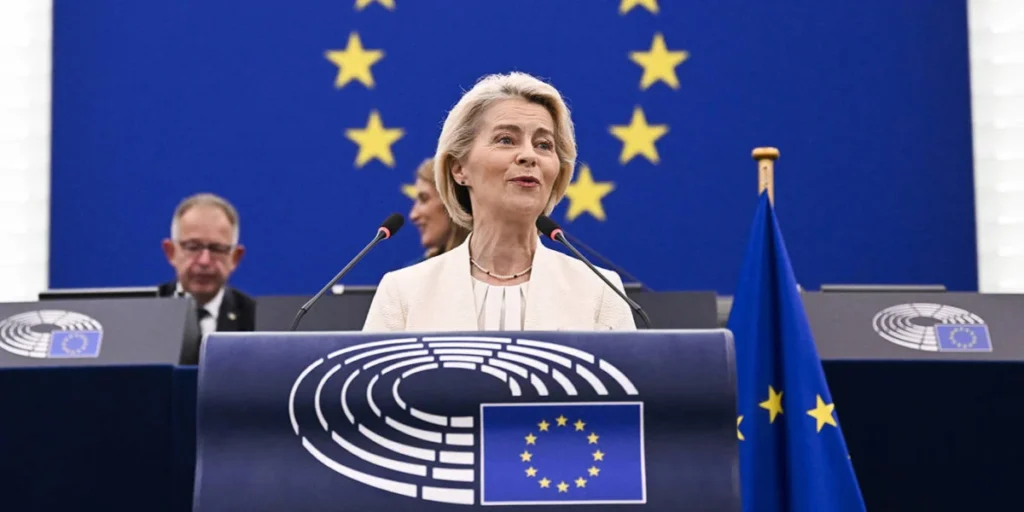
BRUSSELS — As the European Union navigates an era defined by intensifying geopolitical friction, economic headwinds, and democratic backsliding, its leadership is reaching deep into history for inspiration. In her landmark State of the Union address, European Commission President Ursula von der Leyen proposed the convocation of a new Congress of Europe, consciously channeling the historic gathering that took place in The Hague nearly eight decades ago.
While the initiative has been welcomed by integrationists as a bold and necessary move to recalibrate the bloc’s trajectory, foreign policy analysts and institutional experts warn that noble intentions alone will not suffice. To avoid the fate of previous high-minded summits that yielded more rhetoric than reform, the proposed 2027 Congress must directly confront the systemic shortcomings that have long plagued European decision-making.
1. Main Facts
The core of President von der Leyen’s proposal is as follows:
- The Inspiration: Von der Leyen has invoked the seminal 1948 Congress of Europe held in The Hague, a foundational moment that united political figures, intellectuals, and civil society representatives to lay the groundwork for a peaceful, integrated post-war continent.
- The Timeline: The newly proposed Congress is slated to convene next year, symbolically aligning with the 70th anniversary of the 1957 Treaty of Rome, which established the European Economic Community (EEC), the direct precursor to the modern European Union.
- The Mandate: The gathering aims to spark a broad-based, inclusive debate on the future of European integration, institutional design, and the bloc’s positioning in a fractured multipolar world order.
- The Challenge: Unlike the post-World War II era, when the threat was primarily reconstruction and reconciliation, today’s EU faces simultaneous polycrises: aggressive revisionism from neighboring powers, shifting transatlantic alliances, economic stagnation, and mounting internal polarization.
2. Chronology of European Integration and Reform Summits
To understand the weight of von der Leyen’s proposal, it is necessary to trace the historical lineage of major European visionary moments and constitutional milestones:
- May 1948 — The Hague Congress: Over 800 delegates from across Europe gather under the honorary presidency of Winston Churchill. The conference produces sweeping resolutions advocating for economic integration, a human rights court, and a united European assembly, directly inspiring the creation of the Council of Europe a year later.
- March 1957 — The Treaty of Rome: Six nations (Belgium, France, Italy, Luxembourg, the Netherlands, and West Germany) sign the treaty establishing the EEC and Euratom, setting the institutional framework for common markets and economic harmonization.
- December 2001 — The Laeken Declaration: Recognizing that the EU is preparing for its largest eastern enlargement, European leaders convene to address how to bring the EU closer to its citizens, leading to the establishment of the European Convention and the ultimately aborted European Constitution.
- May 2021 – May 2022 — The Conference on the Future of Europe: A massive pan-European citizen-led exercise designed to gather grassroots policy recommendations. While it produced 49 ambitious proposals, critics later argued that its follow-through within the EU’s rigid legislative machinery was uneven.
- September 2026 — The State of the Union Announcement: Ursula von der Leyen formally proposes the new Congress of Europe during her address in Brussels, targeting a 2027 rollout.
3. Supporting Data and Context
The urgency behind von der Leyen’s initiative is underscored by mounting geopolitical and economic pressures facing the 27-member bloc. Recent data highlights the precarious position of the EU on the global stage:
- Declining Global GDP Share: In 1990, the EU accounted for roughly 26% of global nominal GDP. By 2026, that figure has dipped below 17%, squeezed by the rapid economic ascent of Asian economies and the continued resilience of the United States.
- Defense Vulnerability: Following decades of post-Cold War "peace dividends," cumulative EU defense spending has lagged behind strategic competitors. Even with recent post-2022 surges in procurement, fragmentation among national defense industries continues to hamper interoperability and cost efficiency.
- Public Sentiment and Skepticism: According to recent Eurobarometer data, while overall support for EU membership remains near historic highs (averaging around 60-70% across the bloc), trust in national governments and traditional political parties has steadily eroded, creating fertile ground for populist and Eurosceptic movements.
- Enlargement Momentum: The EU currently has nine official candidate countries (including Ukraine, Moldova, and several Western Balkan states). Integrating these nations will require a radical overhaul of EU voting rules, particularly the abolition or curtailment of the national veto in foreign and fiscal policy.
4. Official Responses and Stakeholder Reactions
Reaction to the proposed Congress of Europe has been swift, varying from cautious optimism to outright skepticism across European capitals and institutions.
Institutional Endorsements in Brussels
Pro-integration members of the European Parliament have largely championed the idea. Proponents argue that the EU cannot successfully navigate a world of competing superpowers (such as the United States and China) using governance models designed for a much smaller, more homogenous bloc of Western European states.
"We cannot manage 21st-century geopolitical realities with 20th-century bureaucratic tools," noted a senior European Commission official speaking on condition of anonymity. "The President’s vision is to open the tent—to bring in voices beyond the traditional Brussels bubble to help chart our survival."
Member State Hesitancy
Predictably, capital cities fiercely protective of national sovereignty have expressed reservations. Diplomats from several "frugal" and eastern member states have questioned whether another high-level convention is necessary, pointing out that existing institutional channels—such as the European Council and formal treaty revision procedures—already provide the mechanisms for reform if the political will exists.
Furthermore, smaller member states have voiced anxiety that a grand "Congress" could become dominated by a Franco-German steering committee, sidelining the interests of peripheral nations.
5. Implications for the Future of Europe
If the Congress of Europe is to avoid the fate of previous grand summits that ultimately stalled due to a lack of institutional binding power, it must address several structural imperatives:
Moving Beyond Consultative Fatigue
Citizens and civil society groups across Europe have participated in numerous consultative exercises, most notably the Conference on the Future of Europe. Many participants grew disillusioned when ambitious recommendations—such as eliminating national vetoes in foreign policy or creating transnational candidate lists—collided with national political inertia. For the 2027 Congress to retain credibility, participants must be given a clear pathway to translate debates into concrete legal and constitutional reforms.
Addressing the Veto Dilemma
The single greatest impediment to effective EU action is the requirement for unanimity in critical areas like foreign policy, taxation, and security. Any serious Congress of Europe must tackle the elephant in the room: transitioning toward qualified majority voting (QMV). Without this, an expanded EU of 30 or more members will inevitably grind to a total standstill.
Reconnecting Elites with Citizens
The 1948 Hague Congress succeeded because it captured a genuine, grassroots existential panic and desire for peace following the devastation of war. Re-creating that sense of common purpose in a prosperous, peacetime democracy is infinitely harder. The 2027 Congress must find a way to make ordinary citizens feel that their economic security, digital rights, and physical safety are directly tied to the outcomes debated in the hall.
Conclusion
Ursula von der Leyen’s call for a new Congress of Europe is a timely and visionary acknowledgment that the European Union has reached a historical inflection point. The challenges of the late 2020s—ranging from hybrid warfare on the continent’s borders to technological disruption and economic realignment—demand nothing less than a fundamental rethink of European governance.
However, commemoration must not be mistaken for transformation. As Europe looks toward the 70th anniversary of the Treaty of Rome, the ultimate success of the proposed Congress will not be measured by the eloquence of its speeches or the grandeur of its venue, but by whether Europe’s leaders possess the political courage to enact the structural reforms their continent so urgently requires.