Beyond the Lease: A Comprehensive Guide to Selecting the Best Renters Insurance in 2026
For many Americans, renters insurance is relegated to the status of a "checkbox" item—a mandatory hurdle to clear before receiving the keys to a new apartment. However, viewing insurance as a mere administrative necessity is a costly oversight. In practice, renters insurance is a critical financial safety net, and the discrepancy between the "best" policy and the "bare minimum" can be the difference between a minor inconvenience and a life-altering financial catastrophe.
After conducting an exhaustive review of nine major national insurance providers, it is clear that not all policies are created equal. By evaluating quote flows, digital infrastructure, claims efficiency, financial stability, and aggregate consumer feedback, this guide aims to demystify the market and identify which providers truly deliver value to the modern renter.
The Fundamentals: What Is Renters Insurance?
At its core, a renters insurance policy is a bundle of three primary protections designed to shield you from the unexpected. While terminology may vary slightly, most standard policies include:
- Personal Property Coverage: This covers the cost to repair or replace your belongings—such as electronics, furniture, clothing, and appliances—if they are damaged or destroyed by covered perils like fire, smoke, vandalism, or theft.
- Liability Coverage: Perhaps the most overlooked feature, this protects you if you are found legally responsible for bodily injury or property damage to others. If a guest trips in your apartment or you accidentally cause a fire that damages the building, this coverage pays for legal fees and judgments.
- Loss of Use (Additional Living Expenses): If your home becomes uninhabitable due to a covered event, this coverage helps pay for temporary housing, hotel bills, and related costs like increased food expenses.
Beyond these basics, savvy renters often utilize endorsements—add-ons for high-value items like jewelry, fine art, or specialized equipment, as well as protections against water backup or identity theft. While the "what" of the coverage is relatively standardized across the industry, the "how"—the user experience, the clarity of documents, and the speed of claims—varies wildly.
Methodology: How We Ranked the Providers
To provide an objective assessment, each of the nine providers was subjected to the same rigorous criteria:
- Digital Maturity: We evaluated the intuitiveness of the mobile app and the ability to manage policies, update coverage, and file claims without human intervention.
- Claims Efficiency: We analyzed the speed of the payout process and the complexity of the filing interface.
- Transparency: We scrutinized the quote flow for "hidden" jargon and the ease of understanding what is—and is not—covered.
- Customer Sentiment: We aggregated data from third-party review platforms and public complaint registries to gauge real-world satisfaction.
- Financial Strength: We confirmed that all providers maintain strong financial ratings (A.M. Best, etc.) to ensure they have the capital to pay claims.
1. Lemonade: The Modern Gold Standard
Best for: Tech-savvy renters prioritizing speed and autonomy.
Lemonade was built from the ground up as a digital-first insurer, and the difference is palpable. Unlike legacy carriers that have "bolted on" apps to decades-old infrastructure, Lemonade’s entire lifecycle—from the first quote to the final claim payout—lives within a sleek, AI-driven mobile app.
- The Experience: The quote flow is arguably the fastest in the industry. By utilizing AI to underwrite policies, Lemonade reduces manual friction, often allowing simple claims to be approved and paid out almost instantly.
- The Verdict: For renters who value transparency and hate the idea of sitting on hold with an agent, Lemonade provides an unparalleled experience. It treats the renter as a digital native, not an afterthought.
2. State Farm: The Human Touch
Best for: Renters who want a dedicated advocate.
State Farm remains the juggernaut of the agent-based model. For many, the peace of mind that comes with knowing a specific human being at a local office is managing their account is worth more than the speed of an app.

- The Experience: While their digital tools have improved, the real value lies in the local agent network. If you have questions about complex coverage or need help navigating a difficult claim, having a local advocate can be invaluable.
- The Verdict: If you are the type of person who prefers a face-to-face conversation to solve problems, State Farm is the market leader in reliability and personal service.
3. Allstate: The Bundler’s Choice
Best for: Existing Allstate auto customers.
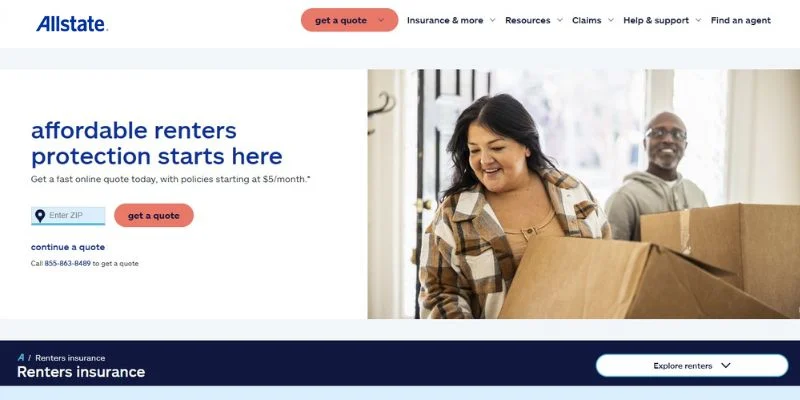
Allstate positions its renters product as a natural extension of its broader insurance portfolio. This is a strategic play for convenience.
- The Experience: By consolidating auto, home, and renters insurance under one account, Allstate provides a streamlined "one-stop-shop" experience. While the interface is heavily oriented toward managing multiple lines of insurance, the convenience of a single billing cycle is a significant draw.
- The Verdict: If you already insure your vehicle with Allstate, the multi-policy discount often makes adding renters coverage a no-brainer.
4. GEICO: The Value Play
Best for: Auto customers seeking an easy, low-cost add-on.
GEICO is synonymous with competitive pricing, and their renters insurance offering follows this pattern.
- The Experience: GEICO’s strength lies in the simplicity of the quote. However, it is important to note that because their renters policies are often underwritten by third-party partners, the service experience can be inconsistent.
- The Verdict: Excellent for those who want a quick, affordable policy, provided they understand that the claims process may be routed through a secondary partner rather than GEICO itself.
5. USAA: The Gold Standard for the Military Community
Best for: Active-duty, veterans, and military families.
USAA consistently ranks at the top of industry satisfaction surveys, though its exclusivity is its primary limitation.
- The Experience: USAA understands the unique needs of the military lifestyle, including frequent moves and deployments. Their mobile tools are robust, and their customer service is widely regarded as the best in the insurance industry.
- The Verdict: If you are eligible, there is little reason to look elsewhere. USAA provides a level of service and trust that is difficult for commercial carriers to match.
6. Nationwide: The Reliable Legacy
Best for: Those who want the stability of a massive, established brand.
Nationwide occupies the middle ground between digital-first startups and agent-heavy giants.
- The Experience: It is a balanced approach. You get the stability of a giant, established brand with a solid, albeit traditional, digital platform. Their claims process is predictable and, for many, that consistency is the most important factor.
- The Verdict: A rock-solid choice for those who value corporate reputation and proven longevity over cutting-edge app features.
7. American Family: The Regional Specialist
Best for: Renters in the Midwest and Western U.S.

American Family excels in regions where they have a dense concentration of agents.
- The Experience: Similar to State Farm, they rely on strong relationships. If you live in a region where they have a significant footprint, you will likely receive highly personalized, high-touch service.
- The Verdict: A top-tier choice for those who value a regional, human-centered insurance approach.
Implications: Why Your Choice Matters
The "best" insurance company is a subjective title, as it depends entirely on your personal priorities. However, the data suggests a clear trend: the market is bifurcating into two distinct camps.
On one side, Digital Disruptors like Lemonade are setting a new bar for accessibility, speed, and user experience. On the other, Legacy Carriers like State Farm and USAA are leaning into the value of the human connection, offering complex support that an algorithm cannot yet replicate.
Frequently Asked Questions (FAQ)
Q: Do I really need renters insurance if my landlord has insurance?
A: Yes. Your landlord’s insurance covers the building structure, not your personal property. If a fire destroys your unit, your landlord’s policy will not pay to replace your laptop, clothes, or furniture.
Q: How much does it cost?
A: Prices vary by state and the value of your possessions, but most policies average between $5 and $20 per month.
Q: Does it cover theft away from home?
A: In most cases, yes. Standard policies usually cover your personal property regardless of whether it is stolen from your apartment, your car, or a hotel room while you are traveling.
Q: Is "AI-underwriting" safe?
A: It is simply a way to process data faster. While it streamlines the quote and simple claims, reputable companies like Lemonade are fully licensed and subject to the same state insurance regulations as traditional carriers.
Final Thoughts
The decision-making process for renters insurance should not be rushed. Before signing your next lease, take 15 minutes to evaluate your needs. Are you a digital nomad who needs an app that works at 2:00 AM? Or are you a family that wants the peace of mind of a local agent? By selecting the right provider, you are doing more than just satisfying a lease requirement—you are investing in your own financial security.