Beyond the Individual: OpenAI Pivots Toward the Family Unit
More than three years after the meteoric launch of ChatGPT effectively brought generative AI into the mainstream, OpenAI is signaling a major strategic shift. No longer content with serving individual productivity, the company is actively moving to integrate its technology into the fabric of the household.
OpenAI is currently recruiting a dedicated product manager in San Francisco to lead the development of specialized experiences for families, caregivers, and older adults. The job posting—a quiet but significant milestone in the company’s history—seeks a professional with deep expertise in "trust-sensitive consumer experiences" and a proven track record in building products designed specifically for parents and family units. This move represents a maturation of the AI industry, as companies begin to treat their software not just as tools for the lone professional, but as digital companions for the entire family.
The Evolution of the User Base
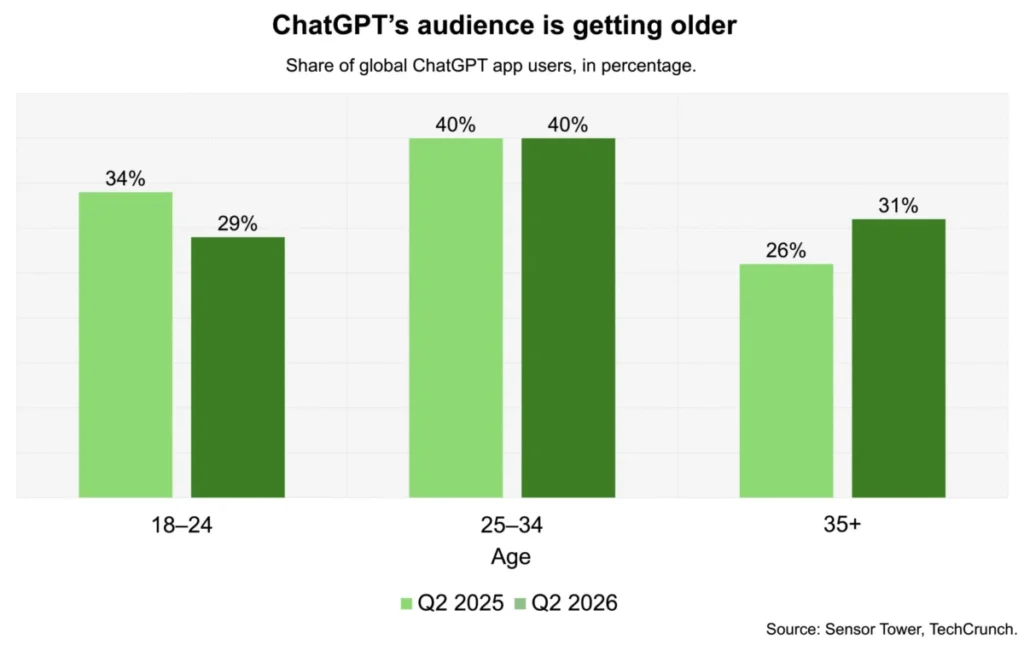
The decision to focus on the household is underpinned by a tangible shift in ChatGPT’s demographic landscape. Data provided by Sensor Tower exclusively to TechCrunch reveals that the profile of the typical ChatGPT user is aging. In the second quarter of this year, the share of global users aged 35 and older climbed to 31%, up from 26% just one year prior. Conversely, the once-dominant 18-to-24-year-old demographic saw its share of the user base dip from 34% to 29%.
This trend is even more pronounced in the United States, where nearly one in four smartphone-using parents reported using ChatGPT during the same quarter—a notable jump from the 16% recorded the previous year. As the technology permeates the home, it is increasingly becoming a shared utility, bridging the gap between generations.
A Strategic Pivot: From Productivity to Domestic Utility
Ben Bajarin, chief executive of the technology consultancy Creative Strategies, notes that this dedicated product role signals a fundamental reclassification of OpenAI’s mission. "This is similar to the path Google, Apple, and Meta eventually followed as their platforms became embedded in everyday life," Bajarin explains. "But AI raises the stakes significantly because the assistant is not just mediating content or devices; it is actively interacting with the user."
According to Bajarin, this shift suggests that the future of generative AI lies in "household-centric" design. As AI becomes a multi-generational tool, industry analysts expect to see a wave of new features: family subscription plans, tailored child and teen profiles, centralized caregiver oversight tools, shared "household memories" that allow the AI to recall family context, and integrated AI tutoring systems.
The Safety Imperative: A Reaction to Crisis
While the move toward family-oriented products is a logical expansion of the business, it is also a direct response to a mounting wave of criticism and legal scrutiny. OpenAI has faced multiple high-profile lawsuits from parents who allege that ChatGPT contributed to profound harms suffered by their children, including instances involving self-harm and psychological distress.
In an effort to mitigate these risks, OpenAI has spent the last year rolling out a suite of safety features. These include the implementation of parental controls for teen accounts, the integration of "reasoning models" designed to detect and escalate signals of distress, and an optional "Trusted Contact" feature. This safeguard allows for an automated alert to be sent to a designated caregiver or family member if the AI detects that a user may be at risk of self-harm.
Stephen Balkam, chief executive of the Family Online Safety Institute, views this as a necessary phase of "safety by redesign." He argues that because the initial versions of generative AI were released without children in mind, the current industry response is a critical, albeit overdue, correction.
"I see this as safety by redesign," Balkam says. "You take the initial product or service that was released—not really with kids in mind—so this is a much-needed reaction and response."

Closing the "Supervision Gap"
The urgency of this redesign is highlighted by recent research from the Family Online Safety Institute. A survey of more than 4,000 families across the United States and Australia revealed a significant "supervision gap." While only 27% of U.S. parents reported that their children had used generative AI in the past week, 38% of the children themselves admitted to doing so.
This disconnect suggests that parents are often unaware of the extent to which AI is shaping their children’s digital lives. Balkam argues that for AI companies to succeed in the family space, they must fundamentally change how they build for younger users. This includes:
- Stronger Content Controls: Granular filters that prevent exposure to inappropriate material.
- Age-Appropriate Experiences: Interfaces that adjust based on the cognitive development of the user.
- Transparent Interaction: Persistent reminders that the user is interacting with a machine, not a human, to prevent the formation of unhealthy parasocial attachments.
Competitive Landscape: How Rivals Stack Up
OpenAI is not the only company vying for the household market, though its demographic trajectory is distinct. Data suggests that while ChatGPT has been relatively under-penetrated among older users compared to its peers, it is acquiring them at a faster clip.
In the second quarter, the share of users aged 45 and above on ChatGPT rose by three percentage points year-over-year. In contrast, Microsoft’s Copilot saw a two-point increase, while Claude and Gemini saw declines in that age bracket.
However, the competition is fierce. Among U.S. parents, Google’s Gemini currently holds the widest reach, with 32% of parents reporting usage, followed by ChatGPT at 24%, Claude at 4%, and Copilot at 2%. OpenAI’s new hiring push is likely an attempt to bridge this gap, leveraging its brand recognition to become the default "family assistant."
Looking Ahead: The Future of AI in the Home
OpenAI’s broader ambitions for the family unit extend beyond software features. In a recent collaboration with the San Antonio Spurs Community Impact organization and the Positive Coaching Alliance, the company began exploring the potential of AI in youth development, focusing on applications in coaching, collaborative learning, and extracurricular engagement.
These initiatives indicate that OpenAI sees its future not just as a chatbot, but as an educational and developmental partner. However, the road ahead is fraught with regulatory and ethical challenges. The tech industry has historically struggled to protect younger users, often treating children as adults until forced by regulators to change course. By hiring a product manager specifically tasked with family-sensitive development, OpenAI is attempting to preempt such intervention.
As the lines between personal assistant and household companion blur, the success of these efforts will likely depend on the company’s ability to balance innovation with ironclad privacy and safety standards. If OpenAI can successfully navigate the trust issues that have plagued social media platforms for years, it may well define the next decade of domestic technology.
For now, the hiring notice remains a quiet marker of a massive pivot. As Ben Bajarin notes, "We are entering an era where the AI is not just a tool, but a member of the household. The companies that build for the family unit first are going to be the ones that win the trust of the next generation."
OpenAI did not respond to requests for comment regarding the specific goals or timeline for its family-focused product division. However, given the pace at which the company has deployed safety features over the past 12 months, it is clear that the "family-first" strategy is already well underway.